
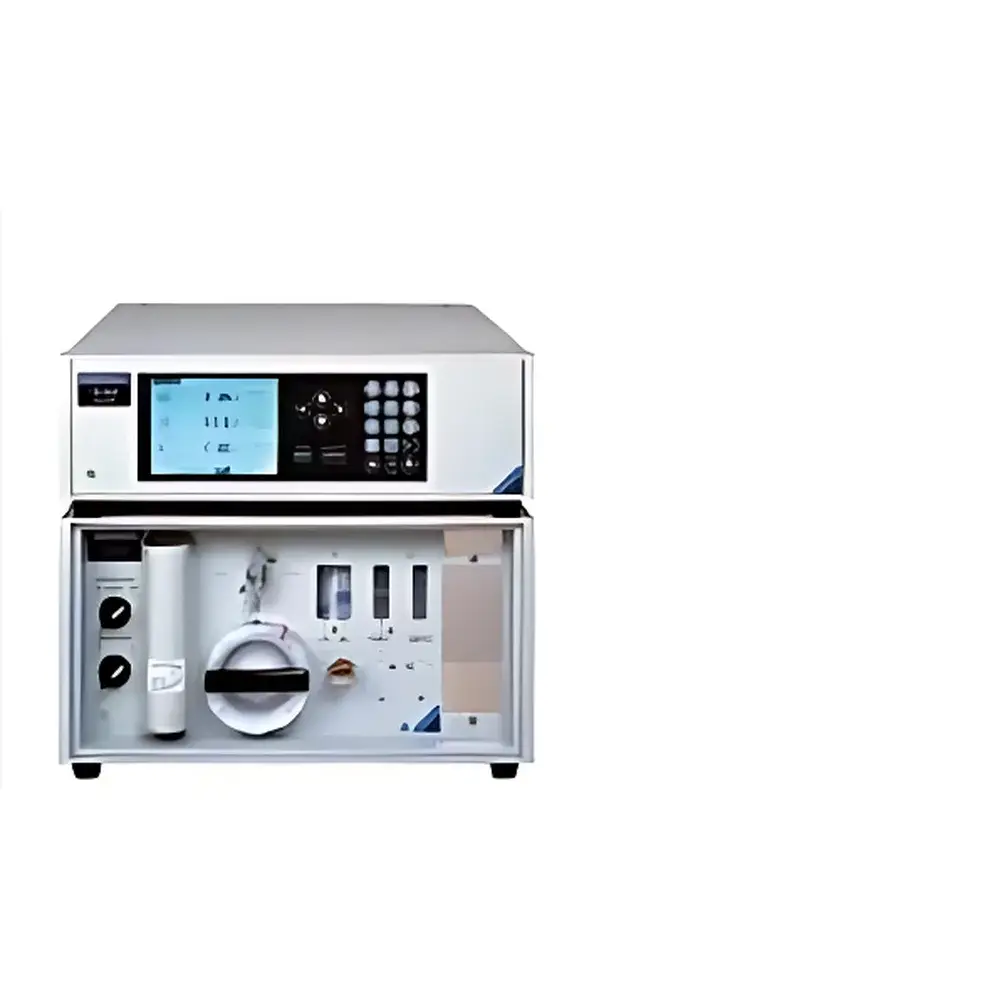
HORIBA VA-3000/VS-3000 Series Infrared Multi-Gas Analyzer
| Brand | HORIBA |
|---|---|
| Origin | Japan |
| Model | VA-3000 / VS-3000 |
| Instrument Type | Online Gas Analyzer |
| Detection Principle | NDIR (CO, CO₂, CH₄, N₂O, SO₂), CLA (NOₓ), MPA (O₂), Electrochemical (O₂), Zirconia (O₂) |
| Minimum Detectable Range | 1–5 ppm |
| Repeatability | ±0.5% of Full Scale |
| Resolution | 0.1 ppm |
| Response Time (T90) | ≤30 s |
| Zero Drift | ±2.0% of Full Scale per week |
| Warm-up Time | 20–60 min depending on sensor type |
| Analog Output | DC 0–1 V or 4–20 mA (optional) |
| Communication Interface | RS-232C |
| Sample Flow Rate | ~0.5 L/min |
| Operating Temperature | 0–40 °C |
| Power Supply | AC 100–120 V or 200–240 V, 50/60 Hz |
| Weight (VA-3000) | ~20 kg |
| Enclosure | 19-inch rack-mount chassis (430 × 132 × 550 mm) |
Overview
The HORIBA VA-3000/VS-3000 Series is a modular, online infrared multi-gas analyzer engineered for high-precision, real-time measurement of trace and percent-level concentrations across diverse industrial, environmental, and research applications. Utilizing multiple complementary detection technologies—including Non-Dispersive Infrared (NDIR) spectroscopy for CO, CO₂, CH₄, N₂O, and SO₂; Chemiluminescence Analysis (CLA) for NOₓ; Magnetic Pressure Analysis (MPA), electrochemical cells, and zirconia-based sensors for O₂—the system delivers analyte-specific selectivity and metrological robustness. Its architecture supports up to three interchangeable sensor modules within a single 19-inch rack-mount analyzer unit (VA-3000), enabling flexible configuration without sacrificing footprint or operational efficiency. Designed for continuous unattended operation in emission monitoring, combustion optimization, biogas quality control, and ambient air quality surveillance, the VA-3000/VS-3000 complies with foundational requirements for long-term stability, low drift, and reproducible quantification under variable sample conditions.
Key Features
- Modular sensor architecture: Up to three independent gas detection modules (NDIR, CLA, MPA, electrochemical, or zirconia) installed in one VA-3000 main unit—reducing space, cabling, and calibration overhead.
- Wide dynamic range capability: Programmable multi-range scaling (up to 10× or optionally 20× for NDIR; up to 100× for CLA) ensures accurate quantification from sub-ppm to 100 vol% levels without manual range switching.
- High metrological performance: Repeatability ±0.5% FS, linearity ±1.0% FS (±1.5% FS beyond 10× range ratio), zero drift ±2.0% FS/week (±1.0% FS/day for electrochemical O₂).
- Fast response and thermal stability: T90 ≤ 30 s from sample inlet; warm-up times optimized per sensor type (20 min for NDIR/zirconia, 40–60 min for MPA/electrochemical).
- Rugged sampling interface: VS-3000 series sampling units (VS-3001–VS-3004) provide conditioned dry sampling at 5 °C dew point, corrosion-resistant wetted materials (SUS, PTFE, PVDF, FKM), and flow-controlled extraction (1.5–5.0 L/min) with dual 0.5 L/min analytical streams.
- Standard digital and analog I/O: RS-232C serial interface for remote command/control and data logging; optional isolated 4–20 mA or 0–1 V analog outputs compliant with industrial SCADA integration protocols.
Sample Compatibility & Compliance
The VA-3000/VS-3000 is validated for use with clean, non-corrosive, non-explosive sample streams meeting defined physical and chemical constraints: sample temperature within ambient range; moisture content ≤5 °C dew point (VS-3000 dryers ensure compliance); particulate loading 50 ppm), NO₂ (>6 ppm), H₂S, Cl₂, NH₃, or unsaturated hydrocarbons unless pre-treated. For reducing gas environments (e.g., syngas, landfill gas), zirconia O₂ sensors require co-presence of H₂O and O₂ satisfying the thermodynamic condition (THC + CO + H₂ < H₂O + O₂) to prevent sensor degradation and cross-interference. The system supports GLP/GMP-aligned operation through configurable audit trails, user-access controls, and electronic calibration logs—though native FDA 21 CFR Part 11 compliance requires external data management software and procedural validation per site-specific QMS.
Software & Data Management
HORIBA provides dedicated PC-based configuration and data acquisition software supporting real-time display, trend logging, alarm thresholding, and export to CSV or Excel formats. All analog outputs are linearized and temperature-compensated per sensor-specific algorithms embedded in firmware. Raw signal diagnostics—including detector voltage, reference cell balance, and heater status—are accessible via RS-232C for preventive maintenance planning. While the VA-3000 does not include onboard storage, its RS-232C interface enables seamless integration with third-party historian systems (e.g., Ignition, WinCC, LabVIEW) using standard ASCII command sets. Calibration sequences—span, zero, and multi-point—can be scheduled, logged, and password-protected to support ISO/IEC 17025 documentation requirements.
Applications
- Continuous Emission Monitoring Systems (CEMS) for stack gases (CO, CO₂, NOₓ, SO₂, O₂) per EPA Method 10, EN 15267, and JIS B 7982.
- Biogas and landfill gas analysis: CH₄/CO₂ ratio monitoring, H₂S interference mitigation (via optional catalyst for N₂O), and O₂ safety interlock verification.
- Combustion efficiency optimization in boilers, kilns, and incinerators via real-time O₂ trim and excess air calculation.
- Indoor air quality (IAQ) and workplace exposure assessment for CO, CO₂, and NO₂ at ppm-level thresholds aligned with OSHA PELs and ACGIH TLVs.
- Research-grade gas standard verification, catalytic converter testing, and fuel cell feed gas purity qualification.
FAQ
What gas species can be measured simultaneously?
Up to three gases may be measured concurrently using configured modules—for example: CO (NDIR), NOₓ (CLA), and O₂ (zirconia). Additional gases (SO₂, CH₄, N₂O, C₂H₄, NH₃) require consultation for sensor compatibility and cross-sensitivity mitigation strategies.
Is calibration gas required for each range setting?
Yes. Each programmable range must be calibrated using certified span gas traceable to NIST or JCSS standards. Multi-range calibration is supported but requires individual verification per range segment.
Can the VA-3000 operate in hazardous areas?
No. The VA-3000 and VS-3000 are rated for general-purpose indoor use (IP20). For Zone 1/2 or Class I Div 1 environments, external explosion-proof enclosures or remote sampling with intrinsically safe interfaces are required.
What maintenance intervals are recommended?
Optical windows and sample path filters should be inspected quarterly; NDIR detectors require annual factory recalibration; electrochemical O₂ sensors have a typical service life of 2–3 years depending on exposure history.
Does HORIBA offer application-specific pre-conditioning solutions?
Yes. HORIBA’s Application Engineering team provides customized sample conditioning schematics—including heated lines, particle filtration, condensate traps, and catalytic scrubbers—for challenging matrices such as flue gas, digester gas, or engine exhaust.







