
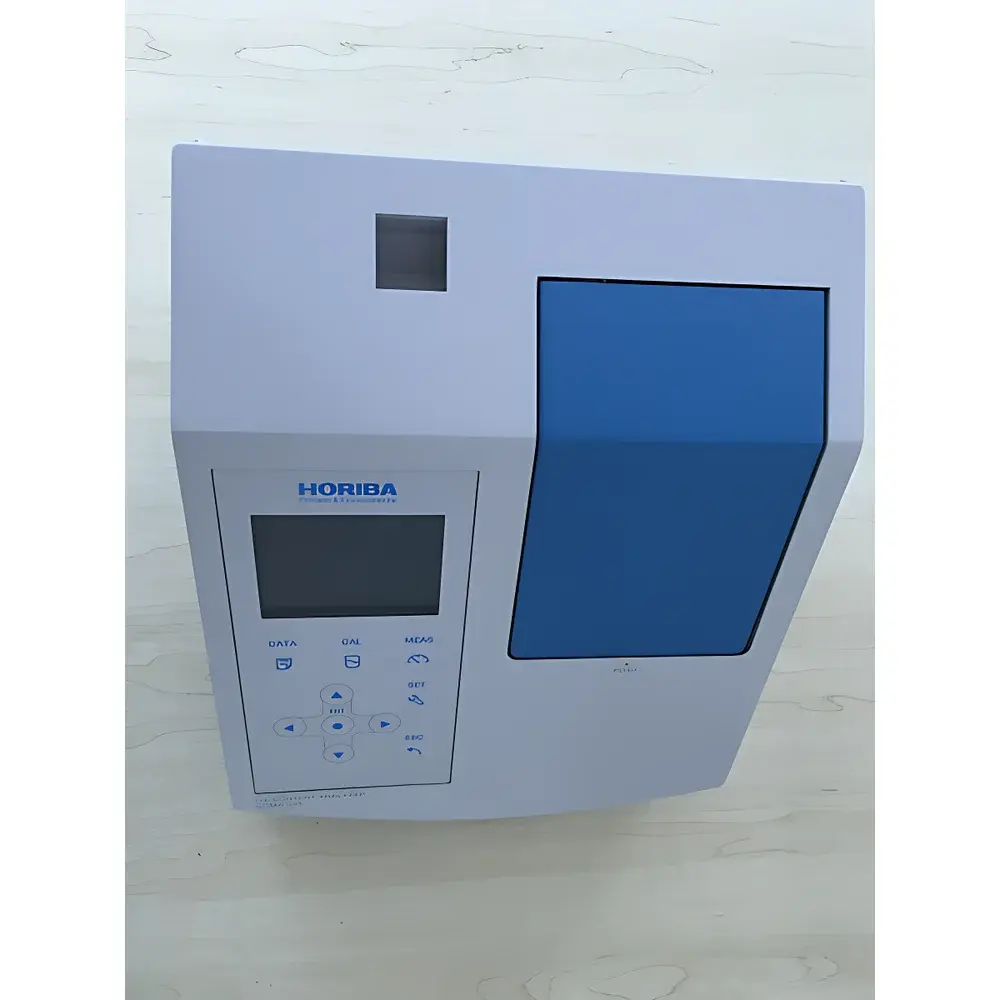
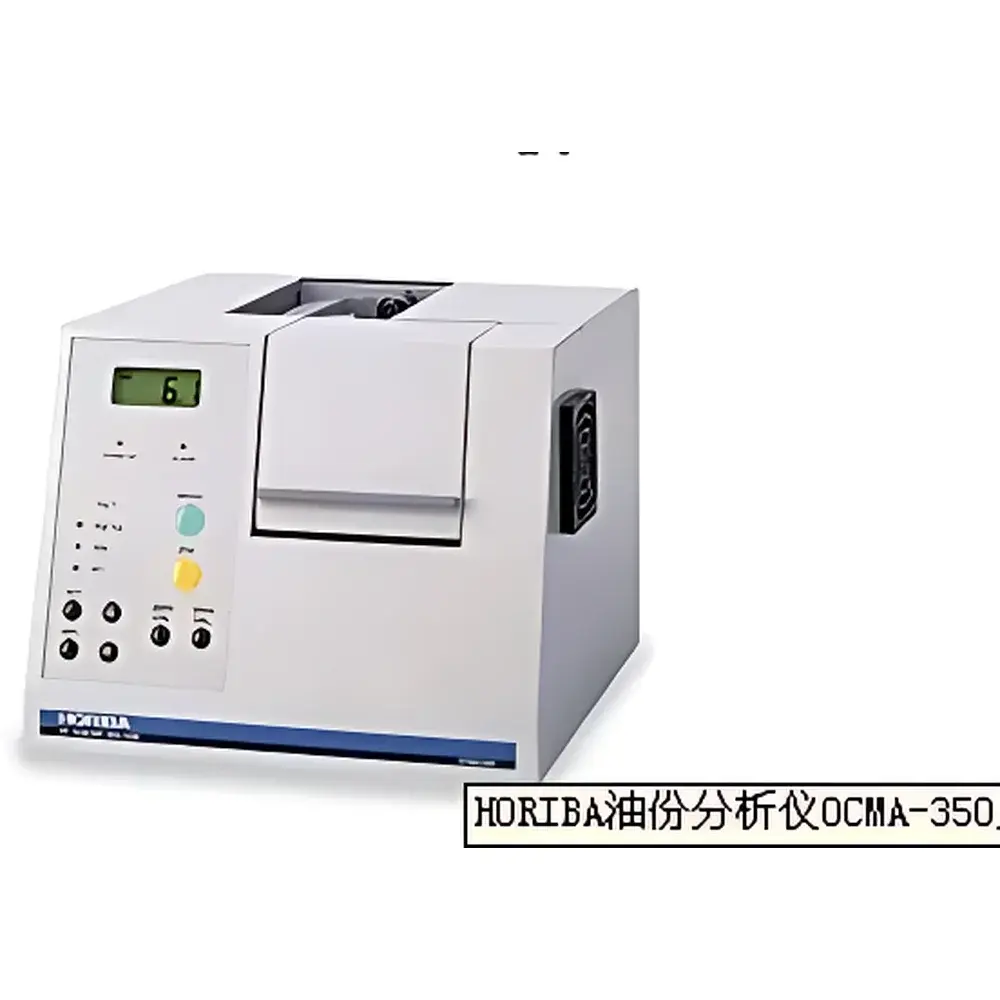
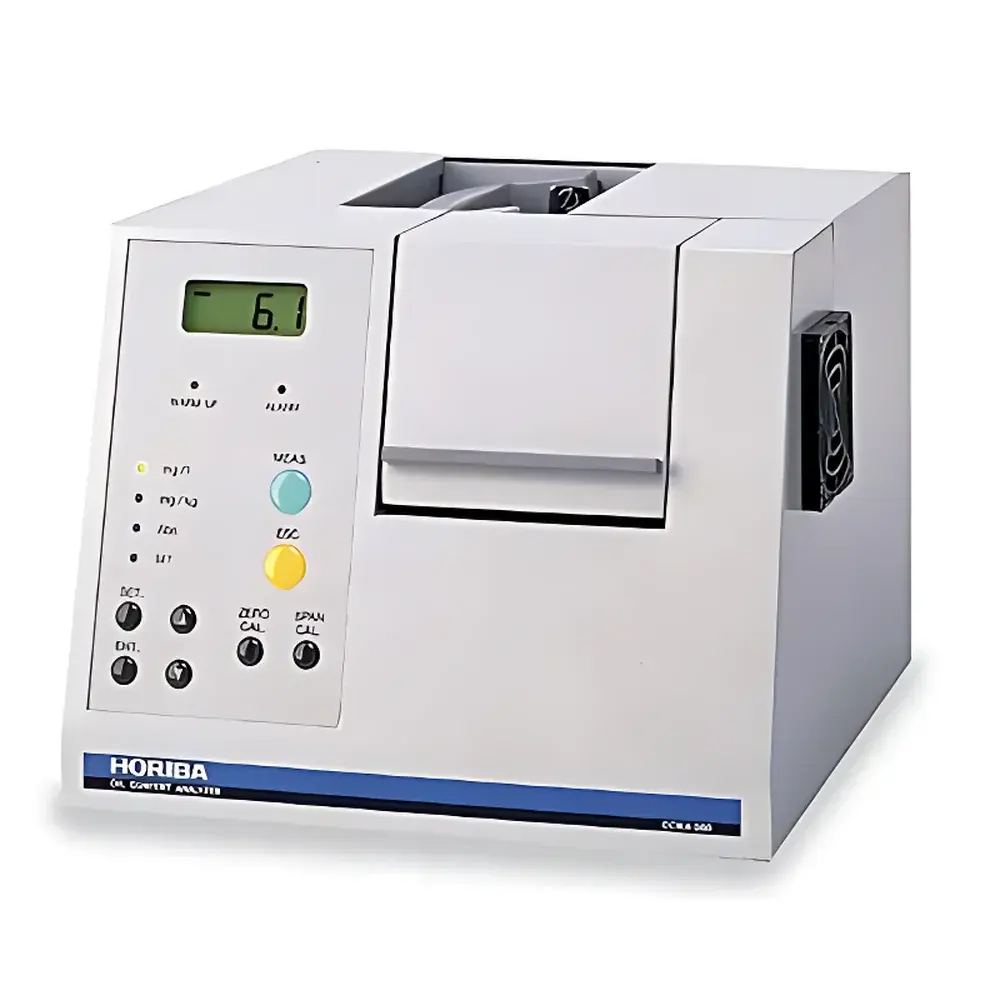
HORIBA OCMA-555 Portable Oil Content Analyzer
| Brand | HORIBA |
|---|---|
| Origin | Japan |
| Model | OCMA-555 |
| Instrument Type | Portable |
| Measurement Principle | Non-Dispersive Infrared (NDIR) Absorption |
| Extraction Solvent | H-997 |
| Detection Range | 0–200 mg/L (water), 0–1000 mg/kg (soil), 0–1 Abs |
| Repeatability | ±0.4 mg/L (0–9.9 mg/L), ±2.0 mg/L (10.0–99.9 mg/L), ±4 mg/L (100–200 mg/L), ±1% F.S. (0–1 Abs) |
| Optical Path | Quartz Cuvette (200 mm path length) |
| Detector | Thermoelectric Sensor |
| Display | Backlit LCD with Timestamp |
| Interface | RS-232C, Parallel Printer Port |
| Power Supply | 230 V AC, 50 Hz |
| Dimensions | 250 × 200 × 285 mm (W × H × D) |
| Standard Accessories | Covered Quartz Cuvette, Power Cord, Heavy Oil Standard (B-grade), 2 A Fuse, 10 mL & 25 µL Syringes |
Overview
The HORIBA OCMA-555 Portable Oil Content Analyzer is a field-deployable, laboratory-grade instrument engineered for quantitative determination of hydrocarbon-based oil contaminants in aqueous and solid-phase environmental samples. It operates on the principle of non-dispersive infrared (NDIR) absorption spectroscopy—specifically targeting the characteristic C–H stretching vibration band near 3.4 µm—enabling selective detection of aliphatic and aromatic hydrocarbons while excluding interferences from water, chlorinated solvents, or polar organics. Unlike fluorescence-based methods, NDIR provides superior specificity for total petroleum hydrocarbons (TPH) and avoids quenching effects or matrix-induced signal distortion. The OCMA-555 requires prior solvent extraction using HORIBA’s proprietary H-997 reagent—a non-toxic, low-volatility chlorinated solvent optimized for high recovery efficiency (>95%) across diverse oil types (e.g., mineral oils, cutting fluids, lubricants, diesel). Following extraction, the oil-solvent mixture is introduced into a standardized 200 mm-path-length quartz cuvette; the instrument performs single-button measurement with automatic zero calibration and thermal drift compensation. Designed for compliance with ASTM D7066-22 (Standard Test Method for Determination of Oil and Grease in Water by Infrared Spectrophotometry) and ISO 9377-2:2000 (Water Quality — Determination of Hydrocarbon Oil Index — Part 2: Infrared Spectrometric Method), the OCMA-555 delivers trace-level sensitivity down to 0.1 ppm (as hexadecane equivalent) with documented linearity over its full 0–200 mg/L range.
Key Features
- Triple-unit display mode: switch seamlessly between concentration units—mg/L (for water), mg/kg (for soil/sludge), or absorbance (Abs)—without recalibration
- Integrated timestamp functionality for GLP-compliant data logging; all measurements retain date/time stamps in internal memory
- Backlit LCD interface with intuitive icon-driven navigation—designed for glove-compatible operation in field or industrial settings
- Thermoelectric detector ensures stable baseline performance across ambient temperature fluctuations (10–40 °C operating range)
- RS-232C serial port and parallel printer interface support direct integration into LIMS or QA/QC reporting workflows
- Modular design accommodates optional solvent regeneration system (SR-305) for H-997 recycling—reducing consumable costs and hazardous waste generation by >80%
Sample Compatibility & Compliance
The OCMA-555 is validated for use with a broad spectrum of sample matrices: wastewater effluents (pre- and post-treatment), cooling tower blowdown, bilge water, soil leachates, metalworking fluid residues, and textile rinse waters. Its extraction protocol meets U.S. EPA Method 1664A requirements for oil and grease determination when paired with H-997 solvent and appropriate filtration (0.45 µm glass fiber). For regulated environmental laboratories, the system supports audit-ready documentation per 21 CFR Part 11 through external data capture—timestamped results, operator ID entry (via optional keyboard), and change-log tracking of calibration events. All optical components comply with IEC 61000-4 electromagnetic compatibility standards, and electrical safety conforms to IEC 61010-1 for measurement/control laboratory equipment.
Software & Data Management
While the OCMA-555 operates as a standalone analyzer, its RS-232C interface enables bidirectional communication with third-party software platforms—including HORIBA’s optional OCMA Data Manager (v3.2+)—for automated report generation, statistical process control (SPC) charting, and trend analysis. Raw absorbance spectra are not stored onboard, but peak-area integrals at 3.4 µm, baseline-corrected transmittance values, and calibration coefficients are exportable as CSV or ASCII files. Each measurement record includes instrument ID, serial number, operator code (if entered), extraction batch ID, cuvette ID, and environmental conditions (ambient temperature/humidity logged via external sensor input). Audit trails are retained for ≥12 months and support FDA-mandated reviewability for pharmaceutical or semiconductor cleanroom wastewater monitoring.
Applications
- Industrial pretreatment compliance: real-time verification of oil removal efficiency in API separators, coalescers, and membrane filtration systems
- Environmental site assessment: rapid screening of groundwater plumes and excavated soils during Phase II investigations
- Semiconductor manufacturing: validation of decontamination efficacy on silicon wafers and stainless-steel process tools (per SEMI F57-0218)
- Automotive and aerospace: quantification of residual machining oils on aluminum castings or turbine blades prior to anodizing or coating
- Textile finishing: monitoring of hydrophobic oil carryover in dye bath effluents to prevent COD spikes in municipal sewer discharge
FAQ
What extraction solvent is required for the OCMA-555, and why is H-997 specified instead of S-316?
The OCMA-555 is calibrated exclusively for use with HORIBA H-997 solvent—a low-toxicity, high-boiling-point chlorinated hydrocarbon formulated to maximize extraction yield across saturated, unsaturated, and aromatic hydrocarbons while exhibiting negligible IR absorbance at 3.4 µm. S-316 is designated for the OCMA-550 model and is incompatible due to differing spectral interference profiles.
Can the OCMA-555 measure emulsified or dispersed oil without phase separation?
No. The method requires complete solvent extraction followed by phase separation; emulsified oil must first be broken via acidification (pH ≤2) and centrifugation per ASTM D7066-22 Section 8.3 before H-997 addition.
Is the 200 mm quartz cuvette included, and what is its expected lifetime under routine use?
Yes, one covered 200 mm-path quartz cuvette is supplied standard. With proper cleaning (acetone rinse followed by nitrogen purge) and avoidance of abrasive wiping, typical service life exceeds 5,000 measurements without measurable transmission loss.
Does the instrument support multi-point calibration, or is it limited to factory-set single-point verification?
The OCMA-555 performs automatic zero calibration prior to each measurement cycle using the solvent blank. Multi-point calibration is not user-accessible; however, NIST-traceable heavy oil standards (B-grade, supplied) enable periodic accuracy verification across the full dynamic range.
How does the OCMA-555 handle particulate-laden samples such as sludge or suspended solids (SS)?
Samples containing SS >50 mg/L must undergo pre-filtration through a 0.45 µm glass-fiber filter prior to extraction. The instrument itself does not perform filtration; inclusion of undissolved particulates will scatter IR radiation and invalidate absorbance readings.







