
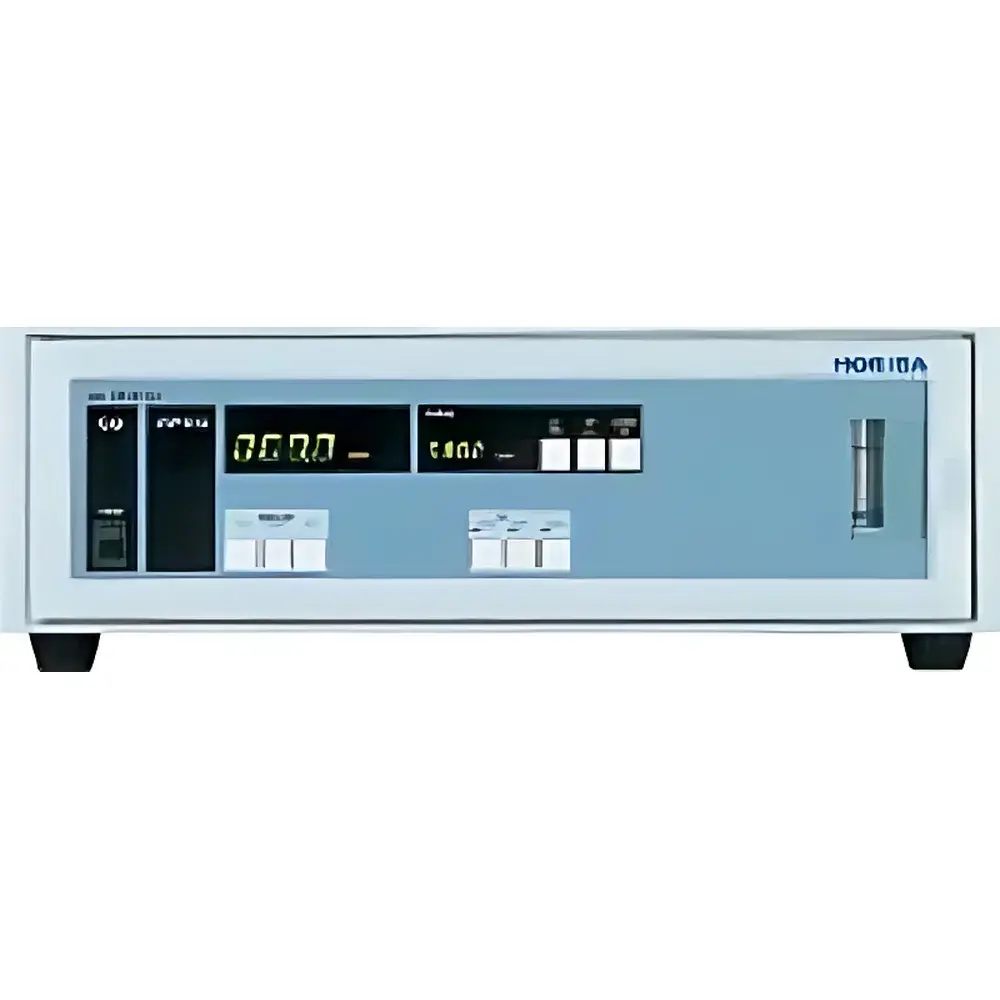
HORIBA FIA-510 Total Hydrocarbon Analyzer
| Brand | HORIBA |
|---|---|
| Origin | Japan |
| Model | FIA-510 |
| Measurement Principle | Partially Pressurized Hydrogen Flame Ionization Detection (FID) |
| Measurand | Total Hydrocarbons (THC) as ppmC |
| Range | 0–50 ppmC (min) to 0–30,000 ppmC (max) |
| Repeatability | ±0.5 %FS (standard range), ±1.0 %FS (high-sensitivity range) |
| Drift | ±1.0 %FS/day (standard range), ±2.0 %FS/day (high-sensitivity range) |
| Response Time (T90) | 10 s |
| Operating Temperature | 0–40 °C |
| Relative Humidity | ≤90 % RH (non-condensing) |
| Dimensions (W×D×H) | 430 × 550 × 132 mm |
| Weight | 20 kg |
| Linearity | ≤±1.0 %FS |
| Dynamic Range | 4-step standard (10:1), optional 20:1 |
| Calibration | Single-touch zero/span adjustment |
| Self-Diagnostic Function | Yes |
| Housing | 19-inch rack-mountable or benchtop configuration |
| Compliance | Designed for continuous emissions monitoring (CEM) in accordance with ISO 8712, JIS B 7982, and applicable EPA Method 25A guidelines |
Overview
The HORIBA FIA-510 Total Hydrocarbon Analyzer is a high-performance, continuously operating gas analyzer engineered for precise, real-time quantification of total hydrocarbons (THC) in flue gas, exhaust streams, and ambient air applications. It employs a partially pressurized hydrogen flame ionization detection (FID) principle — a well-established, ASTM- and EPA-recognized technique for carbon-containing compound measurement. Unlike catalytic or infrared-based methods, FID provides near-universal response to organic compounds (excluding methane under certain configurations) with exceptional sensitivity, linearity, and long-term stability. The FIA-510 is specifically optimized for regulatory-grade CEM systems in industrial combustion sources, automotive emission testing laboratories, boiler stack monitoring, and R&D environments requiring trace-level THC detection across wide dynamic concentration ranges.
Key Features
- Partially pressurized FID detector architecture ensures robust signal-to-noise ratio and minimizes baseline drift under fluctuating sample pressure and flow conditions.
- Seven user-selectable measurement ranges (0–10 ppmC up to 0–30,000 ppmC) with automatic range switching; standard 4-step dynamic range (10:1), extendable to 20:1 via optional firmware configuration.
- T90 response time of ≤10 seconds enables rapid detection of transient THC spikes during engine dynamometer cycles or process upsets.
- Modular design separates sampling unit, analyzer module, and control electronics — facilitating field maintenance, component replacement, and system scalability.
- Integrated microprocessor with embedded diagnostics monitors detector status, flame integrity, hydrogen supply pressure, and calibration validity in real time.
- Rack-mount (19-inch EIA) and benchtop configurations support flexible deployment in fixed CEM stations, mobile test labs, or university research facilities.
- Single-touch zero/span calibration reduces operator dependency and improves procedural consistency across shifts and personnel.
Sample Compatibility & Compliance
The FIA-510 accepts conditioned, filtered, and dried sample gas streams with flow rates of 0.5–2.0 L/min. It is compatible with heated sampling lines (optional) for moisture-sensitive applications and supports integration with extractive CEM systems compliant with ISO 12039, EN 15267-3, and EPA Performance Specification 8 (PS-8). While not intrinsically safe, the analyzer meets CE marking requirements for electromagnetic compatibility (EMC Directive 2014/30/EU) and low-voltage safety (LVD Directive 2014/35/EU). Its measurement performance aligns with the accuracy and stability criteria defined in ISO 8712 for hydrocarbon analyzers used in vehicle exhaust testing and JIS B 7982 for stationary source emission monitoring. Data logging and audit trails support GLP/GMP-aligned workflows when paired with validated third-party SCADA or DCS platforms.
Software & Data Management
The FIA-510 features an onboard LCD display with intuitive menu navigation for real-time concentration readout, alarm status, and diagnostic logs. Analog outputs (4–20 mA, 0–10 V) and RS-232/RS-485 interfaces enable seamless integration into plant-wide monitoring networks. Optional HORIBA’s WinCT software provides remote configuration, trend visualization, report generation (PDF/CSV), and compliance documentation per ISO 17025 requirements. All calibration events, zero/span validations, and system faults are timestamped and stored internally with non-volatile memory retention for ≥30 days — supporting FDA 21 CFR Part 11 readiness when deployed with electronic signature-enabled host systems.
Applications
- Continuous emissions monitoring (CEM) of THC from coal-, oil-, and gas-fired power plants, waste incinerators, and industrial boilers.
- Regulatory exhaust testing per UN/ECE Regulation No. 83, SAE J1094, and GB 18285–2018 for light- and heavy-duty vehicles.
- Engine development and durability testing in OEM and Tier-1 powertrain laboratories.
- Process optimization and fugitive emission screening in petrochemical, pharmaceutical, and semiconductor manufacturing.
- Research on VOC abatement technologies, catalytic converter efficiency, and biofuel combustion characteristics.
FAQ
What gases does the FIA-510 detect?
The FIA-510 measures total hydrocarbons (THC) as ppmC equivalents using flame ionization detection. It responds to most organic compounds containing C–H bonds, including alkanes, alkenes, aromatics, and oxygenates — but exhibits reduced sensitivity to formaldehyde, methanol, and CO.
Is methane included in the THC reading?
Yes, unless configured with a methane-specific pre-column or catalytic converter (optional accessory); standard operation includes methane in the total hydrocarbon sum.
Can the FIA-510 operate unattended for extended periods?
Yes — its ±0.5 %FS repeatability and ±1.0 %FS/day drift specification, combined with automated self-diagnostics and remote alarm outputs, support unattended 7×24 operation in certified CEM installations.
Does it require carrier or fuel gas?
Yes — it requires ultra-high-purity hydrogen (≥99.999%) as fuel gas and compressed air or zero air as oxidant; no carrier gas is needed in standard FID configuration.
How is calibration traceability maintained?
Calibration is performed using NIST-traceable hydrocarbon standards (e.g., propane-in-air); HORIBA recommends quarterly span verification and semiannual full calibration per ISO/IEC 17025 internal procedures.







