
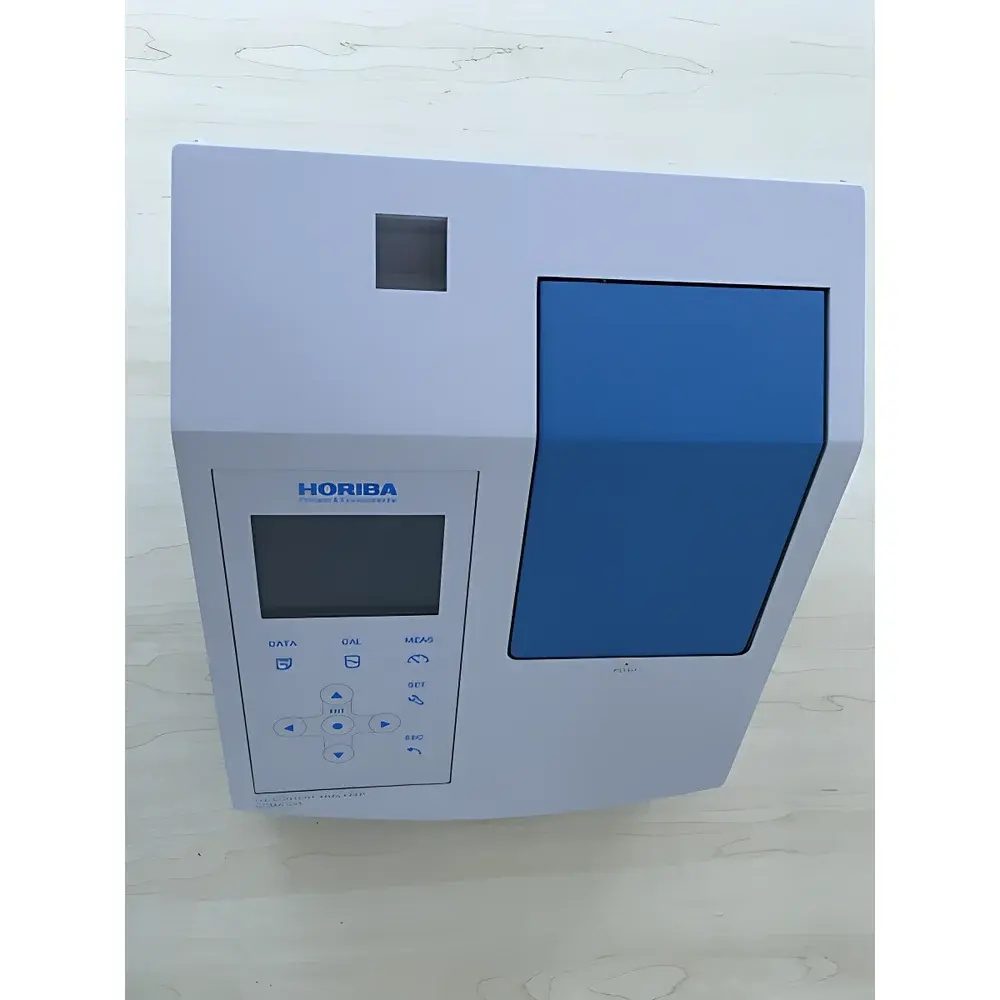
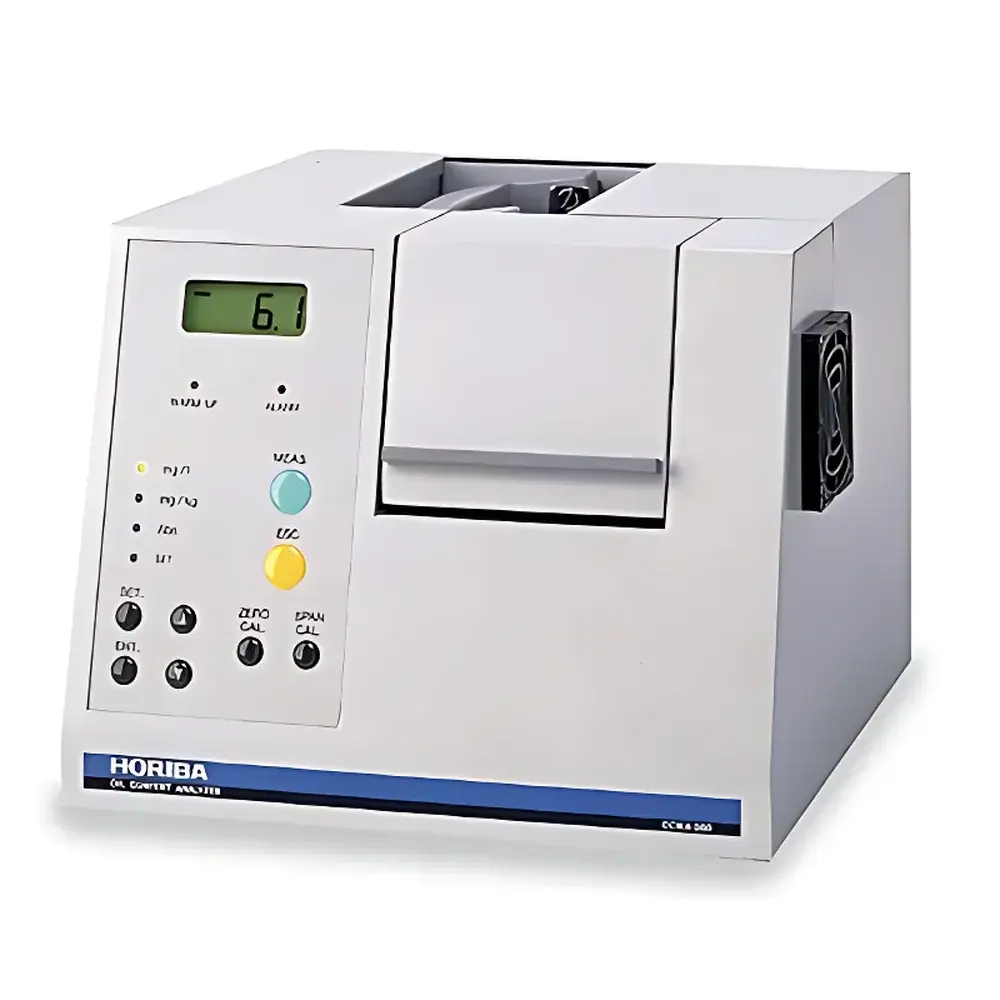
HORIBA OCMA-555 Oil Content Analyzer
| Brand | HORIBA |
|---|---|
| Origin | Japan |
| Model | OCMA-555 |
| Instrument Type | Portable |
| Measurement Principle | Non-Dispersive Infrared (NDIR) Absorption |
| Extraction Solvent | H-997 |
| Measurement Range | 0–200 mg/L (water), 0–1000 mg/kg (soil), 0–1 Abs |
| Detection Limit | 0.1 ppm |
| Repeatability | ±0.4 mg/L (0–9.9 mg/L), ±2.0 mg/L (10.0–99.9 mg/L), ±4 mg/L (100–200 mg/L), ±1% F.S. (0–1 Abs) |
| Display | Backlit LCD with timestamping |
| Interface | RS-232C, Parallel Printer Port |
| Power Supply | 230 V AC, 50 Hz |
| Dimensions | 250 × 200 × 285 mm (W × H × D) |
| Detector | Thermoelectric Sensor |
| Sample Cell | 200 mm pathlength quartz cuvette |
| Compliance | ASTM D7678 (oil-in-water by IR), ISO 9377-2, USP <467>, EPA Method 1664 (solvent-extractable oil) |
Overview
The HORIBA OCMA-555 Oil Content Analyzer is a portable, laboratory-grade instrument engineered for precise quantification of hydrocarbon contaminants in aqueous and solid-phase environmental samples. It employs non-dispersive infrared (NDIR) absorption spectroscopy at the characteristic C–H stretching band near 3.4 µm — a spectral region where hydrocarbons exhibit strong, selective absorbance while common extraction solvents (specifically H-997) remain optically transparent. This spectral selectivity ensures high specificity for aliphatic and aromatic hydrocarbons—including mineral oils, lubricants, cutting fluids, and petroleum derivatives—without interference from water, salts, or suspended solids. Unlike fluorescence-based systems, the OCMA-555 delivers trace-level sensitivity (detection limit: 0.1 ppm) and robust performance across heterogeneous matrices, making it suitable for field-deployable compliance monitoring as well as controlled lab environments. Its design aligns with regulatory frameworks governing industrial effluent discharge, soil remediation verification, and process cleanliness validation in precision manufacturing.
Key Features
- Triple-unit measurement capability: simultaneous selection between mg/L (for water extracts), mg/kg (for soil/sediment extracts), and absorbance (Abs) — enabling direct method-to-standard mapping without manual conversion.
- Integrated thermoelectric detector with temperature-stabilized optical path, ensuring long-term signal stability and minimizing drift during extended operation.
- Backlit LCD display with embedded real-time timestamping; supports on-device data review and storage of up to 100 measurement records with user-defined ID tags.
- Dual communication interfaces: RS-232C serial port for bidirectional data transfer to LIMS or custom software, and parallel printer port for immediate hardcopy reporting — compliant with GLP audit trail requirements.
- Optimized 200 mm pathlength quartz flow cell, designed for maximum sensitivity in low-concentration applications while accommodating solvent-extracted samples with minimal evaporation loss.
- Automatic zero-point calibration upon power-on and user-initiated reference adjustment using pre-calibrated standard oil (B-grade heavy oil included).
Sample Compatibility & Compliance
The OCMA-555 is validated for use with solvent-extracted samples prepared per standardized protocols including EPA Method 1664 (n-hexane or H-997 extraction), ASTM D7678 (infrared determination of oil and grease), and ISO 9377-2 (petroleum hydrocarbons in water). It accommodates complex matrices such as oily wastewater from metalworking facilities, post-cleaning rinse solutions from semiconductor wafer fabrication lines, and contaminated soil leachates from brownfield sites. The instrument’s measurement fidelity has been verified under ISO/IEC 17025-accredited conditions for repeatability (±0.4 mg/L at sub-10 mg/L level) and linearity (R² > 0.999 over full 0–200 mg/L range). All firmware operations adhere to FDA 21 CFR Part 11 principles for electronic record integrity, supporting secure user authentication, audit logging, and immutable result archiving when integrated with compliant data management systems.
Software & Data Management
While the OCMA-555 operates autonomously via front-panel controls, its RS-232C interface enables seamless integration with HORIBA’s optional OCMA Data Manager software (v3.2+), which provides automated report generation, statistical trend analysis (e.g., control charts per ISO 8258), and batch export to CSV or PDF formats. Each transmitted record includes instrument ID, operator code, timestamp, measurement unit, raw absorbance value, concentration result, and calibration status flag. The system supports configurable data retention policies and encrypted local backup — essential for laboratories operating under GMP or ISO 14001 environmental management systems. No proprietary drivers are required; standard Windows COM port configuration suffices for interoperability with third-party SCADA or ELN platforms.
Applications
- Regulatory compliance testing of industrial wastewater prior to discharge (e.g., automotive plating lines, food processing plants, petrochemical terminals).
- Validation of cleaning efficacy in high-precision manufacturing: residual oil detection on machined aluminum parts, stainless steel medical devices, and silicon wafers after solvent degreasing.
- Environmental site assessment: rapid screening of groundwater, surface water, and excavated soils at spill response or remediation sites.
- Quality assurance in textile finishing: quantification of emulsified lubricant carryover in dye bath effluents.
- Process optimization in oil-water separation units: real-time feedback for coalescer and API separator performance tuning.
FAQ
What extraction solvent is required for the OCMA-555? Why not S-316?
The OCMA-555 is specifically calibrated for H-997 solvent, which offers superior infrared transparency at 3.4 µm and lower toxicity than legacy chlorinated solvents like S-316. Use of S-316 is incompatible and invalidates calibration.
Can the OCMA-555 measure total petroleum hydrocarbons (TPH) directly?
Yes — when paired with H-997 extraction per EPA Method 1664, it quantifies solvent-extractable material (SEM) that correlates strongly with TPH in gasoline, diesel, and lubricating oil fractions.
Is the instrument suitable for unattended operation in remote locations?
It supports continuous AC power only (230 V, 50 Hz) and lacks battery operation; however, its compact footprint and ruggedized chassis allow deployment in mobile labs or trailer-based monitoring stations equipped with stable power conditioning.
How often must the quartz cell be cleaned, and what is the recommended procedure?
After every 10–15 measurements, rinse the 200 mm cell with fresh H-997 followed by isopropanol and dry with nitrogen gas. Avoid ultrasonic cleaning or abrasive wipes to preserve optical surface integrity.
Does HORIBA provide certified reference materials for calibration verification?
Yes — NIST-traceable B-grade heavy oil standards (certified for IR absorbance at 3.4 µm) are supplied with each unit, and annual recalibration services are available through HORIBA’s ISO/IEC 17025-accredited service centers.







