
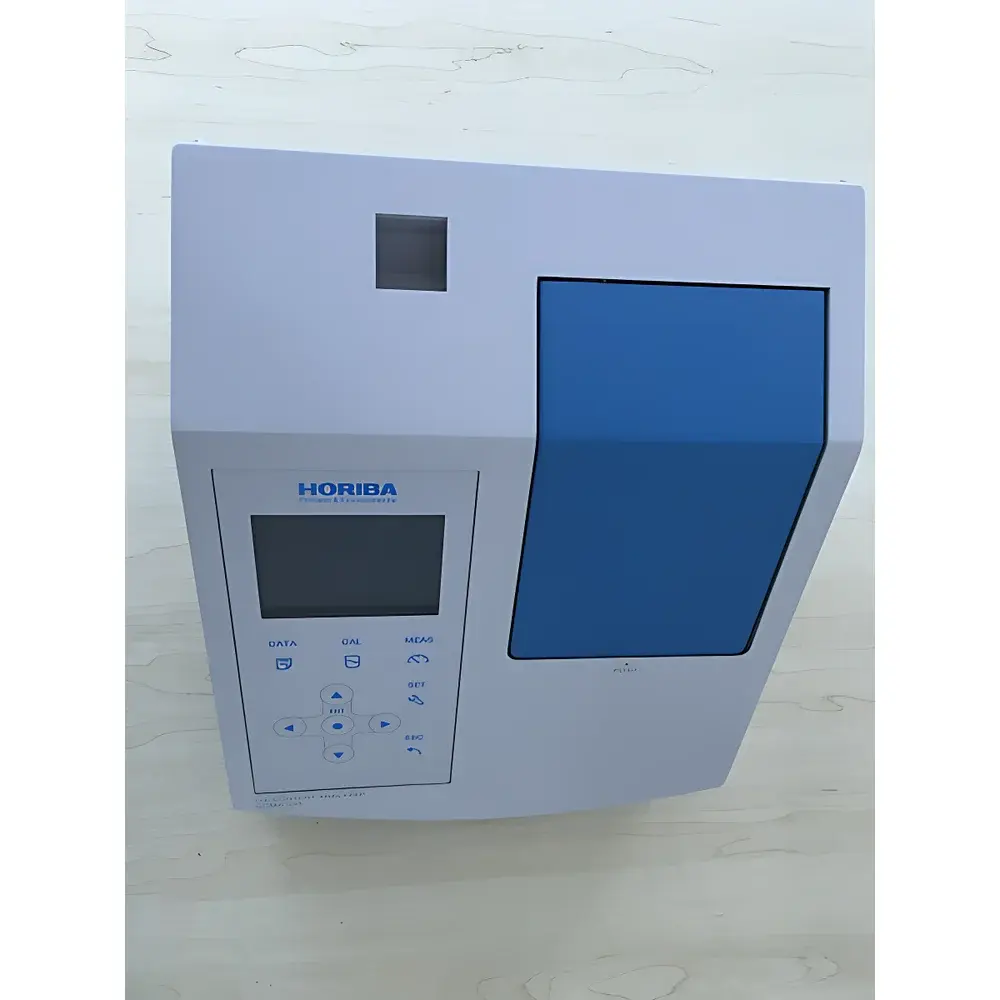
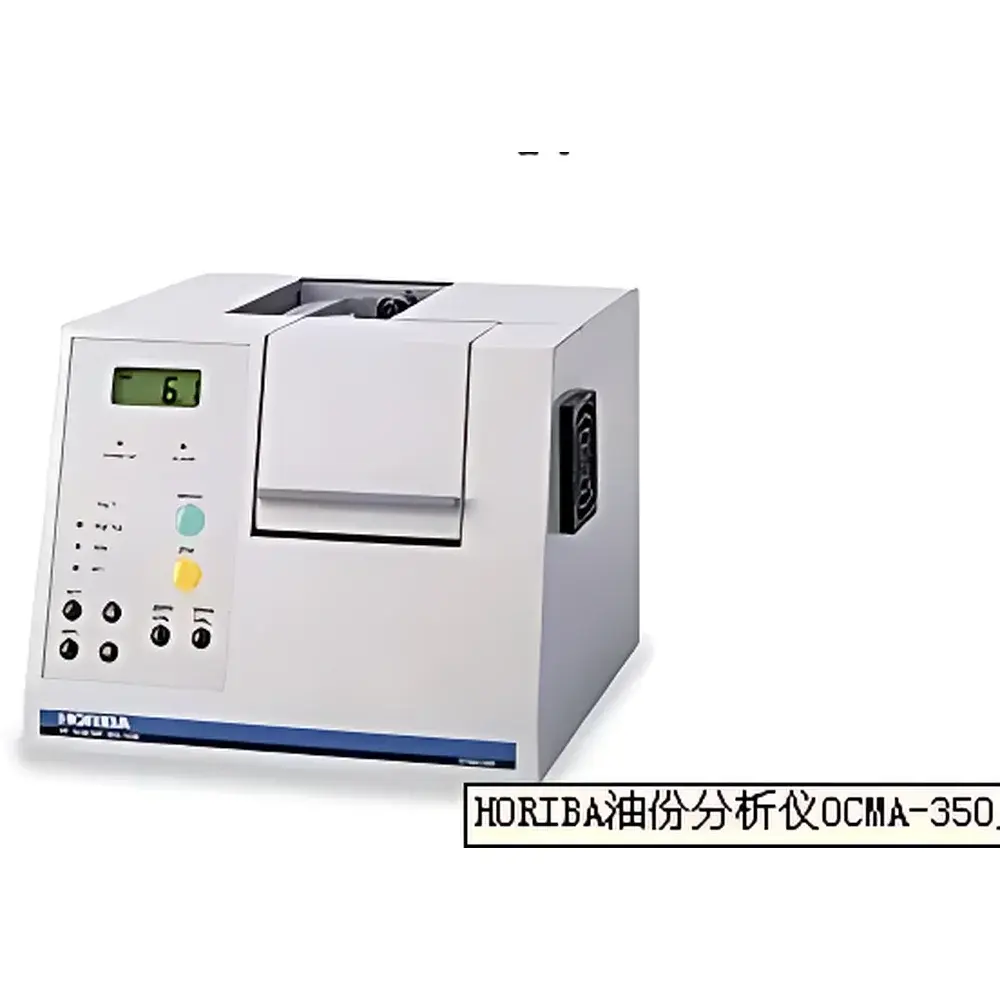
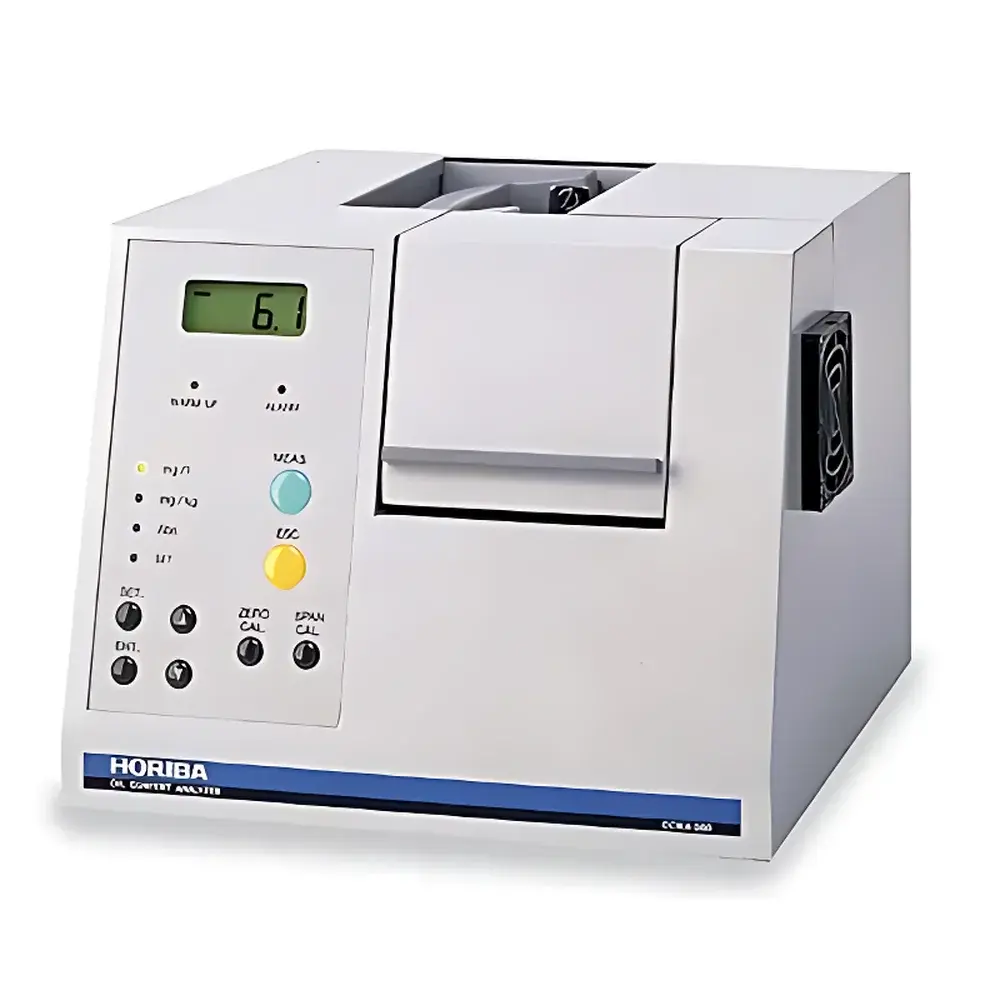
HORIBA OCMA-555 Portable Oil Content Analyzer
| Brand | HORIBA |
|---|---|
| Origin | Japan |
| Model | OCMA-555 |
| Instrument Type | Portable |
| Measurement Principle | Non-Dispersive Infrared (NDIR) Absorption |
| Extraction Solvent | H-997 |
| Measurement Range | 0–200 mg/L (water), 0–1000 mg/kg (soil), 0–1 Abs |
| Detection Limit | 0.1 ppm |
| Repeatability | ±0.4 mg/L (0–9.9 mg/L), ±2.0 mg/L (10.0–99.9 mg/L), ±4 mg/L (100–200 mg/L), ±1% F.S. (0–1 Abs) |
| Display | Backlit LCD with timestamping |
| Interface | RS-232C, Parallel Printer Port |
| Power Supply | 230 V AC, 50 Hz |
| Dimensions | 250 × 200 × 285 mm (W × H × D) |
| Detector | Thermopile Sensor |
| Sample Cell | 200 mm pathlength quartz cuvette |
Overview
The HORIBA OCMA-555 Portable Oil Content Analyzer is a field-deployable, laboratory-grade instrument engineered for precise quantification of hydrocarbon contaminants in aqueous and solid-phase environmental matrices. It operates on the principle of non-dispersive infrared (NDIR) absorption spectroscopy—specifically targeting the C–H stretching vibration band near 3.4 µm—enabling selective detection of petroleum-based oils while minimizing interference from water, solvents, or polar organics. Unlike fluorescence-based systems (e.g., OCMA-550), the OCMA-555 employs H-997 solvent extraction followed by NDIR measurement, delivering superior specificity for aliphatic and aromatic hydrocarbons across complex sample types including industrial wastewater, leachates, soil extracts, and surface wipe samples. Its design adheres to methodological frameworks aligned with ASTM D7066 (Standard Test Method for Determination of Oil and Grease in Water by Infrared Spectrophotometry) and supports compliance with EPA 1664A/B and ISO 9377-2 requirements for oil-in-water analysis. The instrument is calibrated using certified reference standards traceable to NIST, and its automatic zero-tracking function ensures baseline stability over extended operational cycles.
Key Features
- Triple-unit display capability: switch seamlessly between concentration units—mg/L (for water), mg/kg (for soil/solid extracts), and absorbance (Abs)—without recalibration.
- Integrated thermopile detector with high thermal stability and low drift, optimized for long-term field use under variable ambient conditions.
- Backlit LCD interface with embedded real-time timestamping for GLP-compliant data logging; no external PC required for basic operation.
- RS-232C serial interface and parallel printer port support direct data export to LIMS or QA/QC reporting systems, enabling audit-ready traceability.
- Compact benchtop footprint (250 × 200 × 285 mm) and 230 V AC / 50 Hz power compatibility facilitate deployment in mobile labs, onsite remediation trailers, and ISO-classified cleanrooms.
- Pre-configured with NIST-traceable B-grade heavy oil standard, dual-volume syringes (10 mL and 25 µL), capped quartz cuvette (200 mm pathlength), and fuse set—ready for immediate method validation.
Sample Compatibility & Compliance
The OCMA-555 accommodates heterogeneous environmental samples following standardized solvent extraction protocols. Aqueous samples are extracted using H-997 (a chlorinated hydrocarbon solvent with negligible IR absorption at 3.4 µm), while soil and solid matrices undergo Soxhlet or ultrasonic-assisted extraction prior to filtration and dilution. The system demonstrates robust performance across matrices containing suspended solids (SS), emulsified oils, and co-extracted surfactants—provided turbidity is reduced to <1 NTU via centrifugation or membrane filtration (0.45 µm). Data integrity meets GLP and GMP documentation requirements, with optional 21 CFR Part 11-compliant software modules available for electronic signature, audit trail, and user access control. All measurements conform to ISO/IEC 17025 analytical validation criteria, including linearity (R² ≥ 0.999 over 0–200 mg/L), limit of detection (LOD = 0.1 ppm), and intermediate precision (RSD ≤ 3.2% at 10 mg/L, n = 6).
Software & Data Management
While the OCMA-555 operates autonomously via front-panel controls, its RS-232C interface enables bidirectional communication with HORIBA’s optional OCMA Data Manager v3.2 software. This Windows-based application supports automated calibration curve generation, multi-point standardization, batch result compilation, and PDF report export compliant with ISO 14001 environmental management documentation. Raw absorbance values, timestamps, operator IDs, and instrument serial numbers are embedded in each exported record. Audit trails log all parameter modifications, calibration events, and data exports—including user login/logout sequences—satisfying FDA 21 CFR Part 11 electronic record requirements when deployed in regulated manufacturing environments (e.g., semiconductor wafer cleaning validation or pharmaceutical wastewater monitoring).
Applications
- Regulatory compliance monitoring of effluent discharge per local water authority limits (e.g., EU WFD, US Clean Water Act Section 402).
- On-site assessment of soil contamination at brownfield sites, including TPH (Total Petroleum Hydrocarbons) screening prior to excavation.
- Validation of industrial degreasing processes in precision machining, metal finishing, and electronics manufacturing—quantifying residual lubricant on substrates post-cleaning.
- Quality assurance of textile processing fluids and coolant emulsions where hydrocarbon carryover affects dye uptake or corrosion resistance.
- Emergency response triage during oil spill incidents, providing rapid (<5 min/sample) semi-quantitative data to guide containment strategy.
FAQ
What solvent is required for OCMA-555 operation?
H-997 solvent is mandatory for extraction; it exhibits minimal IR absorption at the 3.4 µm detection wavelength, ensuring high selectivity for hydrocarbons.
Can the OCMA-555 measure emulsified oil without phase separation?
No—samples must be pre-treated to break emulsions via acidification, centrifugation, or filtration; undispersed droplets cause scattering artifacts and overestimation.
Is the quartz cuvette included with the instrument?
Yes—a 200 mm pathlength, stoppered quartz cell is supplied as standard equipment.
Does the instrument support multi-point calibration?
Yes—up to six standard concentrations can be programmed manually or imported via serial link for polynomial curve fitting.
What maintenance is required for long-term accuracy?
Annual thermopile sensitivity verification using NIST-traceable reference standards is recommended; optical windows require periodic cleaning with spectroscopic-grade methanol.







