
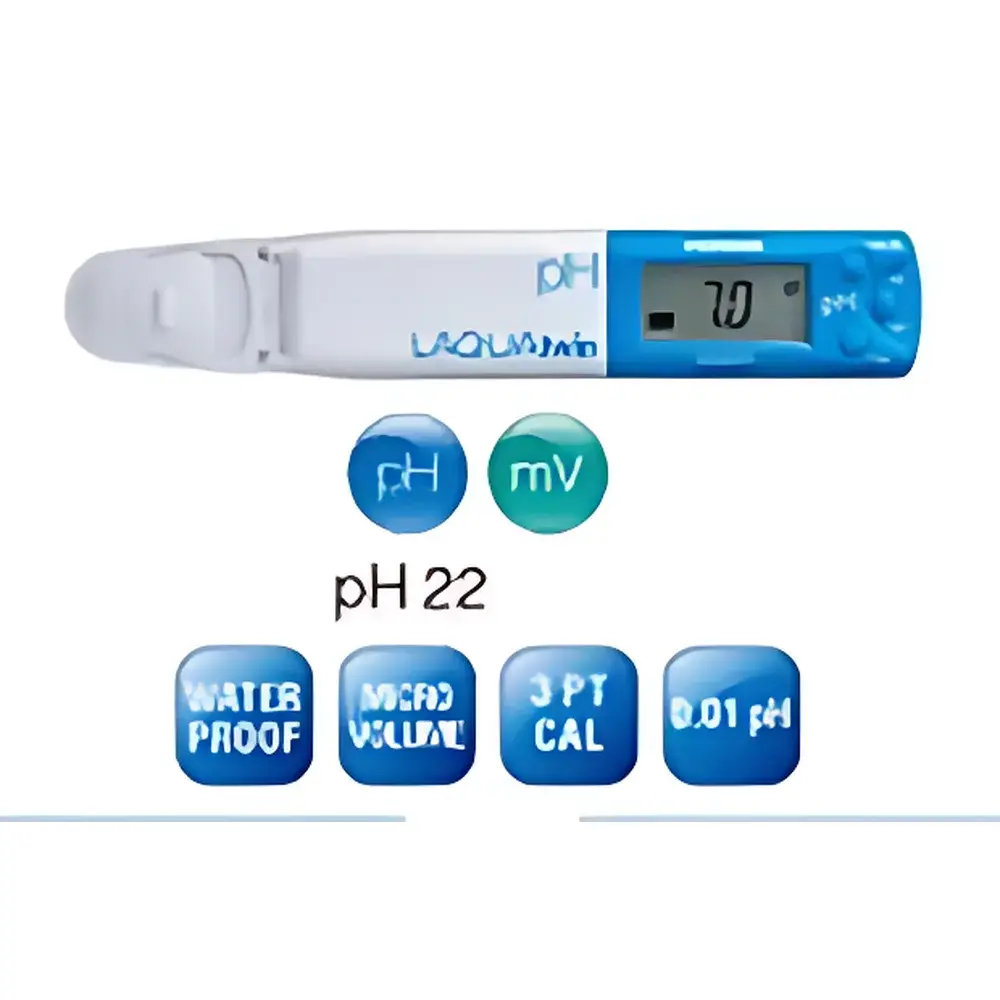
HORIBA PH22 Portable Pen-Style pH Meter
| Brand | HORIBA |
|---|---|
| Origin | Japan |
| Model | PH22 |
| Instrument Type | Pen-Style pH Meter |
| Parameter Type | Single-Parameter (pH) |
| Measurement Range | 0–14 pH |
| Resolution | ±0.01 pH |
| Accuracy | ±0.01 pH |
| Calibration Solutions | pH 4.01 and pH 7.00 standard buffers |
| Temperature Compensation | Automatic (ATC) |
| Electrode Type | Flat-Surface pH Sensor |
| Minimum Sample Volume | 100 µL |
| Compliance | Designed for routine compliance with ISO 8655, ASTM D1293, and EPA Method 150.1 |
Overview
The HORIBA PH22 is a compact, pen-style portable pH meter engineered for field-deployable and benchtop electrochemical measurement of aqueous solutions. It operates on the fundamental principle of potentiometric pH determination—measuring the potential difference between a glass pH-sensing electrode and a built-in reference electrode in contact with the sample. The integrated flat-surface pH electrode enables stable, reproducible readings even on semi-solid or viscous surfaces (e.g., moist soil, food gels, or agar plates), eliminating the need for sample dilution or transfer to a beaker. Its micro-volume capability supports direct immersion in as little as 100 µL of solution—ideal for high-value, limited-quantity samples encountered in QC labs, aquaculture monitoring, and environmental fieldwork. The device features automatic temperature compensation (ATC) via an integrated NTC thermistor, ensuring pH values are referenced to 25 °C per IUPAC conventions without manual correction.
Key Features
- Flat-surface pH sensor architecture—minimizes junction clogging and improves response time on heterogeneous or particulate-laden samples
- True single-hand operation: power-on, calibration, and measurement initiated via a single tactile button
- Auto-ranging digital display with large LCD and backlight for low-light environments (e.g., greenhouse, hatchery, or field tent)
- Factory-calibrated at two points (pH 4.01 and 7.00); user-accessible 2-point calibration protocol compliant with ISO/IEC 17025 documentation requirements
- Rugged ABS housing rated IP67 for dust and temporary water immersion—suitable for outdoor deployment in rain, humidity, or splashing conditions
- Battery life exceeding 2,000 measurements on a single CR2032 coin cell; low-battery indicator and auto-power-off after 10 minutes of inactivity
Sample Compatibility & Compliance
The PH22 is validated for use across diverse matrices including freshwater, seawater, nutrient solutions, soil extracts (1:5 w/v suspensions), fruit juices, dairy products, and buffered pharmaceutical preparations. Its flat electrode design avoids air bubble entrapment during surface contact measurement—critical for non-homogeneous samples where conventional bulb electrodes yield erratic drift. The instrument conforms to key regulatory frameworks governing routine pH testing: it supports traceable calibration records aligned with GLP and GMP quality systems; its accuracy specification (±0.01 pH) meets acceptance criteria outlined in USP , ASTM D1293-22 (Standard Test Method for pH of Water), and EPA Method 150.1 (Laboratory pH Determination). While not FDA 21 CFR Part 11–validated out-of-the-box, audit-ready calibration logs can be manually documented per laboratory SOPs.
Software & Data Management
The PH22 is a standalone, embedded-system device with no Bluetooth, USB, or software dependency—designed explicitly for operational simplicity and regulatory stability. All calibration and measurement data remain on-device only; no firmware updates or cloud synchronization are implemented, minimizing cybersecurity exposure and validation overhead. This architecture aligns with laboratories prioritizing instrument qualification under ISO/IEC 17025 Clause 6.4 (Equipment) and Annex A.1 (Verification of Equipment Functionality). Users maintain full control over data integrity through standardized paper-based or LIMS-integrated manual entry of calibration dates, buffer lot numbers, operator IDs, and measured values—fully auditable during internal QA reviews or external accreditation assessments.
Applications
- Aquaculture & hydroponics: real-time pH tracking in recirculating aquaculture systems (RAS), nursery tanks, and nutrient film technique (NFT) channels
- Environmental field screening: rapid assessment of stream, pond, and wetland pH per EPA Region 10 protocols
- Food safety & quality control: surface pH of meat cuts, cheese rinds, fermented vegetables, and ready-to-eat meals per FSMA Preventive Controls requirements
- Academic teaching labs: student-friendly introduction to electrochemical principles, calibration theory, and measurement uncertainty concepts
- Soil health evaluation: on-site pH estimation of agricultural topsoil using saturated paste extracts—compatible with USDA NRCS Field Handbook procedures
FAQ
Does the PH22 support three-point calibration?
No—the PH22 is optimized for rapid, two-point calibration using certified pH 4.01 and 7.00 standard buffers. Three-point calibration is unnecessary for its specified accuracy class and intended use cases.
Can the flat electrode be cleaned and reused after measuring sticky or oily samples?
Yes—rinse thoroughly with deionized water, then soak the sensing surface in 0.1 M HCl for 2 minutes followed by DI water rinse. Avoid abrasive cleaning agents or ultrasonic baths.
Is temperature compensation mandatory for accurate readings?
Yes—temperature directly affects hydrogen ion activity and electrode potential. The built-in ATC ensures all reported pH values are automatically referenced to 25 °C, per international standard practice.
What is the recommended recalibration frequency?
Calibrate before each measurement session; additionally, recalibrate if ambient temperature changes >5 °C or after measuring aggressive samples (e.g., strong acids/bases, high-salt brines).
Does HORIBA provide NIST-traceable calibration certificates for the PH22?
NIST-traceable certificates are available upon request for the pH 4.01 and 7.00 calibration standards used with the instrument—not for the meter itself, as it is a Class II portable device per IEC 62304 classification.




