
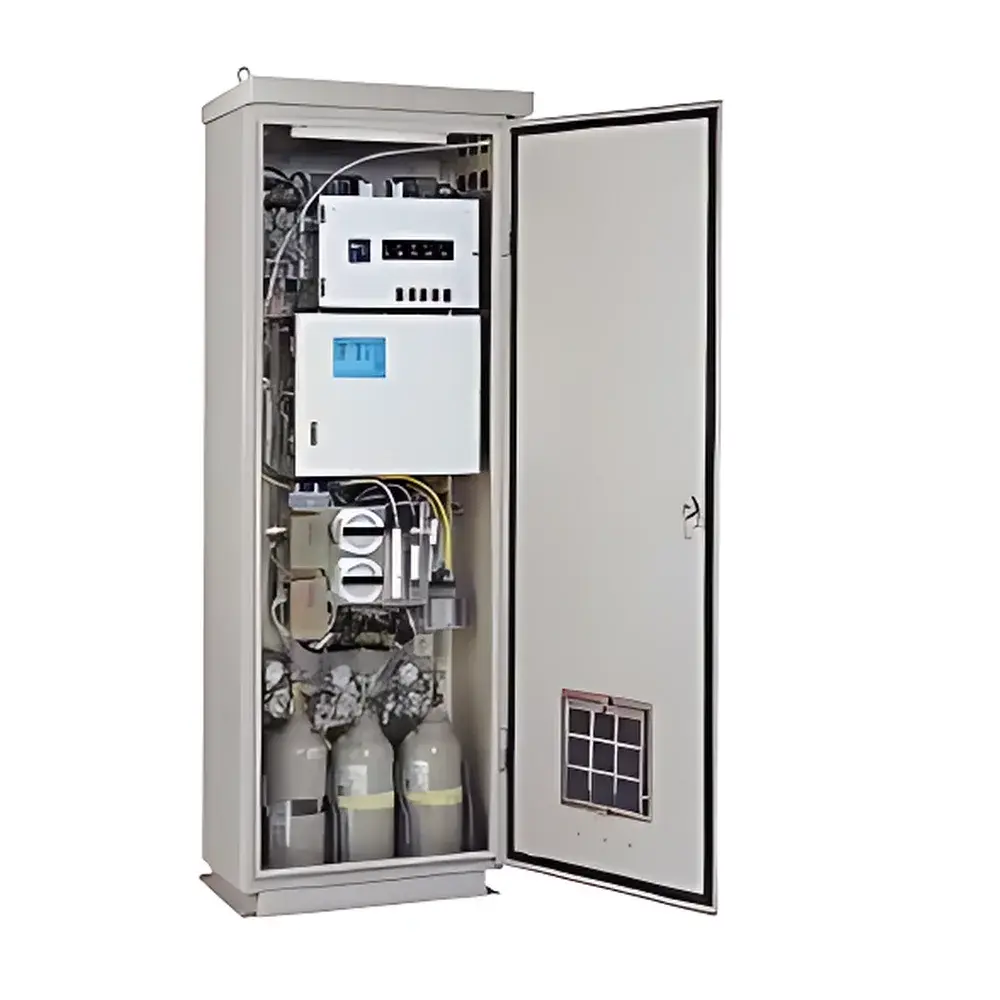
HORIBA ENDA-600ZG Series Continuous Emission Monitoring System (CEMS) for Flue Gas Analysis
| Brand | HORIBA |
|---|---|
| Origin | Japan |
| Model | ENDA-600ZG Series |
| Instrument Type | Continuous Emission Monitoring System (CEMS) |
| Measurement Accuracy | ±2.0% of reading |
| Repeatability | ±0.5% F.S. |
| Response Time (SO₂) | 60–240 s (T₉₀) |
| Long-term Stability | ±2.0% F.S./week |
Overview
The HORIBA ENDA-600ZG Series is a compact, high-integrity Continuous Emission Monitoring System (CEMS) engineered for regulatory-compliant, simultaneous online analysis of up to five flue gas components—NOx, SO2, CO, CO2, and O2—in industrial combustion exhaust streams. Designed for permanent installation in demanding stack environments, the system employs dual-principle detection: alternating-flow non-dispersive infrared (NDIR) spectroscopy for NOx, SO2, CO, and CO2, and magnetic pressure (paramagnetic) detection for O2. This hybrid architecture eliminates the need for carrier gases (e.g., N2) in O2 measurement and avoids optical alignment drift inherent in single-beam or conventional dual-beam NDIR systems. The alternating flow design ensures continuous zero-point referencing at 1 Hz frequency—effectively suppressing zero drift and minimizing span shift over time. With over three decades of field-proven deployment across >100,000 installations globally, the ENDA-600ZG meets stringent international performance requirements for CEMS under ISO 14956, EN 15267, and EPA Performance Specification 3/PS 4/PS 5.
Key Features
- Single-analyzer multi-component capability: Simultaneous real-time quantification of NOx, SO2, CO, CO2, and O2 without external analyzers or gas switching manifolds.
- Drift-free NDIR architecture: Alternating-flow modulation enables automatic zero referencing every second; no manual optical recalibration required throughout service life.
- Integrated interference compensation: Dedicated interference filter wheels and H2O-compensated detectors mitigate cross-sensitivity from water vapor and CO2—critical for accurate NOx and SO2 reporting in wet flue gas.
- Compact footprint: Overall analyzer volume reduced by 50% vs. prior-generation ENDA platforms; wall-mountable auto-blowback controller (350 × 550 × 180 mm) occupies 23% less space.
- Reduced calibration burden: Dry-gas SO2 span calibration completed in ≤3 minutes—compared to 15 minutes for legacy wet-cal methods—minimizing downtime.
- Low-power operation: Power consumption reduced by 200 VA versus predecessor models, supporting energy-efficient continuous operation.
- O2 measurement via magnetic pressure method: Ambient air serves as reference gas; no consumable N2 supply required—reducing operating cost and infrastructure complexity.
Sample Compatibility & Compliance
The ENDA-600ZG accommodates highly variable flue gas matrices through application-specific sampling subsystems. For waste incineration, a chlorine scrubber prevents Cl2-induced corrosion; for coal-fired power plants, an NH3 removal module minimizes SO2 adsorption loss during conditioning. A three-stage electronic cooling system (primary + dual secondary chillers) achieves dew points ≤2 °C, drastically reducing solubility-related losses of SO2 and NO2 in condensate. An integrated SO3 mist eliminator protects downstream optics and sensors from acid deposition. All sampling trains comply with EPA Method 1–4 for representative isokinetic extraction and adhere to ISO 12141 for particulate-laden gas handling. The system supports full audit trails, secure user access levels, and data integrity features aligned with FDA 21 CFR Part 11 and EU Annex 11 requirements for regulated emissions reporting.
Software & Data Management
The ENDA-600ZG runs HORIBA’s embedded CEMS software with a 10.4-inch capacitive touchscreen interface. Real-time concentration plots, alarm history, calibration logs, and maintenance schedules are accessible without external PCs. The system provides twelve configurable analog/digital outputs—including instantaneous values, O2-corrected concentrations (per EN 14181), and rolling 1-hour dynamic averages—for integration into DCS/SCADA networks. Data export complies with ISO 14064-1 and EU MRV reporting formats. Built-in diagnostics monitor detector signal-to-noise ratio, chiller performance, and filter differential pressure—triggering predictive maintenance alerts prior to failure. Firmware updates are performed via encrypted USB or secure Ethernet, preserving configuration integrity and traceability.
Applications
The ENDA-600ZG is validated for continuous monitoring in thermal processes where regulatory compliance, long-term reliability, and minimal site footprint are critical. Primary applications include:
- Coal- and gas-fired power generation units subject to EU IED and US Clean Air Act Title V permitting.
- Municipal solid waste and hazardous waste incinerators requiring chlorine-resistant sampling and rapid T90 response (<90 s for SO2 with Cl2 scrubber).
- Steam boilers in chemical and food processing facilities with fluctuating load and moisture content.
- Iron & steel sinter plants and coke ovens with high dust loading—supported by optional auto-blowback filtration.
- Glass melting furnaces and sulfuric acid production lines demanding SO3 mitigation and low-ppm SO2 detection stability.
System configurations are certified to EN 15267-3 for QAL1 (Quality Assurance Level 1) and support periodic QAL2/QAL3 verification per EN 14181.
FAQ
What detection principles does the ENDA-600ZG use for each gas?
It employs alternating-flow NDIR for NOx, SO2, CO, and CO2, and magnetic pressure (paramagnetic) detection for O2.
Does the system require nitrogen or other carrier gases?
No—ambient air serves as the reference gas for O2 measurement; no external gas supply is needed.
How is water vapor interference managed in NOx and SO2 measurement?
Dedicated H2O-compensated detectors and interference filter wheels actively correct for spectral overlap.
Can the ENDA-600ZG meet EPA PS-3/PS-4 certification requirements?
Yes—when configured with certified sampling systems and operated per QAL1 protocols, it satisfies U.S. and EU CEMS performance specifications.
What is the recommended calibration frequency?
Automatic zero/span checks occur daily; full multi-point calibration is recommended every 7 days per EN 14181 Tier 2 guidelines.







