
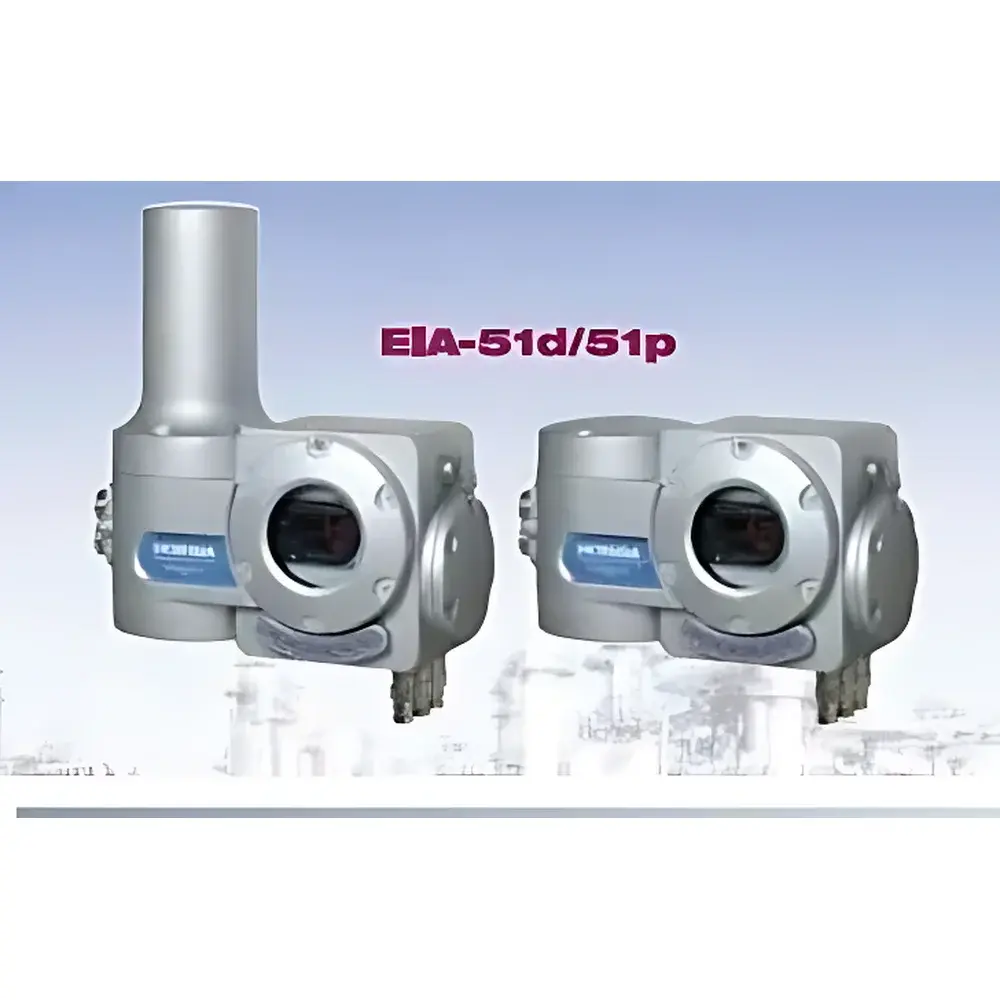
HORIBA TIA-51d / TIA-51p Intrinsically Safe Infrared Gas Analyzer for CO₂ and CO
| Brand | HORIBA |
|---|---|
| Origin | Japan |
| Model | TIA-51d / TIA-51p |
| Explosion Protection | Ex d IIB+H2 T4 / Ex px d IIC T4X |
| Detection Principle | Non-Dispersive Infrared (NDIR) |
| Measured Gases | Carbon Dioxide (CO₂), Carbon Monoxide (CO) |
| Measurement Range (CO₂) | 0–10 vol% to 0–100 vol% (configurable) |
| Measurement Range (CO) | 0–50 ppm to 0–10,000 ppm (configurable) |
| Repeatability | ±0.5% FS (standard range) |
| Linearity | ±1.0% FS |
| Zero Drift | ±1.0% FS/week |
| Span Drift | ±2.0% FS/week |
| Response Time (T90) | ≤20 s |
| Sample Flow Rate | 500 mL/min (TIA-51d), 1.5 L/min (TIA-51p) |
| Sample Pressure | ≥1.98 kPa (TIA-51d), 14.7–24.5 kPa (TIA-51p) |
| Ambient Operating Temperature | –10 to +50 °C |
| Wetted Materials | SUS304, SUS316, FKM, fused silica, gold-coated optics |
| Compliance | IEC 60079-0, IEC 60079-1 (Ex d), IEC 60079-2 (Ex p), ATEX Directive 2014/34/EU, IECEx Scheme |
Overview
The HORIBA TIA-51d and TIA-51p are certified explosion-proof infrared gas analyzers engineered for continuous, real-time monitoring of carbon dioxide (CO₂) and carbon monoxide (CO) in hazardous industrial environments. Unlike thermal conductivity or paramagnetic analyzers, the TIA series employs non-dispersive infrared (NDIR) spectroscopy—leveraging the unique absorption bands of CO₂ (4.26 µm) and CO (4.67 µm) in the mid-infrared spectrum. This optical method ensures high selectivity, minimal cross-sensitivity to background gases (e.g., N₂, O₂, CH₄), and long-term stability without consumables or moving mechanical parts. The analyzers are designed for installation in Zone 1 and Zone 2 classified areas per IEC 60079 standards, supporting both continuous process control and safety interlock applications in chemical plants, refineries, biogas facilities, and confined-space entry systems.
Key Features
- Explosion protection certified to international standards: Ex d IIB+H2 T4 for TIA-51d (flameproof enclosure) and Ex px d IIC T4X for TIA-51p (pressurized + flameproof hybrid design), enabling safe deployment in environments with hydrogen, ethylene, or acetylene-class atmospheres.
- Dual-wavelength NDIR detection with temperature-stabilized IR source and dual-detector architecture, delivering robust compensation against ambient thermal drift and optical contamination.
- Configurable multi-range measurement: up to four user-selectable ranges per gas (e.g., CO₂: 0–10 vol%, 0–25 vol%, 0–50 vol%, 0–100 vol%; CO: 0–50 ppm, 0–500 ppm, 0–5,000 ppm, 0–10,000 ppm), with maximum range ratio of 1:25.
- Optimized sample handling: integrated flow control, pressure regulation, and particulate/moisture-resistant inlet filtration; wetted materials include electropolished SUS316, FKM elastomers, fused silica windows, and gold-coated optical components for corrosion resistance.
- Real-time diagnostics and self-monitoring: continuous verification of detector signal integrity, source output stability, and optical path cleanliness; alarm outputs trigger on fault conditions including zero/span deviation, flow loss, or pressure out-of-spec.
- Modular electronics architecture with isolated analog outputs (4–20 mA), RS-485 Modbus RTU, and optional Ethernet/IP or PROFIBUS DP interfaces for integration into DCS, SCADA, or SIS platforms.
Sample Compatibility & Compliance
The TIA-51d and TIA-51p accept dry, particle-free sample gas streams with oxygen concentration ≤21 vol%, free of condensable vapors and aggressive halogenated compounds. Minimum sample pressure is 1.98 kPa (gauge) for TIA-51d and 14.7–24.5 kPa for TIA-51p, ensuring laminar flow through the measurement cell. Both models comply with IEC 60079-0 (general requirements), IEC 60079-1 (flameproof “d” enclosures), and IEC 60079-2 (pressurized “p” enclosures). Certification documentation includes ATEX EU-Type Examination Certificates (Notified Body: UL International UK Ltd.) and IECEx Test Reports (IECEx TUN 22.0001X). The analyzers support traceability under GLP and GMP frameworks via optional audit-trail-enabled firmware and 21 CFR Part 11-compliant software modules.
Software & Data Management
HORIBA’s proprietary TIA Control Software provides configuration, calibration management, and diagnostic logging via USB or Ethernet connection. Calibration routines support single-point zero and multi-point span adjustments with automated coefficient storage. All calibration events—including date/time stamp, operator ID, gas standard lot number, and before/after readings—are recorded in a tamper-evident internal log. Optional cloud-connected gateway enables remote firmware updates, predictive maintenance alerts (e.g., optical window soiling rate estimation), and secure data export in CSV or OPC UA format. Audit trail functionality meets FDA 21 CFR Part 11 requirements when paired with user authentication and electronic signature modules.
Applications
- Continuous emission monitoring (CEM) of CO and CO₂ from combustion sources (boilers, incinerators, kilns) in compliance with EPA Method 10 and EN 15267.
- Safety monitoring in hydrogen production units, ammonia synthesis loops, and syngas processing where CO serves as a key indicator of catalyst performance or leak detection.
- Biomethane upgrading plants: real-time CO₂ removal efficiency verification and CO slip monitoring prior to grid injection.
- Confined space entry pre-check: portable or fixed-mount deployment for OSHA 1910.146-compliant atmospheric testing in tanks, reactors, and tunnels.
- Pharmaceutical inerting validation: CO₂ concentration tracking during nitrogen-purged vessel blanketing to ensure oxygen displacement and pyrogen control.
FAQ
What is the difference between TIA-51d and TIA-51p explosion protection types?
The TIA-51d uses flameproof (Ex d) enclosure only, rated for IIB+H2 T4 environments. The TIA-51p combines pressurization (Ex p) for the electronics housing and flameproof (Ex d) for the sensor module, achieving IIC T4X certification for higher-risk acetylene-class atmospheres.
Can the analyzer measure CO and CO₂ simultaneously?
Yes—both gases are measured concurrently using dual-channel NDIR optics within a single sample cell, with independent calibration and output signals.
Is field calibration possible without removing the analyzer from service?
Yes—zero calibration can be performed using certified zero air; span calibration requires certified span gas but does not require disassembly or chamber opening.
What maintenance intervals are recommended?
Optical window inspection every 6 months; full functional verification annually; filter replacement every 3–6 months depending on sample cleanliness.
Does the TIA series support SIL2-rated safety functions?
When integrated with certified safety PLCs and configured per IEC 61511, the TIA-51d/p can serve as the sensing element in SIL2 safety instrumented functions (SIFs) for gas over-limit shutdowns.







