
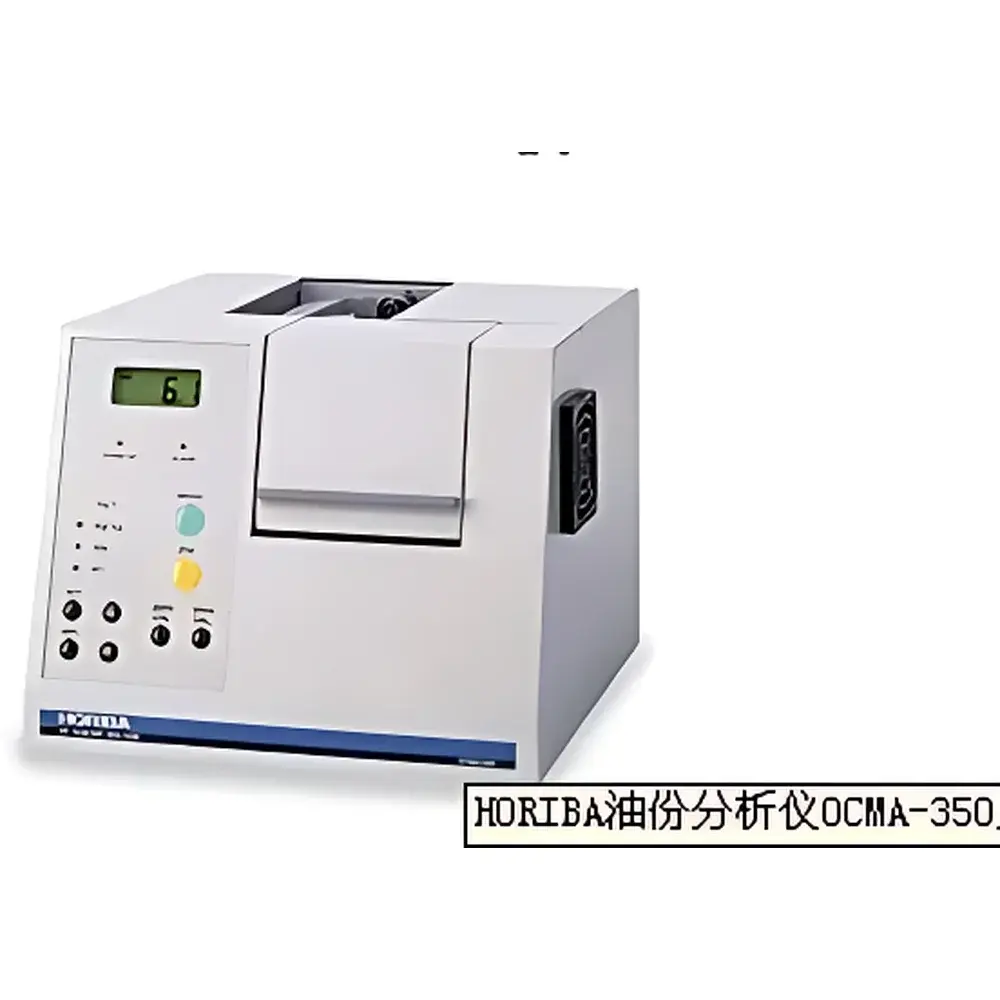
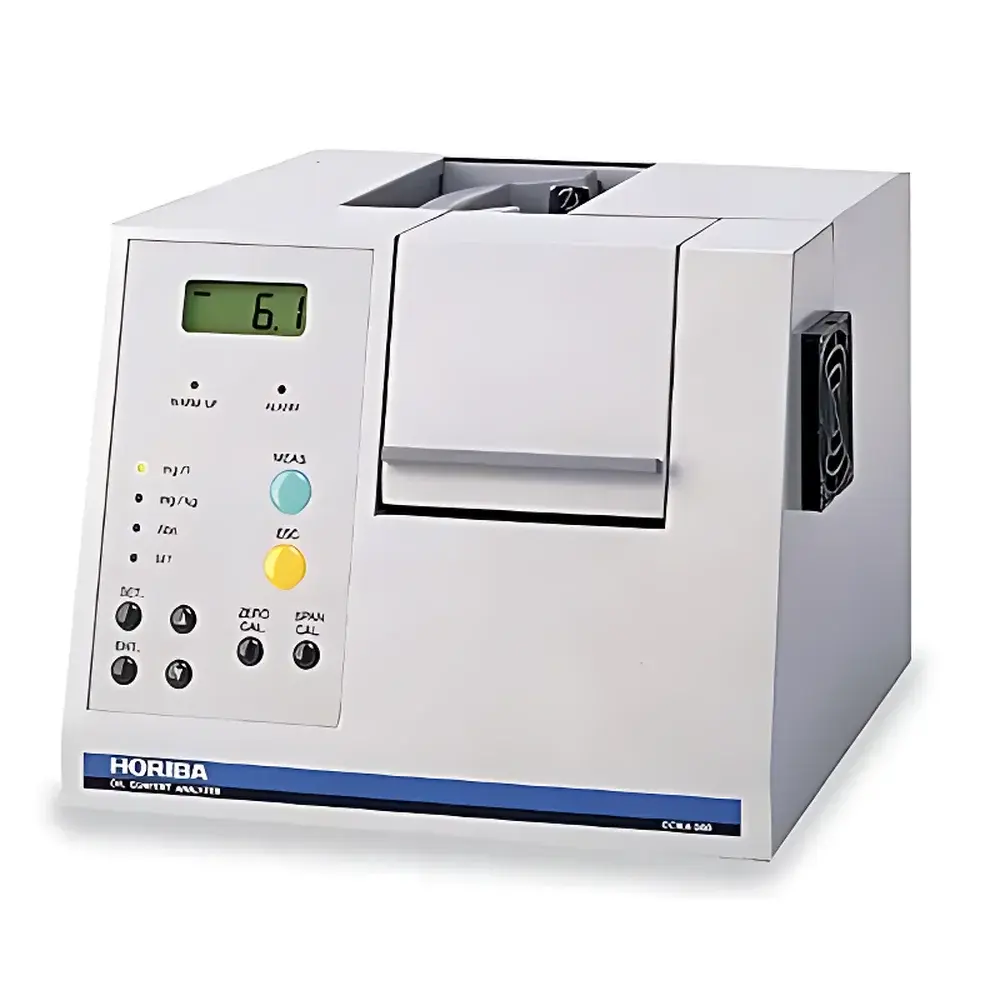
HORIBA OCMA-350/355 Oil Content Analyzer
| Brand | HORIBA |
|---|---|
| Origin | Japan |
| Model | OCMA-350/355 |
| Detection Method | Non-dispersive Infrared (NDIR) Absorption |
| Extractant | S-316 (OCMA-350) / H-997 (OCMA-355) |
| Measurement Range | 0–200 mg/L, 0–1000 mg/kg, 0–1 Abs |
| Repeatability | ±0.4 mg/L (0–9.9 mg/L), ±2.0 mg/L (10.0–99.9 mg/L), ±4 mg/L (100–200 mg/L), ±1% F.S. (0–1 Abs) |
| Sensitivity | 1% of full-scale lower limit |
| Optical Path | Quartz Cuvette (200 mm path length) |
| Detector | Thermoelectric sensor |
| Display | Backlit LCD with timestamping |
| Interface | RS-232C serial port, parallel printer port |
| Power Supply | 230 V AC, 50 Hz |
| Dimensions | 250 × 200 × 285 mm (W × H × D) |
| Standard Accessories | Covered quartz cuvette, power cord, heavy oil standard (B-grade), 2 A fuse, 10 mL syringe, 25 µL syringe |
Overview
The HORIBA OCMA-350 and OCMA-355 are benchtop non-dispersive infrared (NDIR) oil content analyzers engineered for precise quantification of hydrocarbon contaminants in aqueous, solid, and surface-bound matrices. These instruments operate on the principle of selective infrared absorption at ~3.4 µm—the characteristic C–H stretching vibration band common to aliphatic and aromatic hydrocarbons—enabling highly specific detection of extractable petroleum-based oils without interference from water or polar solvents. Unlike broad-spectrum UV-Vis methods, NDIR eliminates spectral overlap from suspended solids (SS), turbidity, or organic co-extractives, making the OCMA series particularly robust for industrial wastewater, post-treatment effluent, soil leachate, and precision cleaning validation in semiconductor and high-precision machining applications. The analyzer requires prior solvent extraction using standardized reagents—S-316 for the OCMA-350 and H-997 for the OCMA-355—both selected for minimal IR absorbance at the target wavelength and compatibility with regulatory extraction protocols.
Key Features
- Triple-unit measurement capability: direct readout in mg/L (aqueous phase), mg/kg (soil/solid matrix), or absorbance (Abs) for method flexibility and traceability
- High-stability thermoelectric detector with <20 mV drift over 8-hour operation, ensuring baseline integrity during extended batch analysis
- Backlit LCD display with embedded real-time timestamping—compliant with GLP data integrity requirements for audit-ready recordkeeping
- Automatic zero calibration upon power-up and user-initiated reference adjustment, reducing operator-dependent variability
- Dual communication interfaces: RS-232C for integration into LIMS or SCADA systems and parallel port for direct thermal printer output
- Optimized optical path using a 200 mm path-length quartz cuvette, enhancing sensitivity to sub-ppm levels (detection limit: 0.1 ppm as oil)
- Compact footprint (250 × 200 × 285 mm) suitable for field-deployable labs, QC benches, or mobile environmental monitoring units
Sample Compatibility & Compliance
The OCMA-350/355 supports a broad range of sample types following standardized extraction procedures per ASTM D7066 (oil in water by IR), ISO 9377-2 (petroleum hydrocarbons in soil), and EPA Method 1664A (n-hexane extractable material). It is routinely deployed for regulatory compliance testing in industrial pretreatment programs, landfill leachate screening, and semiconductor wafer cleaning validation where residual hydrocarbon contamination must be verified below 1 mg/m². The instrument’s fixed-wavelength NDIR architecture avoids spectral misalignment issues associated with grating-based spectrometers, delivering consistent performance across temperature fluctuations (15–35°C ambient operating range). All firmware and calibration routines adhere to FDA 21 CFR Part 11 principles—including electronic signature support when paired with compliant data acquisition software—and maintain full audit trails for GMP/GLP environments.
Software & Data Management
While the OCMA-350/355 operates as a standalone analyzer, its RS-232C interface enables seamless integration with third-party laboratory data management systems. Raw absorbance values, concentration results, timestamps, and unit selection metadata are transmitted in ASCII format with configurable baud rates (up to 19200 bps). No proprietary driver is required; standard terminal emulation (e.g., Tera Term, PuTTY) allows immediate log capture. For regulated environments, validated CSV export modules—compatible with LabWare LIMS and Thermo Fisher SampleManager—support structured data ingestion with automatic field mapping (e.g., Sample ID, Extraction Lot, Analyst ID, Instrument Serial). Internal memory retains the last 100 measurements with time/date stamps, serving as a local fallback during network outages.
Applications
- Industrial wastewater monitoring: real-time verification of oil-water separator efficiency and compliance with discharge limits (e.g., <10 mg/L per EU Directive 2000/60/EC)
- Hazardous waste site characterization: quantification of total petroleum hydrocarbons (TPH) in soil extracts per RCRA SW-846 Method 9071B
- Precision manufacturing: validation of solvent-based degreasing processes for metal parts, silicon wafers, and optical components
- Textile and coating industry QA: measurement of residual lubricants on finished fabrics or pre-treated substrates
- Environmental forensics: differentiation of crude oil vs. refined product signatures via comparative absorbance profiling (when used with reference standards)
FAQ
What extraction solvents are compatible with the OCMA-350 and OCMA-355?
The OCMA-350 is calibrated for use with S-316 (1,1,2-trichloro-1,2,2-trifluoroethane), while the OCMA-355 uses H-997 (a proprietary chlorinated hydrocarbon blend). Both solvents exhibit negligible IR absorption at 3.4 µm and meet ASTM D7066 purity specifications.
Can the instrument measure emulsified or dissolved oil fractions?
No—the OCMA series quantifies only solvent-extractable hydrocarbons. Emulsified or micellar-phase oil requires phase separation or acidification prior to extraction to ensure quantitative recovery.
Is the quartz cuvette included with the system autoclavable?
The supplied 200 mm path-length quartz cuvette is chemically resistant but not rated for repeated autoclaving; cleaning is recommended with S-316 rinse followed by nitrogen purge to avoid residue buildup.
Does the analyzer support multi-point calibration?
Calibration is performed using a single certified reference standard (B-grade heavy oil); linearity across the full range is factory-verified per ISO/IEC 17025 and documented in the Certificate of Conformance shipped with each unit.
How is solvent recycling implemented?
The optional SR-305 Solvent Regenerator employs dual-stage adsorption (activated carbon + activated alumina) to remove oxidized hydrocarbons and water from spent S-316 or H-997, extending solvent life by ≥80% and reducing hazardous waste generation in high-throughput labs.







