
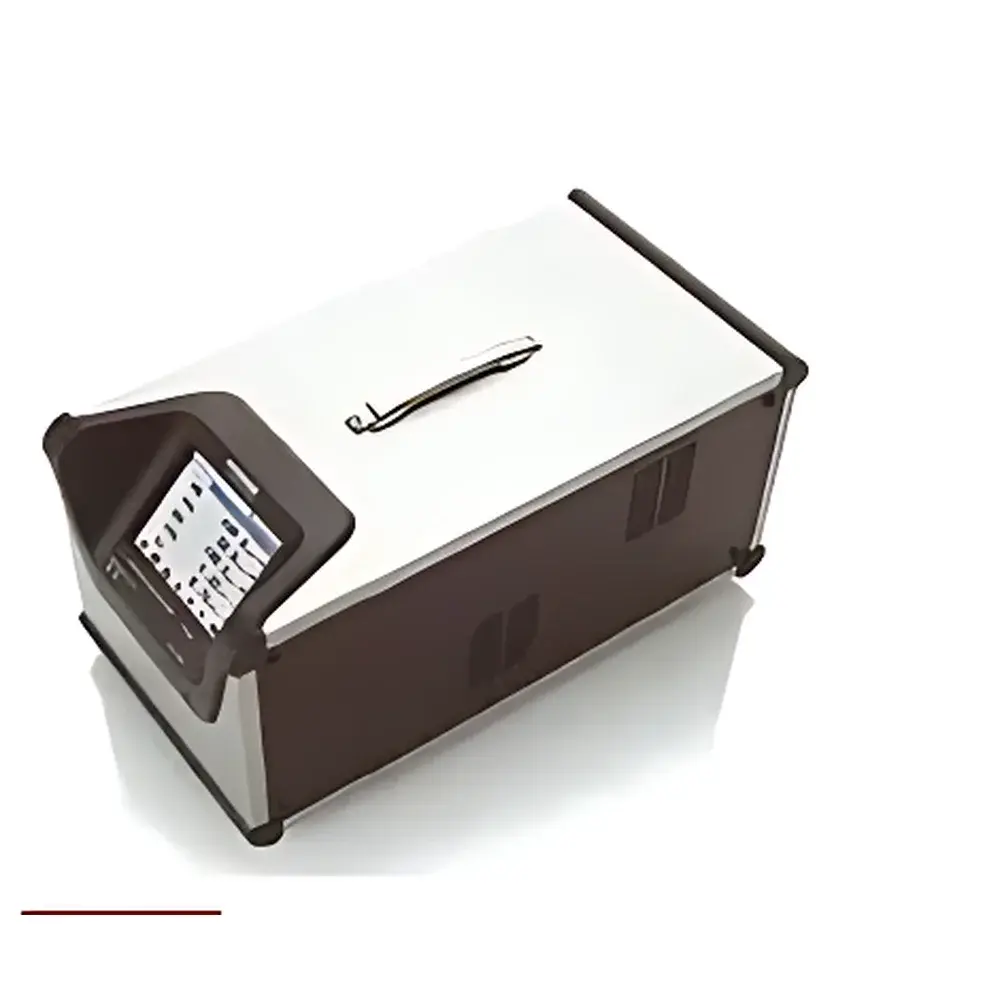
HORIBA PG-350 Portable Multi-Gas Analyzer
| Brand | HORIBA |
|---|---|
| Origin | Japan |
| Model | PG-350 Series |
| Instrument Type | Portable |
| Measured Gases | NOₓ, SO₂, CO, CO₂, O₂ |
| Range Options | 0–5/10/25 vol% (O₂, CO₂) |
| Repeatability | ±1.0% F.S. |
| Drift | ±1.0% F.S./day (±2.0% F.S./day for SO₂) |
| Linearity | ±2.0% F.S. |
| Response Time (T₉₀) | ≤45 s (all gases except SO₂) |
| Sample Flow Rate | ~0.5 L/min |
| Display | Color TFT touchscreen with real-time trend graphs and step-by-step on-screen guidance |
| Data Storage | SD card (user-configurable interval) |
| Outputs | 4–20 mA analog, Ethernet |
| Warm-up Time | 30 min |
| Operating Environment | 5–40 °C, ≤85% RH |
| Dimensions | 226 × 265 × 510 mm (W×H×D) |
| Weight | ~14 kg |
| Certifications | TÜV (EU), MCERTS (UK), GOST-R (Russia), ETV (USA), China Metrology Certification (CMC), Korea Metrology Certification, Japan JIS/JCSS |
Overview
The HORIBA PG-350 Portable Multi-Gas Analyzer is an engineered field-deployable instrument designed for high-fidelity, simultaneous quantification of up to five critical gas components—NOₓ, SO₂, CO, CO₂, and O₂—in flue gas, combustion exhaust, and ambient emission streams. Built upon HORIBA’s proprietary alternating-flow modulation (AFM) technology, the PG-350 integrates multiple detection principles within a single compact platform: chemiluminescence detection (CLD) for NOₓ, non-dispersive infrared (NDIR) absorption for SO₂, CO, CH₄, and CO₂, and electrochemical (galvanic cell) sensing for O₂. This hybrid architecture ensures metrological traceability and cross-gas interference mitigation without compromising portability or operational robustness. Unlike benchtop analyzers requiring fixed installation and complex sample conditioning, the PG-350 delivers laboratory-grade accuracy—verified against ISO 12039, EN 15267, and US EPA Methods 6C, 7E, and 10—directly at the measurement point, supporting compliance-driven applications such as CEMS backup verification, catalyst performance evaluation, and mobile stack auditing.
Key Features
- Alternating-flow modulation NDIR and CLD detection—eliminates zero drift from optical path contamination and enhances signal-to-noise ratio under variable flow and moisture conditions.
- Integrated electronic condensate management system with automatic and manual drainage modes, enabling stable operation in high-humidity environments without external chillers.
- Color TFT capacitive touchscreen interface with intuitive navigation, on-screen operational guidance, and real-time multi-parameter trend visualization (gas concentration vs. time).
- Full-system calibration capability—including heated sampling line, filter, and internal optical path—traceable to NIST-certified standards and compliant with ISO/IEC 17025 calibration documentation requirements.
- Dual-mode data handling: local SD card logging (configurable sampling interval down to 1 second) + Ethernet-based remote access for live monitoring and firmware updates.
- Robust mechanical design: IP54-rated enclosure, shock-absorbing chassis, and vibration-damped optical modules validated per IEC 60068-2-6 for field transport and on-site deployment.
- Power-flexible operation: auto-ranging 100–240 VAC, 50/60 Hz input with internal power conditioning to maintain measurement stability during voltage fluctuations.
Sample Compatibility & Compliance
The PG-350 accepts conditioned extractive gas samples at flow rates of approximately 0.5 L/min, compatible with standard heated probe systems (up to 180 °C) and particulate filtration (≤1 µm). It meets stringent regulatory acceptance criteria across global markets: certified to MCERTS (UK), TÜV Class 1 (EU), ETV Verified (USA), GOST-R (Russia), and national metrology standards in Japan (JIS B 7981), South Korea (KOLAS), and China (CMC). Its measurement uncertainty profile satisfies ISO 14064-3 verification requirements for GHG monitoring and aligns with ASTM D6522 for NOₓ analysis and ASTM D6216 for SO₂. The analyzer supports GLP-compliant audit trails via embedded event logging (calibration events, alarm triggers, sensor diagnostics) stored on SD card with timestamped metadata.
Software & Data Management
Firmware v3.2+ includes embedded data acquisition logic supporting configurable averaging (1–60 s), linearization correction per gas channel, and automatic span/zero validation reporting. All raw and processed data are stored in CSV format on removable SD cards with file naming conventions compliant with 21 CFR Part 11 (electronic signatures enabled via password-protected user roles). Ethernet connectivity enables integration into SCADA or LIMS platforms using Modbus TCP or HTTP REST API. Remote diagnostics—including optical path transmittance history, detector gain tracking, and pump performance logs—are accessible via secure HTTPS portal, facilitating predictive maintenance and reducing unplanned downtime.
Applications
- CEMS redundancy and periodic validation in thermal power plants, waste incinerators, and cement kilns.
- In-situ combustion optimization studies for boiler tuning, low-NOₓ burner evaluation, and SCR/SNCR efficiency assessment.
- Mobile emissions testing for industrial process heaters, reciprocating engines, and fuel cell test benches.
- Research-grade gas profiling in university laboratories conducting catalytic reaction kinetics, sorbent breakthrough studies, and atmospheric simulation experiments.
- Regulatory field audits by environmental agencies requiring portable, legally defensible measurement evidence under EN 14181 QAL2/QAL3 protocols.
FAQ
What gas components does the PG-350 measure by default?
The standard PG-350 configuration measures NOₓ, SO₂, CO, CO₂, and O₂ simultaneously. CH₄ detection is available as an optional channel.
Is the PG-350 suitable for high-moisture flue gas sampling?
Yes—the integrated electronic condensate trap and heated internal sample path (maintained above dew point) enable reliable operation with wet gas streams up to 90% RH, eliminating need for external dryers in most applications.
How is calibration traceability maintained?
All calibrations use NIST-traceable certified gas mixtures; full-system calibration reports include uncertainty budgets per ISO/IEC 17025 and are archived automatically on SD card with digital signature.
Does the PG-350 support remote data export and alarm notification?
Yes—via Ethernet, users can configure email/SNMP alerts for out-of-spec conditions and schedule automated FTP uploads of logged data to centralized servers.
What is the minimum warm-up time required before valid measurements?
30 minutes from cold start, after which specifications for repeatability, drift, and linearity apply per manufacturer’s stated tolerances.
Related Products







