
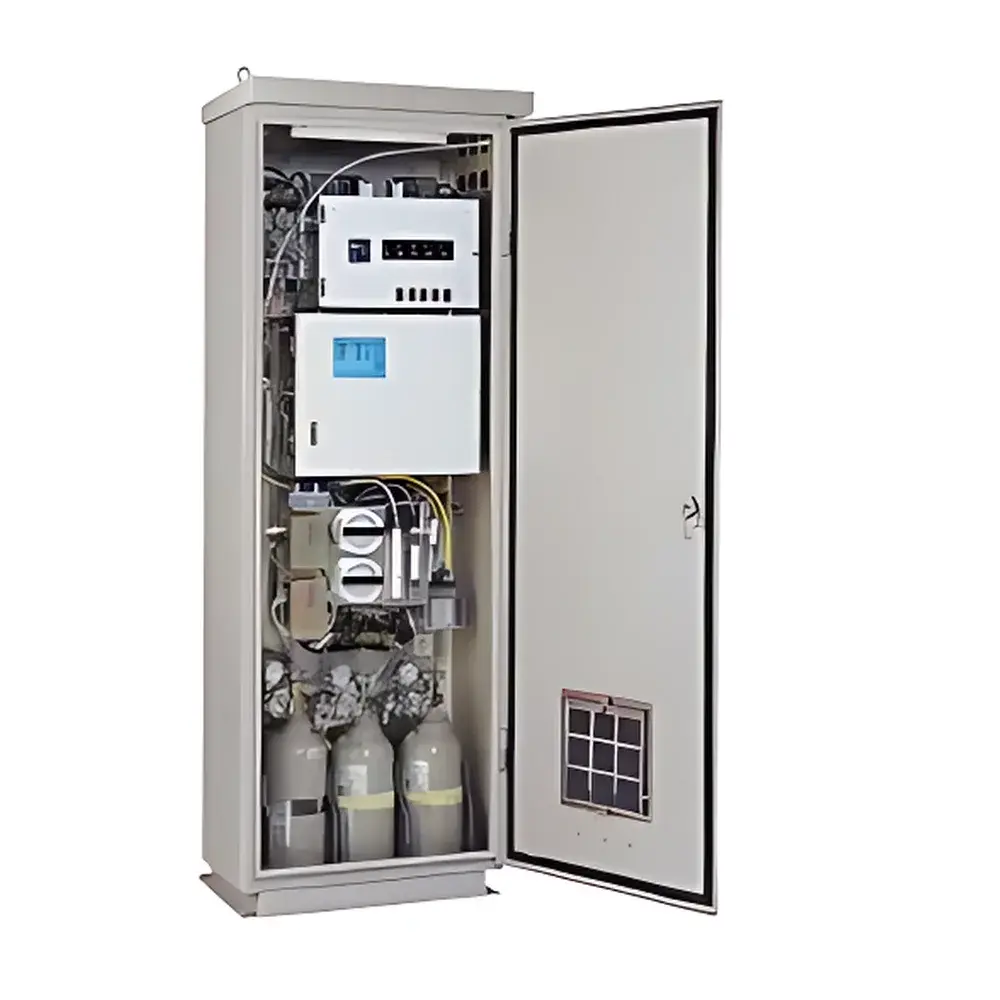
HORIBA ENDA-600ZG Series Flue Gas Continuous Emission Monitoring System (CEMS)
| Brand | HORIBA |
|---|---|
| Origin | Japan |
| Model | ENDA-600ZG Series |
| Instrument Type | Flue Gas CEMS |
| Measurement Accuracy | ±1.0% F.S. |
| Repeatability | ±0.5% F.S. |
| Response Time (SO₂) | 60–240 s |
| Stability | ±2.0% F.S./week |
| Detection Principle | Alternating Flow NDIR (NOₓ, SO₂, CO, CO₂), Magnetic Pressure O₂ Sensing |
| Display | Integrated Touchscreen LCD |
| Dimensions (Analyzer) | 50% reduction vs. predecessor |
| Auto-Backflush Controller Size | 350 × 550 × 180 mm |
| Power Consumption | Reduced by 200 VA vs. prior generation |
| Compliance | Designed for ISO 14001, EN 15267, EPA PS-11/PS-15, and China HJ 75–2017 CEMS technical specifications |
Overview
The HORIBA ENDA-600ZG Series is a compact, high-integrity flue gas continuous emission monitoring system (CEMS) engineered for long-term, unattended operation in demanding industrial environments. It employs alternating flow non-dispersive infrared (NDIR) spectroscopy for simultaneous, real-time quantification of up to five key combustion gases—NOₓ (as NO), SO₂, CO, CO₂, and O₂—within a single analyzer unit. Unlike conventional dual-beam or fixed-path NDIR systems, the ENDA-600ZG utilizes a proprietary alternating flow modulation architecture: sample and reference gas streams are sequentially introduced into the same detection cell at 1 Hz frequency. This design eliminates optical misalignment drift, obviates routine optical recalibration, and ensures zero-point stability over extended periods—critical for regulatory compliance reporting under ISO 14001, EN 15267-3, and U.S. EPA Performance Specification 11 (PS-11) and PS-15. Oxygen measurement is performed via magnetic pressure (paramagnetic) sensing, eliminating the need for external carrier gas (e.g., nitrogen) and minimizing maintenance while preventing sensor corrosion from acidic flue constituents. The system’s core architecture supports full traceability, audit-ready data logging, and adherence to GLP/GMP-aligned operational protocols.
Key Features
- Single-unit multi-component analysis: Simultaneous, independent measurement of NOₓ, SO₂, CO, CO₂, and O₂ without cross-interference compensation artifacts.
- Zero-drift alternating flow NDIR: Sample and reference gas alternate through one common detection cell; no mechanical alignment required; immunity to vibration, thermal expansion, or transport-induced calibration shift.
- Integrated interference compensation: Dedicated interference filter wheels and H₂O-compensated detectors suppress spectral overlap effects—particularly critical for SO₂ measurement in humid, chlorine-rich waste incineration flue gas.
- Touchscreen HMI with contextual navigation: 7-inch capacitive LCD enables rapid access to real-time concentration plots, span/zero calibration menus, alarm history, dilution ratio configuration, and O₂ correction settings—all operable without external PC.
- Modular, front-access maintenance: 50% footprint reduction versus legacy ENDA platforms; all service points—including filter cartridges, desiccant traps, and calibration valve assemblies—are accessible from the instrument front panel.
- Energy-efficient design: Total power draw reduced by 200 VA relative to predecessor models; optimized thermal management extends component lifetime in ambient temperatures up to 50°C.
Sample Compatibility & Compliance
The ENDA-600ZG is paired with application-specific sampling systems validated across diverse emission sources: municipal solid waste (MSW) incinerators, coal- and gas-fired power plants, glass melting furnaces, sulfuric acid production lines, and steel reheating furnaces. Sampling configurations include optional Cl₂ scrubbers (for MSW), NH₃ removal modules (for SCR-equipped boilers), and high-efficiency three-stage electronic coolers (primary + dual secondary) that achieve dew point ≤2°C—minimizing aqueous-phase loss of SO₂ and NO₂. For particulate-laden streams (>100 mg/Nm³), an integrated auto-backflush controller (350 × 550 × 180 mm) performs timed reverse-pulse cleaning of the probe filter, extending maintenance intervals. All ENDA-600ZG installations comply with mandatory CEMS certification frameworks including China’s HJ 75–2017 and HJ 76–2017, EU’s EN 14181, and U.S. EPA PS-11/PS-15 requirements for accuracy, response time, and data continuity.
Software & Data Management
Firmware supports native Modbus TCP/RTU, 4–20 mA analog outputs (up to 12 channels), and Ethernet-based data export compliant with IEC 62443-3-3 cybersecurity guidelines. Internal memory logs second-by-second raw detector signals, calibrated concentrations, diagnostic flags (e.g., flow fault, temperature deviation, mirror contamination warning), and calibration event timestamps. Data export formats include CSV and XML, structured for seamless ingestion into central SCADA or environmental data management systems (EDMS). Audit trails record all user-initiated actions—including calibration start/stop, parameter modification, and alarm acknowledgment—with operator ID and timestamp. Optional firmware upgrade enables 21 CFR Part 11-compliant electronic signatures and role-based access control (RBAC) for QA/QC personnel.
Applications
- Regulatory CEMS for coal-, oil-, and biomass-fired utility boilers subject to national emission limits (e.g., NOₓ < 100 mg/Nm³, SO₂ < 35 mg/Nm³).
- Waste-to-energy plants requiring chlorine-resistant sampling and sub-90 s T90 response for SO₂ during transient load changes.
- Steel industry annealing and galvanizing lines where CO and CO₂ ratios inform furnace atmosphere control.
- Sulfuric acid manufacturing units monitoring SO₂ conversion efficiency across catalytic beds.
- Glass furnace operators optimizing combustion air/fuel ratio using real-time O₂ feedback coupled with NOₓ trend analysis.
FAQ
What gas components does the ENDA-600ZG measure simultaneously?
NOₓ (reported as NO), SO₂, CO, CO₂, and O₂—measured concurrently in a single analyzer housing using orthogonal detection principles.
How does the alternating flow NDIR method improve long-term stability?
By cycling sample and reference gas through one shared detection cell at 1 Hz, it cancels out optical path-length drift, detector aging effects, and thermal lensing—eliminating zero-point drift and reducing annual calibration frequency.
Is external nitrogen required for O₂ measurement?
No. The magnetic pressure O₂ sensor uses ambient air as its reference medium; no bottled N₂ or synthetic air supply is needed.
Can the system meet U.S. EPA PS-11 requirements for SO₂ analyzers?
Yes—when configured with certified sampling, three-stage cooling, and Cl₂ scrubbing (where applicable), the ENDA-600ZG achieves PS-11 accuracy (±2.5% of span), response time (T90 ≤ 240 s), and stability (±2.0% F.S./week) under field validation protocols.
What maintenance tasks require scheduled intervention?
Filter replacement (every 3–6 months depending on dust loading), desiccant cartridge exchange (annually), and biannual verification of calibration gas delivery integrity—fully accessible via front-panel service doors.







