
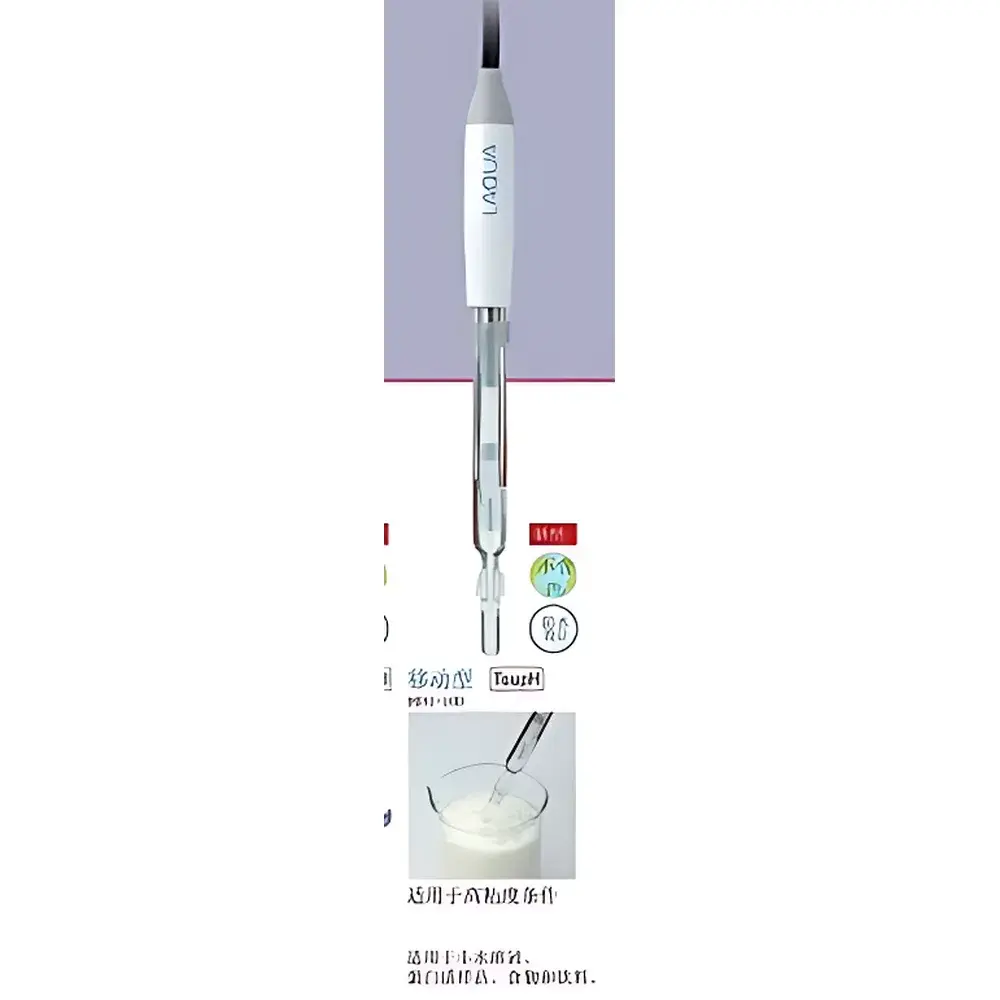
HORIBA 9681-10D High-Precision Tri-Function (Combined) pH Electrode
| Brand | HORIBA |
|---|---|
| Origin | Japan |
| Model | 9681-10D |
| Temperature Range | 0–60 °C |
| pH Range | 0–14 |
| Electrode Type | Combined Glass/Reference/ATC (Integrated Temperature Compensation) |
| Construction | Ruggedized Plastic Body with Hemispherical Tip |
| Sensing Surface | Flat-Tip Glass Membrane |
| Compliance | Meets JIS Z 8802 for pH electrode mechanical strength (10× requirement) |
Overview
The HORIBA 9681-10D is a high-precision, tri-function combined pH electrode engineered for laboratories requiring exceptional stability, rapid response, and robust operation across diverse sample matrices—including low-conductivity aqueous solutions, semi-solid surfaces, and micro-volume droplets. Unlike conventional combination electrodes, the 9681-10D integrates three functional elements into a single probe: a patented fast-response pH-sensitive glass membrane, a low-drift Ag/AgCl reference system with cation-selective hollow-fiber junction, and an embedded thermistor for automatic temperature compensation (ATC). Its measurement principle follows the Nernst equation, where the potential difference between the sensing and reference elements is linearly proportional to pH (−59.16 mV/pH at 25 °C), with built-in thermal correction ensuring accuracy across 0–60 °C. Designed for ISO/IEC 17025-compliant environments, the electrode supports traceable calibration protocols and meets mechanical durability requirements per JIS Z 8802—exceeding standard strength thresholds by over one order of magnitude.
Key Features
- Patented Rare-Earth-Doped Glass Membrane: Incorporates HORIBA-developed lanthanide-based compounds to reduce response time by up to 50% versus conventional pH glasses while enhancing chemical resistance to alkali error and hydrolysis.
- Stabilized Reference System: Utilizes a cation-conductive hollow-fiber liquid junction that suppresses Ag⁺ migration by >99.9%, minimizing junction clogging and maintaining stable reference potential over extended use—critical for long-term GLP/GMP monitoring.
- Flat-Tip Hemispherical Geometry: Features a mechanically reinforced, flat-surface sensing area with <100 µm gap between tip and protective sleeve—enabling direct surface pH mapping of solids, gels, and thin-film samples without air bubble entrapment.
- ESD-Protected Semiconductor Architecture: Integrates proprietary static-dissipative circuitry to mitigate electrostatic discharge effects—a known failure mode in ISFET-augmented or hybrid sensor platforms—ensuring reliable operation in dry-lab or low-humidity environments.
- Dry-Storage Compatibility: Unlike traditional glass electrodes, the 9681-10D maintains hydration stability during intermittent storage without KCl soaking, reducing maintenance overhead and cross-contamination risk.
Sample Compatibility & Compliance
The 9681-10D is validated for use with aqueous buffers (pH 0–14), low-ionic-strength waters (<50 µS/cm), ethanol/water mixtures, and hydrated solid-phase interfaces (e.g., pharmaceutical tablets, food surfaces, soil slurries). It complies with ASTM D1293 (Standard Test Method for pH of Water), ISO 7888 (Water Quality – Determination of pH), and USP (pH Measurement). The electrode’s junction design minimizes liquid junction potential drift in non-aqueous media, supporting method development under ICH Q2(R2) validation guidelines. All materials contact surfaces conform to USP Class VI biocompatibility standards and are free of leachable heavy metals per RoHS Directive 2011/65/EU.
Software & Data Management
When paired with HORIBA’s LAQUA Smart software (v3.2+), the 9681-10D enables full audit-trail functionality compliant with FDA 21 CFR Part 11. Calibration records—including date/time stamps, operator ID, buffer lot numbers, slope (%), offset (mV), and ATC verification data—are encrypted and exportable as CSV or PDF. Real-time stability monitoring flags deviations exceeding ±0.02 pH units over 30 seconds, triggering automated recalibration prompts. Data integrity safeguards include write-protected memory, dual-signature electronic signatures, and synchronized NTP time stamping.
Applications
- Quality control of lyophilized biopharmaceuticals via surface pH mapping of vial stoppers and cake interfaces
- In-process monitoring of fermentation broths with fluctuating conductivity and suspended solids
- Environmental analysis of rainwater, pore water from sediment cores, and atmospheric particulate extracts
- R&D of battery electrolytes and fuel cell membranes requiring non-invasive, low-volume pH assessment
- Educational labs performing Nernstian slope verification and junction potential studies
FAQ
Can the 9681-10D be used in non-aqueous solvents such as methanol or acetonitrile?
Yes—its optimized liquid junction and rare-earth glass composition reduce solvent-induced asymmetry potentials; however, calibration must be performed in matching solvent/buffer systems per ISO 10523 Annex B.
Is routine cleaning with a soft-bristled toothbrush recommended?
Yes—mechanical cleaning with non-abrasive brushes is explicitly endorsed in HORIBA Technical Bulletin TB-9681-EN to remove proteinaceous or colloidal fouling without damaging the flat-tip geometry.
Does this electrode support two-point or multi-point calibration?
It supports up to five-point calibration (pH 1.68, 4.01, 6.86, 7.00, 9.18, 10.01, 12.45) with automatic slope and offset validation per IUPAC recommendations.
What is the expected service life under continuous 24/7 operation?
Based on accelerated aging tests per JIS Z 8802, median operational lifetime exceeds 18 months at 25 °C with daily calibration and proper storage; performance degradation is monitored via slope decay rate in LAQUA Smart.
Can it be connected to third-party meters (e.g., Mettler Toledo, Thermo Orion)?
Yes—BNC connector compatibility ensures interoperability with any pH meter supporting standard mV input and ATC signal (±0.1 °C resolution), though full Part 11 features require HORIBA’s native hardware/software stack.





