
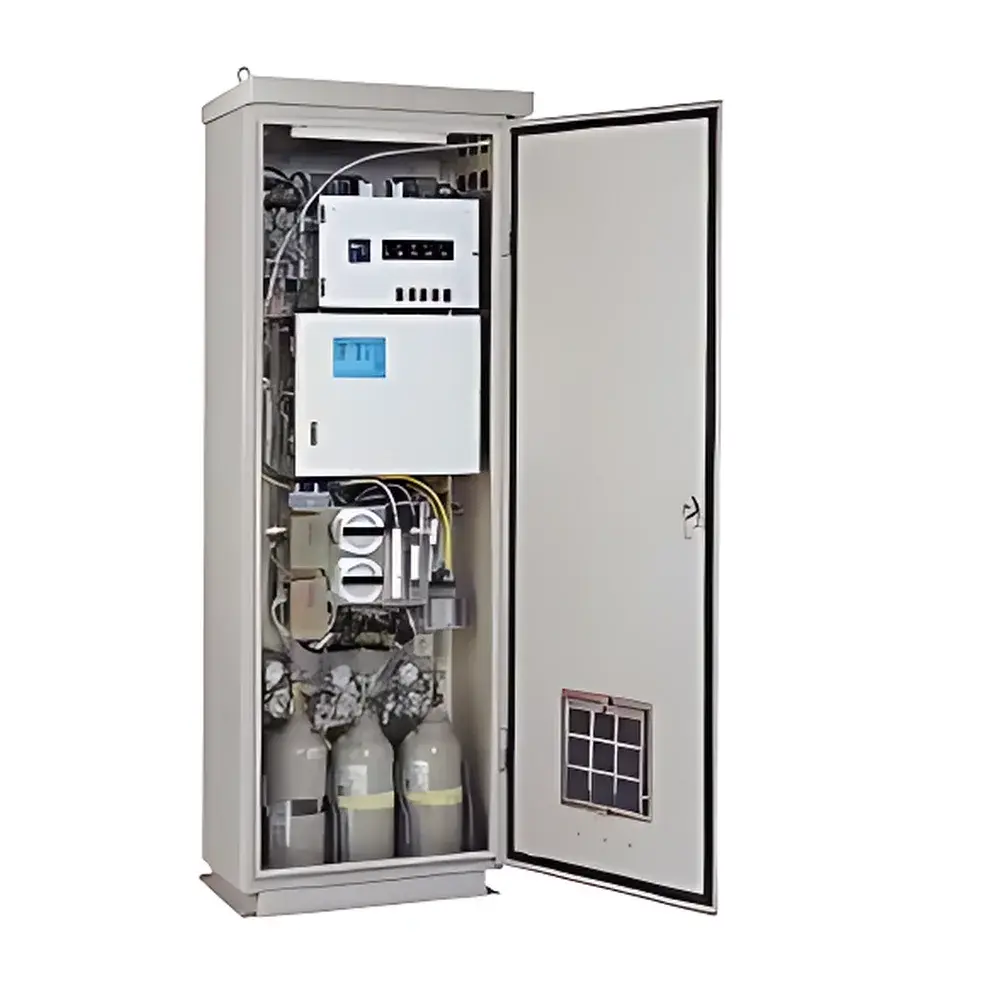
HORIBA ENDA-600ZG Series Online Flue Gas Continuous Emission Monitoring System (CEMS)
| Brand | HORIBA |
|---|---|
| Origin | Japan |
| Model | ENDA-600ZG Series |
| Instrument Type | In-situ / Extractive Online CEMS |
| Measured Gases | NOx, SO₂, CO, CO₂, O₂ (simultaneous 5-component analysis) |
| Minimum Range | 50 ppm |
| Repeatability | ±5% F.S. |
| Response Time (T₉₀ for SO₂) | 60–240 s |
| Zero Drift | ±1% F.S. |
| Span Drift | ±2.0% F.S./week |
| Linearity Error | ±1.0% F.S. |
Overview
The HORIBA ENDA-600ZG Series is a compact, high-integrity online flue gas continuous emission monitoring system (CEMS) engineered for regulatory compliance and long-term operational stability in demanding industrial environments. Designed to meet stringent global air quality standards—including EU Directive 2010/75/EU (IED), US EPA Methods 6C, 7E, 10, and ISO 12039—the ENDA-600ZG employs dual-principle detection: alternating-flow modulation non-dispersive infrared (NDIR) spectroscopy for NOx, SO₂, CO, and CO₂; and magnetic pressure (paramagnetic) detection for O₂. This hybrid architecture eliminates optical alignment requirements, suppresses zero and span drift, and ensures measurement integrity without carrier gas dependency for oxygen analysis. The system achieves true multi-component quantification within a single analyzer unit—reducing footprint, cross-calibration complexity, and maintenance overhead—while maintaining traceable accuracy across fluctuating stack conditions typical of waste incineration, power generation, and metallurgical processes.
Key Features
- Single-Unit 5-Component Simultaneous Analysis: Measures NOx (as NO₂), SO₂, CO, CO₂, and O₂ concurrently using integrated NDIR and paramagnetic detection—no external analyzers or gas switching manifolds required.
- Zero-Drift Suppression Architecture: Alternating-flow modulation cycles sample and reference gas through the same optical path at 1 Hz frequency, enabling real-time baseline stabilization and eliminating mechanical or thermal zero drift.
- Self-Cleaning Optical Path: Continuous alternation between sample and reference gas flushes the detection cell, preventing particulate accumulation and minimizing span drift over extended operation.
- Interference Compensation Technology: HORIBA-exclusive interference filter wheels and H₂O/CO₂ cross-sensitivity correction algorithms mitigate spectral overlap effects—particularly critical for accurate NOx measurement in high-moisture, high-CO₂ flue streams.
- Compact Modular Design: Overall analyzer volume reduced by 50% vs. predecessor models; wall-mountable auto-blowback controller (350 × 550 × 180 mm) occupies 23% less space; all service access points located on front panel.
- Dry Calibration Protocol: SO₂ calibration completed in ≤3 minutes using dry standard gas—eliminating time-consuming wet-gas conditioning and associated condensation artifacts.
Sample Compatibility & Compliance
The ENDA-600ZG accommodates highly variable flue gas matrices via application-specific sampling subsystems. For waste-to-energy plants, an integrated Cl₂ scrubber prevents halogen-induced corrosion; for coal-fired boilers, NH₃ removal modules minimize SO₂ adsorption losses during sampling. A three-stage electronic cooling system (primary + dual secondary chillers) achieves dew point suppression to −10 °C, reducing SO₂ and NO₂ dissolution in condensate to 100 mg/m³) are handled via optional automated pulse-blowback filtration with adjustable interval control. All configurations comply with QA/QC requirements under ISO/IEC 17025, support GLP/GMP audit trails, and generate data compliant with EPA 40 CFR Part 60 Appendix B performance specifications.
Software & Data Management
The embedded Linux-based operating system features a 10.1-inch capacitive touchscreen interface supporting multilingual operation (English, Japanese, Chinese, German). Real-time concentration plots, alarm history (with timestamped event logs), calibration records, and dynamic averaging (1-hour rolling mean per component) are accessible onsite. Data export supports Modbus TCP, RS-485, and analog 4–20 mA outputs (up to 12 channels). Optional CEMS-Link™ software enables remote diagnostics, firmware updates, and integration with central SCADA or environmental data management systems (EDMS). Audit logging meets FDA 21 CFR Part 11 requirements, including electronic signatures, user-level access control, and immutable record retention.
Applications
The ENDA-600ZG is deployed globally across regulated emission sources requiring Tier 1 CEMS certification. Primary applications include:
- Waste incineration facilities—handling high-chlorine, high-moisture flue gas with rapid response to transient load changes;
- Coal- and biomass-fired power plants—operating under variable O₂ and NOx profiles while meeting IED Best Available Techniques (BAT) conclusions;
- Steel reheating furnaces and sintering plants—withstanding high particulate loading and thermal cycling;
- Glass melting tanks and sulfuric acid production units—where SO₃ removal and corrosion-resistant sampling are critical;
- Cement kilns and petrochemical crackers—supporting simultaneous NOx/SO₂/CO reporting for carbon accounting and process optimization.
Over 100,000 HORIBA CEMS installations worldwide provide empirical validation of field reliability under ISO 9001-certified manufacturing and third-party type approval (TÜV, MCERTS).
FAQ
What gas components does the ENDA-600ZG measure simultaneously?
NOx (reported as NO₂), SO₂, CO, CO₂, and O₂—all measured in real time within a single analyzer housing.
Does the system require external carrier gas for O₂ measurement?
No. The magnetic pressure O₂ sensor uses ambient air as the reference medium—eliminating nitrogen supply infrastructure and associated operational costs.
How is moisture interference mitigated during SO₂ and NOx analysis?
Through a triple-stage electronic cooling system and proprietary H₂O compensation algorithms embedded in the NDIR signal processing firmware.
What is the recommended calibration frequency?
Automatic zero/span verification every 7 days is factory-default; manual calibration intervals may be adjusted per site-specific QA/QC protocols or regulatory mandates (e.g., EPA PS-11, EN 14181 QAL2).
Can the ENDA-600ZG integrate with existing plant DCS or environmental reporting platforms?
Yes—via native Modbus TCP, analog 4–20 mA outputs (configurable per component), and optional OPC UA gateway modules for seamless SCADA/EDMS interoperability.







