
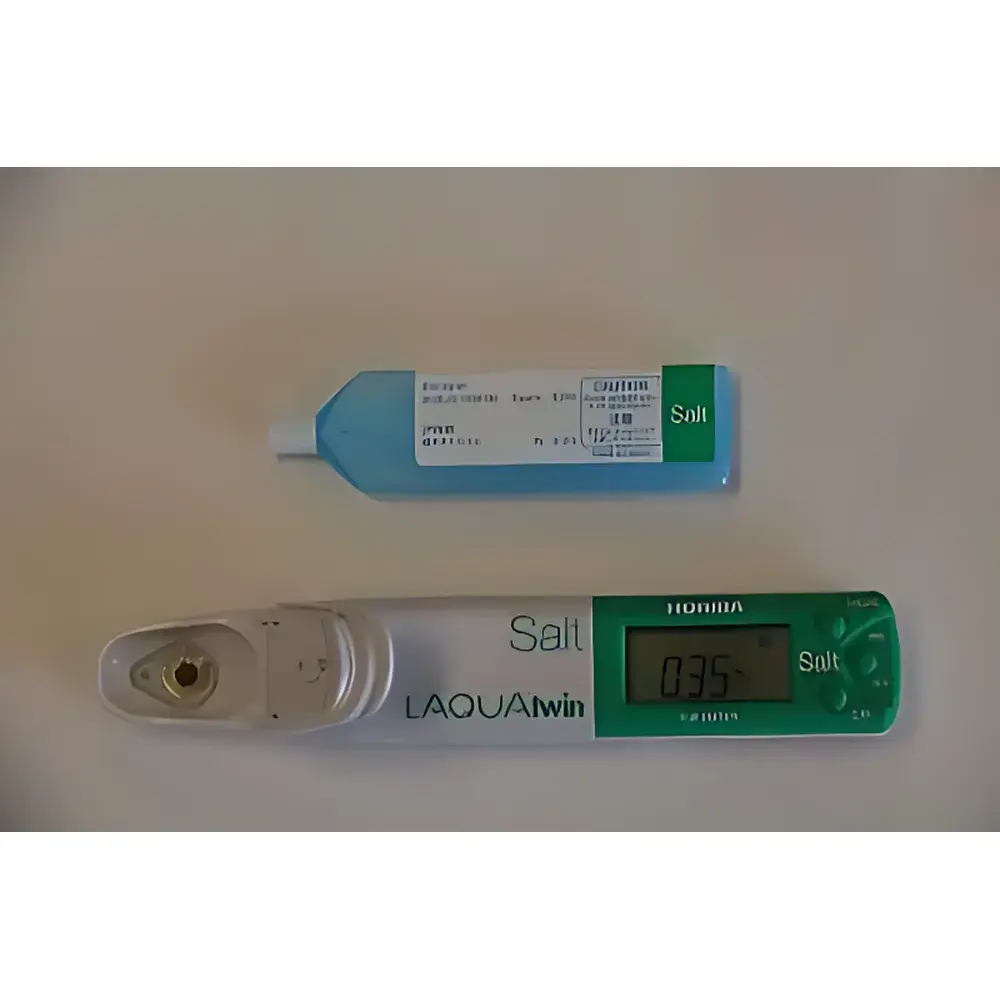
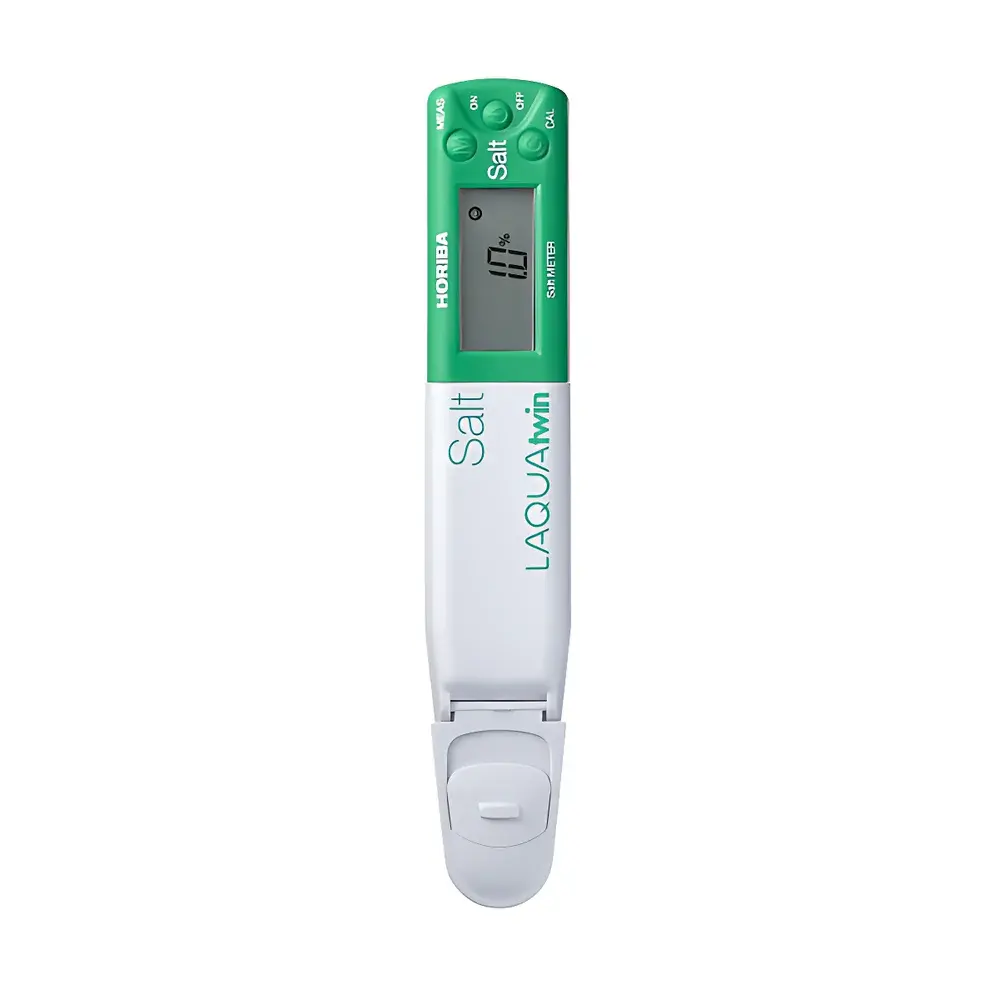
HORIBA B-721 Portable Salinity Meter (Japan-Made)
| Brand | HORIBA |
|---|---|
| Origin | Japan |
| Model | B-721 |
| Measurement Principle | Ion-Selective Electrode Method |
| Salinity Range | 0.1–10% w/w (based on specific gravity) |
| Temperature Range | 5–40 °C |
| Accuracy | ±10% of reading |
| Resolution | 0.1% |
| IP Rating | IP67 |
| Power Supply | Two CR2032 batteries |
| Dimensions | 164 × 29 × 20 mm (excl. protrusions) |
| Weight | ~50 g (instrument only) |
Overview
The HORIBA B-721 is a compact, handheld salinity meter engineered for rapid, field-deployable measurement of sodium chloride concentration in aqueous solutions using ion-selective electrode (ISE) technology. Unlike traditional conductivity-based salinometers, the B-721 employs a dedicated NaCl-selective electrode pair operating via potentiometric detection—delivering direct, chemistry-specific quantification without reliance on empirical conversion factors or temperature-dependent conductivity-to-salinity algorithms. This approach ensures improved specificity in complex matrices where interfering ions (e.g., K⁺, Ca²⁺, NO₃⁻) may compromise accuracy in generic EC/TDS instruments. Designed for routine quality control in food processing, aquaculture, hydroponics, and environmental monitoring, the B-721 delivers reliable single-parameter salt analysis with minimal sample volume (as low as 0.05 mL per measurement) and no requirement for external calibration solutions beyond standard NaCl reference standards.
Key Features
- Ion-selective electrode architecture optimized for NaCl detection—minimizes cross-sensitivity to common cations and anions
- True portable form factor: 164 mm length, 50 g mass, IP67-rated enclosure for dust immersion and water jet resistance
- Auto-hold function freezes stable readings for documentation; temperature compensation applied per ISE Nernstian response (2%/°C fixed coefficient)
- Two-point calibration protocol compliant with ISO 8655-5 and ASTM D1125 guidelines for electrochemical sensor validation
- Low-power operation using two standard CR2032 coin cells—typical battery life exceeds 5,000 measurements under normal use
- Operating ambient range: 5–40 °C at ≤85% RH (non-condensing), suitable for laboratory, greenhouse, and outdoor deployment
Sample Compatibility & Compliance
The B-721 is validated for use with aqueous samples having total dissolved solids (TDS) below 20,000 ppm and ionic strength < 0.5 mol/L. It performs reliably across seawater dilutions, brine solutions, processed food extracts (e.g., soy sauce, pickling brines), and recirculating aquaculture system (RAS) effluents. While not certified for pharmaceutical-grade compliance, its measurement traceability aligns with GLP principles when used with NIST-traceable NaCl reference materials (e.g., 1.00% and 5.00% w/w standards). The instrument meets IEC 61010-1 safety requirements for portable electrical equipment and conforms to RoHS 3 and REACH substance restrictions.
Software & Data Management
The B-721 operates as a standalone, microprocessor-controlled meter with no embedded data logging or Bluetooth connectivity. All measurements are displayed in real time on a high-contrast LCD with backlight. For regulated environments requiring audit trails, users may manually record values alongside timestamp, operator ID, and calibration verification status per internal SOPs. When integrated into quality management systems (QMS), the device supports 21 CFR Part 11-compliant workflows through external documentation platforms—provided calibration logs, maintenance records, and measurement entries are maintained separately in validated electronic lab notebooks (ELN) or LIMS interfaces.
Applications
- Food & beverage QC: Rapid verification of salting levels in cured meats, fermented products, and condiments
- Aquaculture: On-site monitoring of salinity in hatchery tanks, marine nurseries, and shrimp ponds
- Agriculture: Assessment of irrigation water salinity and nutrient solution balance in soilless cultivation
- Environmental fieldwork: Screening of estuarine mixing zones, coastal groundwater intrusion, and desalination plant effluent
- Educational labs: Hands-on instruction in ion-selective sensing principles, Nernst equation application, and electrochemical metrology
FAQ
What calibration standards are required for the B-721?
Standard NaCl solutions at two concentrations—typically 1.0% and 5.0% (w/w)—are recommended for two-point calibration. Use only certified reference materials traceable to national metrology institutes.
Can the B-721 measure seawater directly?
Yes, but for optimal accuracy in full-strength seawater (~3.5% NaCl), ensure electrode hydration prior to immersion and perform calibration within the 0.1–10% range using appropriate standards.
Is temperature compensation automatic?
Yes—the built-in thermistor enables real-time temperature correction based on the fixed 2%/°C coefficient specified in the electrode’s Nernst response profile.
How often should the electrode be cleaned or serviced?
Rinse with deionized water after each use; store immersed in 1.0% NaCl solution. Replace the electrode module every 12–18 months under regular use, or sooner if drift exceeds ±15% of reading during calibration verification.
Does the B-721 comply with ISO/IEC 17025 requirements?
The instrument itself is not accredited, but its measurement process—including calibration, uncertainty estimation, and environmental controls—can be incorporated into an ISO/IEC 17025-compliant testing procedure when operated within a validated laboratory framework.
Related Products





