
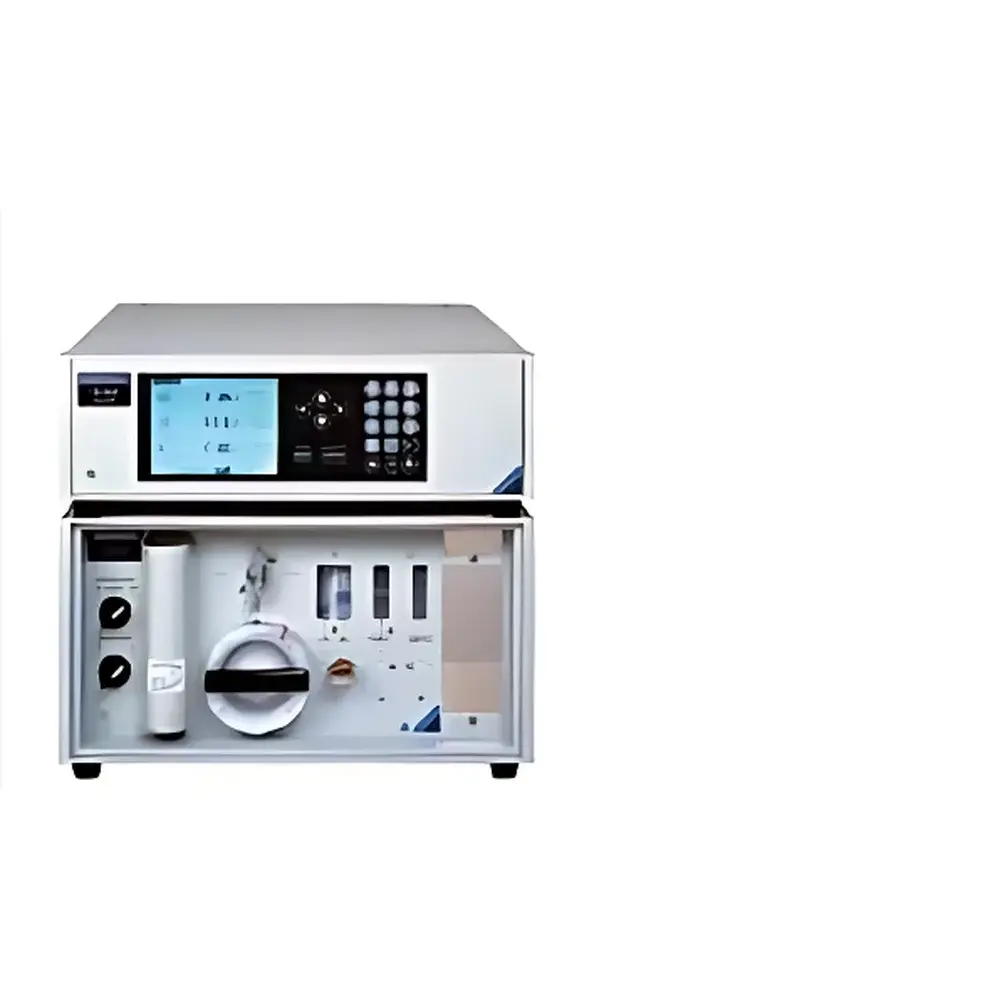
HORIBA VA-3000/VS-3000 Series NDIR-Based Multi-Component In-Situ Gas Analyzer
| Brand | HORIBA |
|---|---|
| Origin | Japan |
| Model | VA-3000 / VS-3000 |
| Instrument Type | Online Fixed Gas Analyzer |
| Detection Principle | Non-Dispersive Infrared (NDIR), Chemiluminescence (CLA), Magnetic Pressure (MPA), Electrochemical (Galvanic), Zirconia |
| Measured Gases | CO, CO₂, CH₄, NOₓ, SO₂, N₂O, O₂, C₂H₄ (optional) |
| Minimum Detectable Range | 1–5 ppm (CH₄) |
| Repeatability | ±0.5% of Full Scale |
| Resolution | 0.01 ppm |
| Response Time | T₉₀ ≤ 30 s |
| Zero Drift | ±2.0% of Full Scale per Week |
| Warm-up Time | ~20 min (NDIR/MPA/ZrO₂), ~60 min (CLA/Galvanic) |
| Analog Outputs | DC 0–1 V or 4–20 mA (isolated optional) |
| Digital Interface | RS-232C |
| Sample Flow Rate | 0.5 L/min |
| Operating Temperature | 0–40 °C |
| Relative Humidity | ≤90% RH (non-condensing) |
| Power Supply | AC 100–120 V or 200–240 V, 50/60 Hz |
| Power Consumption | ~200 VA (VA-3000), ~250–450 VA (VS-3001–VS-3004) |
| Enclosure | 19-inch rack-mount (430 × 132 × 550 mm, ~20 kg) |
Overview
The HORIBA VA-3000/VS-3000 Series is a modular, multi-technology online gas analyzer engineered for high-precision, continuous measurement of trace and major gaseous components in industrial, environmental, and research applications. At its core, the system integrates multiple detection principles—including Non-Dispersive Infrared (NDIR) for CO, CO₂, CH₄, N₂O, and SO₂; Chemiluminescence (CLA) for NOₓ; Magnetic Pressure (MPA) for O₂; and electrochemical (galvanic or zirconia-based) sensors—within a single compact 19-inch rack-mount chassis. This architecture eliminates the need for separate analyzers per gas species, reducing footprint, calibration complexity, and total cost of ownership. The VA-3000 analyzer unit supports up to three interchangeable sensor modules simultaneously, enabling flexible configuration for site-specific requirements—from low-concentration ambient air monitoring (e.g., 1–100 ppm CH₄) to high-volume stack emission compliance (e.g., 0–100 vol% CO₂). All measurements adhere to fundamental spectroscopic and electrochemical principles, with optical path lengths and detector geometries optimized for signal stability and minimal cross-sensitivity under real-world sample conditions.
Key Features
- Modular sensor architecture: Up to three independent detection modules (NDIR, CLA, MPA, galvanic, or zirconia) can be installed in one VA-3000 chassis, supporting concurrent multi-gas analysis without external multiplexing.
- Wide dynamic range capability: Standard configurations offer up to 10:1 full-scale ratio per module; optional extended-range NDIR modules provide up to 20:1 (subject to optical cell length constraints), while CLA modules support up to 100:1 via 8-step programmable range selection.
- High metrological performance: Repeatability of ±0.5% FS, linearity of ±1.0% FS (≤10× range), and zero drift limited to ±2.0% FS/week (NDIR/MPA/zirconia) or ±1.0% FS/day (galvanic O₂) ensure long-term data integrity for regulatory reporting.
- Rapid response and stable operation: T₉₀ ≤ 30 seconds across all NDIR channels; warm-up time as low as 20 minutes for NDIR and MPA modules enables fast deployment in transient process environments.
- Robust sample conditioning interface: Compatible with HORIBA’s VS-3000 series sampling systems (VS-3001 to VS-3004), which deliver dry, particle-free, temperature-stabilized sample streams at 0.5 L/min using PTFE, PVDF, and SUS-wetted materials compliant with ISO 8573-1 Class 2 particulate and Class 3 moisture specifications.
- Regulatory-ready connectivity: Standard RS-232C serial interface and analog outputs (0–1 V or 4–20 mA) facilitate integration into DCS, SCADA, and EPA-compliant data acquisition systems; optional isolated outputs support hazardous area installations.
Sample Compatibility & Compliance
The VA-3000/VS-3000 system is designed for continuous operation in demanding industrial environments, including combustion exhaust stacks, biogas upgrading facilities, semiconductor cleanrooms, and municipal air quality monitoring networks. Sample gas must meet defined physical and chemical limits: temperature within ambient range (0–40 °C), dew point ≤5 °C (for NDIR), particulate loading 50 ppm SO₃, >6 ppm NO₂), flammable, or explosive constituents. For zirconia O₂ measurement, coexistence of H₂O and O₂ is required to prevent sensor degradation when reducing gases (CO, H₂, THC) are present—conditions governed by the stoichiometric inequality (THC + CO + H₂) < (H₂O + O₂). The system complies with key international standards for emissions monitoring, including EN 15267-3 (QAL1 certification framework), ISO 12039 (CO/CO₂ in flue gas), ISO 7935 (CH₄), and ASTM D6522 (NOₓ). Its hardware design and firmware architecture support audit-trail-enabled operation aligned with GLP and 21 CFR Part 11 data integrity requirements when paired with validated HORIBA data management software.
Software & Data Management
The VA-3000 operates with HORIBA’s proprietary PC-based configuration and data logging software, delivered with standard RS-232C communication. The software enables full remote control of measurement parameters—including range selection, zero/span calibration scheduling, alarm thresholds, and module diagnostics—as well as real-time waveform visualization and trend logging. All calibration events, sensor status changes, and configuration modifications are timestamped and stored locally with user attribution, satisfying basic ALCOA+ (Attributable, Legible, Contemporaneous, Original, Accurate) data governance criteria. Export functions support CSV and Excel-compatible formats for integration with LIMS, ERP, or third-party analytics platforms. While the base system does not include built-in 21 CFR Part 11 electronic signature functionality, it is compatible with validated middleware solutions used in pharmaceutical and regulated environmental laboratories to achieve full compliance.
Applications
- Continuous Emissions Monitoring Systems (CEMS): Simultaneous quantification of CO, CO₂, NOₓ, SO₂, and O₂ in thermal power plant, cement kiln, and waste incineration exhaust streams per EPA Method 10, 10A, and EN 14181 QA/QC protocols.
- Biogas and landfill gas analysis: Real-time tracking of CH₄ (1–100 vol%), CO₂ (0–100 vol%), H₂S (via optional CLA or electrochemical module), and O₂ for upgrading control and safety interlock logic.
- Industrial hygiene and ambient air quality: Low-level detection of CO (0–200 ppm), N₂O (0–5000 ppm), and ethylene (C₂H₄) in semiconductor fabrication, pharmaceutical manufacturing, and urban background stations.
- Research and development: Flexible multi-gas profiling in catalytic reaction studies, fuel combustion optimization, and carbon capture verification where cross-sensitivity and long-term baseline stability are critical.
- Process safety monitoring: Dual-range O₂ measurement (0–5 vol% for inerting control; 0–25 vol% for ventilation verification) using redundant MPA and zirconia modules for SIL2-capable redundancy schemes.
FAQ
What detection technologies are supported in the VA-3000 platform?
The VA-3000 accommodates NDIR (for CO, CO₂, CH₄, SO₂, N₂O), CLA (for NOₓ), MPA (for O₂), galvanic electrochemical (for O₂), and zirconia-based electrochemical (for O₂) modules—each operating independently within the same chassis.
Can the system measure NH₃ or H₂S?
NH₃ and H₂S are not supported by standard VA-3000 modules. Custom sensor development or third-party integration may be explored upon technical consultation with HORIBA Application Engineering.
How is zero and span calibration performed?
Calibration is executed manually or scheduled automatically via the RS-232C interface using certified reference gases. Each module accepts dedicated zero (N₂ or synthetic air) and span (gas mixture at known concentration) inputs through the VS-3000’s RC1/8 calibration port.
Is the system suitable for explosive atmospheres?
The VA-3000/VS-3000 is rated for general-purpose indoor use (IP20). For Zone 1/2 hazardous locations, external explosion-proof enclosures or purge systems compliant with IEC 60079-13 must be implemented—HORIBA does not supply ATEX- or IECEx-certified variants of this series.
What maintenance intervals are recommended?
Optical windows and sample filters require cleaning every 3–6 months depending on particulate load; NDIR light sources have a typical lifetime of >5 years; electrochemical sensors require replacement every 12–24 months per manufacturer datasheets. Preventive maintenance schedules align with ISO/IEC 17025 competency requirements for accredited labs.







