
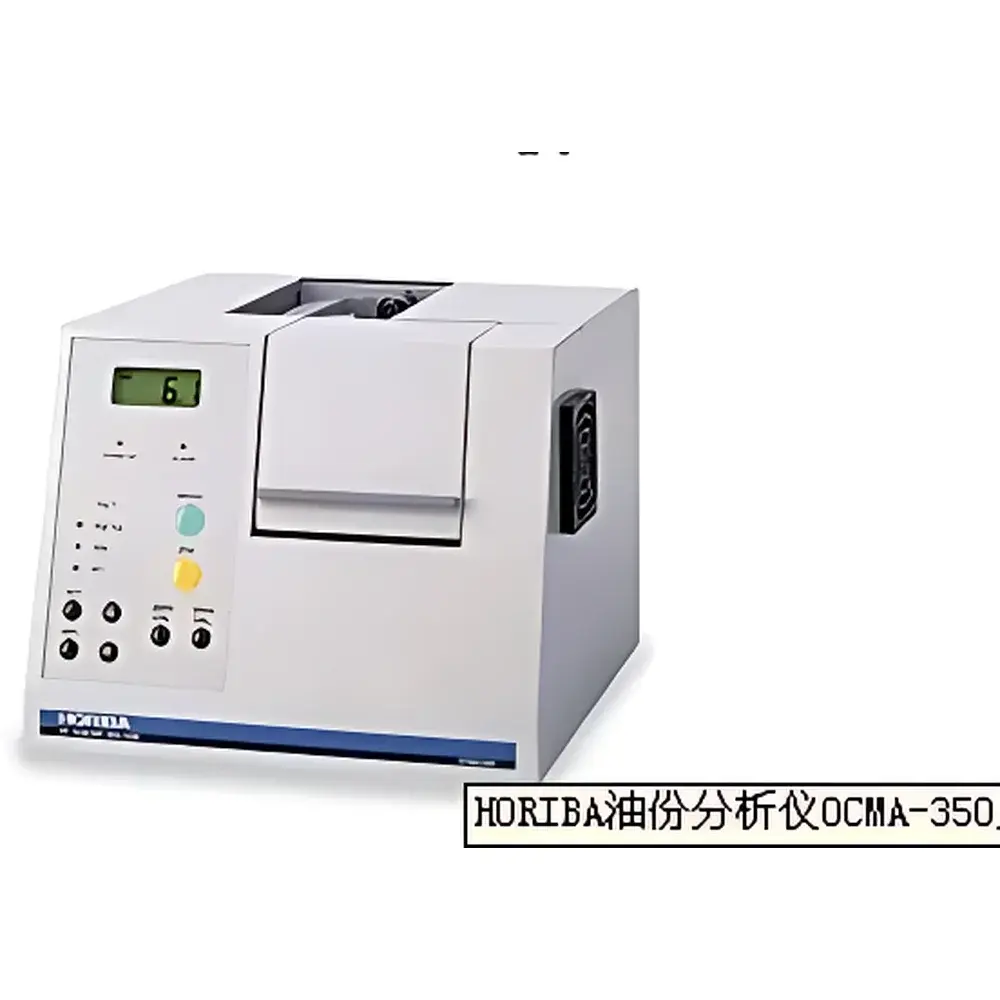
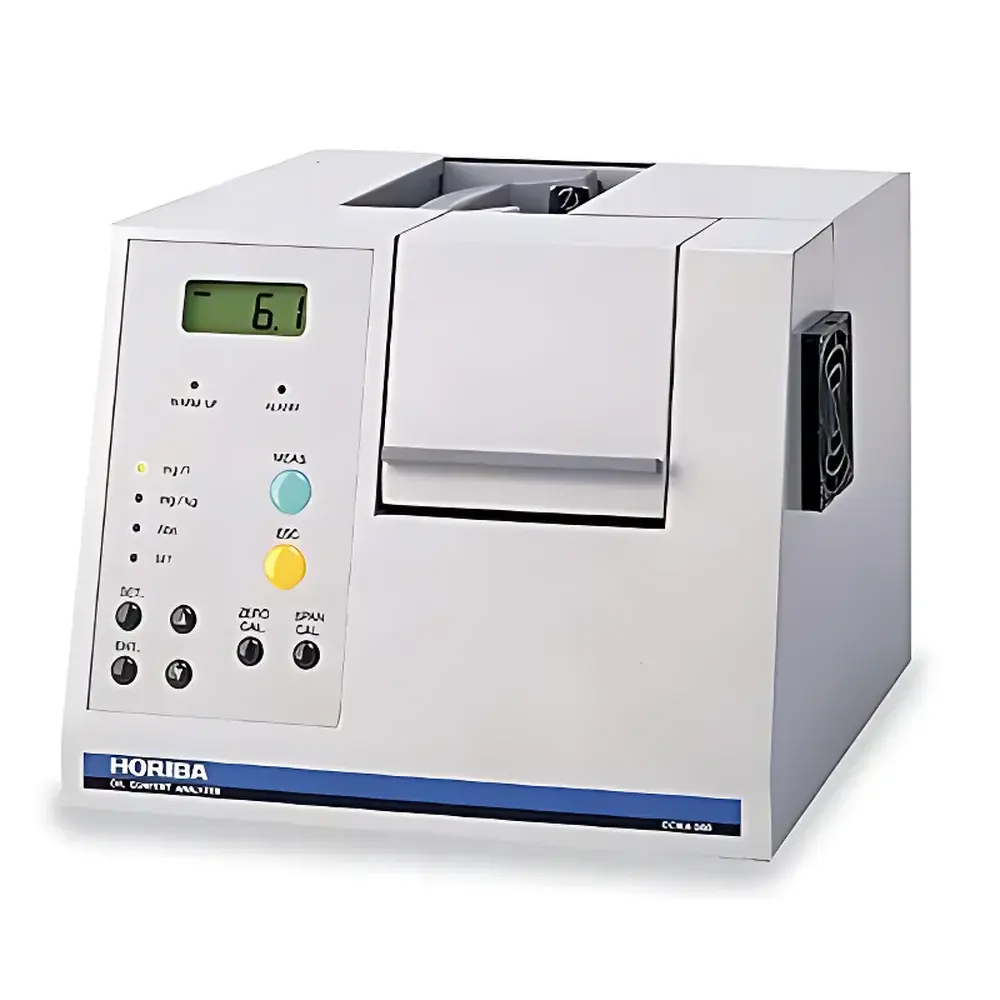
HORIBA OCMA-350/355 Oil Content Analyzer
| Brand | HORIBA |
|---|---|
| Origin | Japan |
| Model | OCMA-350/355 |
| Detection Method | Non-Dispersive Infrared (NDIR) Absorption |
| Extractant | S-316 (OCMA-350) / H-997 (OCMA-355) |
| Measurement Range | 0–200 mg/L, 0–1000 mg/kg, 0–1 Abs |
| Repeatability | ±0.4 mg/L (0–9.9 mg/L), ±2.0 mg/L (10.0–99.9 mg/L), ±4 mg/L (100–200 mg/L), ±1% F.S. (0–1 Abs) |
| Sensitivity | 1% of full-scale lower limit |
| Optical Path | Quartz Cuvette (200 mm path length) |
| Detector | Thermoelectric sensor |
| Display | Backlit LCD with timestamping |
| Interface | RS-232C serial port & parallel printer port |
| Power Supply | 230 V AC, 50 Hz |
| Dimensions | 250 × 200 × 285 mm (W × H × D) |
| Weight | Approx. 8.5 kg |
Overview
The HORIBA OCMA-350 and OCMA-355 are benchtop non-dispersive infrared (NDIR) oil content analyzers engineered for precise, trace-level quantification of hydrocarbon contaminants in aqueous, solid, and surface-bound matrices. Designed for compliance-critical environments—including wastewater treatment plants, industrial effluent monitoring stations, semiconductor cleanroom validation labs, and hazardous waste characterization facilities—the instruments operate on the principle of selective infrared absorption at ~3.4 µm, corresponding to the C–H stretching vibration band characteristic of aliphatic and aromatic hydrocarbons. Unlike broad-spectrum UV-Vis methods, NDIR eliminates interference from suspended solids (SS), turbidity, and colored organics by leveraging solvent-specific spectral transparency: S-316 (for OCMA-350) and H-997 (for OCMA-355) exhibit negligible absorbance at the target wavelength, enabling exclusive detection of extracted oil components. This methodology conforms to foundational principles outlined in ASTM D7066-04 (Standard Test Method for Determination of Oil and Grease in Water by Infrared Spectrophotometry) and supports alignment with ISO 9377-2:2000 (Water quality — Determination of hydrocarbon oil index — Part 2: Infrared spectrometric method).
Key Features
- Triple-unit measurement capability: switch seamlessly between concentration units—mg/L (for water extracts), mg/kg (for soil/sediment digests), and absorbance (Abs) for method development or calibration verification.
- High-stability thermoelectric detector with temperature-compensated signal processing ensures long-term baseline integrity and minimizes drift during extended operation.
- Integrated timestamping functionality logs each measurement with date/time metadata, supporting audit-ready recordkeeping under GLP and GMP frameworks.
- Backlit monochrome LCD display with intuitive menu navigation enables rapid setup and real-time result visualization without external computing hardware.
- Dual communication interfaces: RS-232C serial port for bidirectional data exchange with LIMS or SCADA systems; parallel printer port for hard-copy documentation compliant with 21 CFR Part 11 electronic record requirements (when paired with validated print drivers).
- Optimized optical path using a 200 mm quartz cuvette maximizes sensitivity for low-concentration samples while maintaining robustness against solvent-induced etching or thermal stress.
Sample Compatibility & Compliance
The OCMA-350/355 is validated for use with solvent-extracted samples prepared per standardized protocols. It accommodates liquid-phase extracts from water (via liquid–liquid extraction), solid-phase extracts from soils or sludges (using Soxhlet or ultrasonic-assisted extraction), and swab-based surface residues from machined parts or cleanroom surfaces. The system meets functional equivalence requirements for EPA Method 1664A (n-Hexane Extractable Material, HEM) when used with S-316 as an alternative extractant, provided method validation is performed per laboratory SOPs. Instrument design adheres to IEC 61010-1 safety standards for electrical equipment used in laboratory environments. CE marking confirms conformity with EU Electromagnetic Compatibility (EMC) Directive 2014/30/EU and Low Voltage Directive 2014/35/EU.
Software & Data Management
While the OCMA-350/355 operates as a standalone instrument with embedded firmware, its RS-232C interface enables integration with third-party data acquisition software (e.g., LabVIEW, MATLAB, or custom Python scripts) for automated reporting, statistical process control (SPC), and trend analysis. All transmitted data packets include ASCII-formatted headers containing instrument ID, measurement unit, timestamp, and raw absorbance values. When connected to a validated PC-based system, the analyzer supports full 21 CFR Part 11 compliance—including electronic signatures, audit trails, and user-access controls—provided the host software implements required security features. No proprietary HORIBA software is bundled; users retain full control over data ownership and archival policies.
Applications
- Industrial wastewater compliance monitoring: real-time verification of oil removal efficiency in API separators, dissolved air flotation (DAF) units, and activated carbon polishing stages.
- Hazardous waste site assessment: quantification of total petroleum hydrocarbons (TPH) in groundwater and soil cores prior to remediation and post-treatment verification.
- Semiconductor manufacturing: validation of rinse efficacy in wafer cleaning processes, where sub-ppm residual hydrocarbon contamination can induce dielectric failure.
- Metalworking fluid management: periodic testing of coolant sumps for tramp oil ingress, supporting predictive maintenance of filtration systems.
- Textile finishing QA: measurement of lubricant carryover on synthetic fibers following heat-setting operations.
- Regulatory reporting: generation of defensible analytical records for discharge permits governed by local environmental agencies (e.g., UK EA, German LAWA, or US state DEPs).
FAQ
What extractants are compatible with the OCMA-350 and OCMA-355?
The OCMA-350 is optimized for S-316 (1,1,2-trichloro-1,2,2-trifluoroethane), while the OCMA-355 uses H-997 (a proprietary chlorinated fluorocarbon blend). Both solvents are selected for minimal IR absorbance at 3.4 µm and high hydrocarbon solubility.
Can the instrument measure emulsified oil directly?
No. Emulsified or colloidal oil must first be separated via acidification, centrifugation, or coalescence prior to solvent extraction. The analyzer measures only solvent-dissolved hydrocarbons.
Is calibration traceable to NIST standards?
Yes—calibration is performed using certified reference materials (CRMs) traceable to NIST SRM 2781 (Diesel Fuel Oil) or equivalent, with certificate of analysis provided upon request.
What maintenance is required beyond routine cleaning?
Annual verification of detector responsivity and optical alignment is recommended. Quartz cuvettes require periodic inspection for scratches or solvent residue; replacement is advised every 12–18 months under continuous use.
Does HORIBA offer IQ/OQ/PQ documentation support?
Yes—HORIBA provides optional qualification packages including Installation Qualification (IQ), Operational Qualification (OQ), and Performance Qualification (PQ) protocols aligned with ISO/IEC 17025 and pharmaceutical GMP expectations.







