
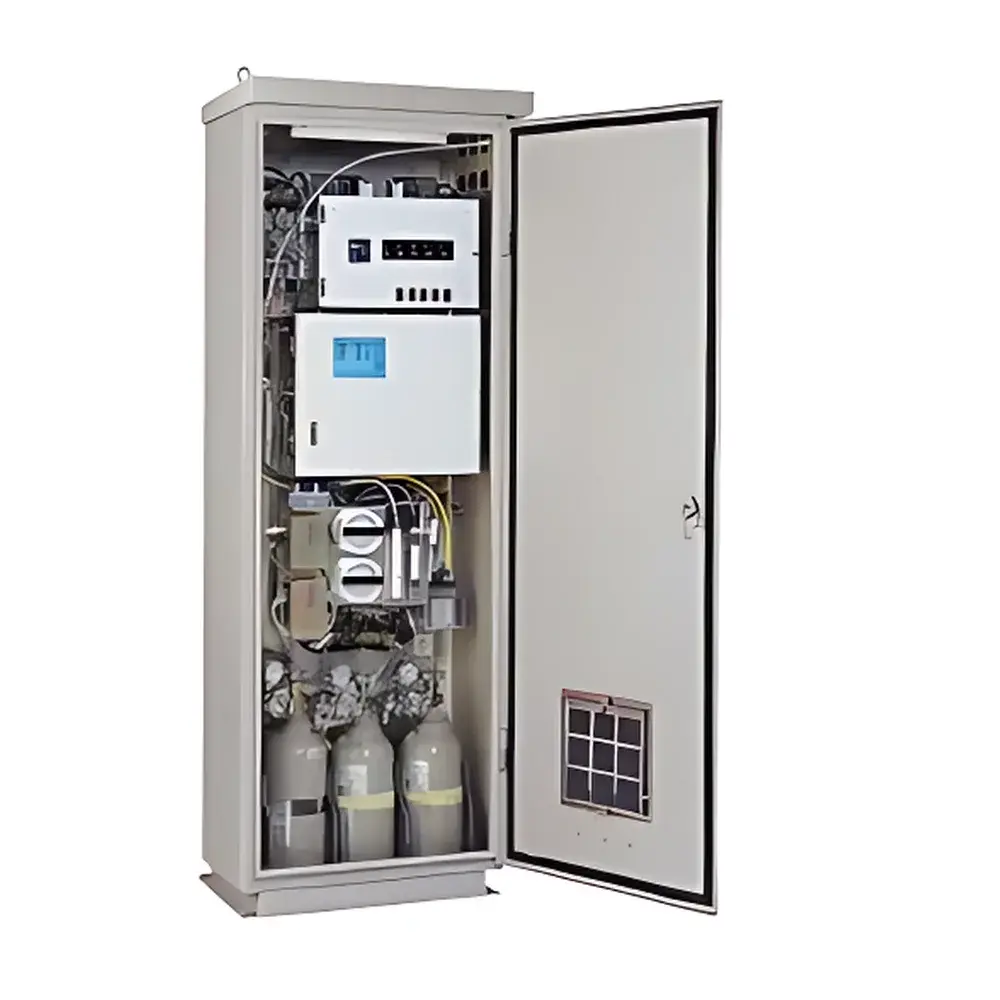
HORIBA ENDA-640ZG Online Flue Gas Analyzer
| Brand | HORIBA |
|---|---|
| Origin | Japan |
| Model | ENDA-640ZG |
| Instrument Type | Continuous Emission Monitoring System (CEMS) |
| Accuracy | ±1.0% F.S. |
| Repeatability | ±0.5% F.S. |
| Response Time (SO₂) | 60–240 s |
| Stability | ±2.0% F.S./week |
Overview
The HORIBA ENDA-640ZG is a compact, high-reliability continuous emission monitoring system (CEMS) engineered for real-time, simultaneous measurement of up to five critical flue gas components: NOx, SO2, CO, CO2, and O2. Designed for compliance-driven industrial environments—including power plants, waste incinerators, steel mills, glass furnaces, and sulfuric acid production facilities—the system employs dual physical detection principles: alternating-flow non-dispersive infrared (NDIR) spectroscopy for NOx, SO2, CO, and CO2, and paramagnetic oxygen sensing (magnetopneumatic pressure detection) for O2. Unlike conventional dual-beam NDIR systems requiring optical alignment and periodic recalibration, the ENDA-640ZG’s alternating-flow architecture alternates sample and reference gas streams into a single detection cell at 1 Hz frequency—eliminating zero drift, minimizing optical contamination effects, and ensuring long-term baseline stability without manual optical adjustment. This architecture meets the fundamental metrological requirements of ISO 14956, EN 15267, and EPA Performance Specification 3 (PS-3) for CEMS verification.
Key Features
- Single-analyzer, five-component simultaneous monitoring—NOx, SO2, CO, CO2, O2—reducing footprint, integration complexity, and cross-calibration uncertainty.
- Alternating-flow NDIR detection with integrated interference compensation: proprietary bandpass interference filters mitigate spectral overlap from H2O, CO2, and other matrix gases—critical for accuracy in high-moisture or variable-composition flue streams.
- Magnetopneumatic O2 sensor: eliminates need for external carrier gas (e.g., N2); uses ambient air as reference medium—reducing consumables, installation space, and operational cost.
- Front-access modular design: 100% maintenance—including filter replacement, calibration gas connection, and sensor inspection—performed from the instrument front panel; no rear access required.
- Compact footprint: 50% smaller volume vs. prior-generation ENDA platforms; auto-blowback controller reduced to 77% of predecessor dimensions (350 W × 550 H × 180 D mm), enabling wall-mounting in constrained spaces.
- Fast SO2 calibration: dry-gas calibration completed in ≤3 minutes—versus 15 minutes for legacy wet-calibration protocols—minimizing downtime during QA/QC procedures.
- Integrated CO2 compensation channel in NOx measurement path to correct for CO2-induced quenching effects per ISO 12039.
Sample Compatibility & Compliance
The ENDA-640ZG integrates with application-specific sampling systems validated for diverse thermal processes. For waste-to-energy plants, optional Cl2 scrubbers and triple-stage thermoelectric coolers (primary + dual secondary) suppress SO2/NO2 loss due to aqueous dissolution. In coal-fired boiler applications, NH3 removal modules prevent sulfite formation during SO2 analysis. High-dust environments utilize an intelligent auto-blowback controller synchronized with particulate loading thresholds—preventing filter clogging while preserving measurement continuity. All sampling configurations comply with EN 14181 (QAL1–QAL3) and support GLP/GMP audit trails. The analyzer itself is certified to CE marking standards, conforms to IEC 61000-6-2/6-4 EMC requirements, and supports 21 CFR Part 11–compliant data integrity when paired with HORIBA’s optional secure logging software.
Software & Data Management
The ENDA-640ZG features a 10.4-inch resistive touchscreen interface with intuitive navigation, supporting multilingual UI (English, Japanese, Chinese, German). Real-time concentration trends for all five gases are displayed simultaneously with configurable time axes (1-min to 24-h). Calibration history, alarm logs, and diagnostic events—including sensor health status, flow stability alerts, and optical path contamination warnings—are stored locally for ≥1 year and exportable via USB or Ethernet (Modbus TCP, OPC UA). Up to 12 analog outputs (4–20 mA) are configurable for instantaneous values, O2-corrected concentrations (per EN 14181 Annex B), or dynamic 1-hour rolling averages. Remote firmware updates and configuration backups are supported via HTTPS-secured web interface, facilitating centralized fleet management across multi-site CEMS deployments.
Applications
The ENDA-640ZG is deployed globally in regulatory-compliant emission monitoring across:
- Thermal power generation: continuous NOx/SO2 tracking under EU IED and U.S. MATS requirements.
- Municipal solid waste incineration: Cl2-resistant sampling + rapid SO2 response for compliance with EU Directive 2000/76/EC.
- Iron and steel production: high-temperature, high-dust sampling compatibility with robust particulate filtration and auto-blowback.
- Glass manufacturing: low-drift CO/CO2 ratio monitoring for combustion efficiency optimization.
- Sulfuric acid plants: corrosion-resistant sampling train with SO3 mist removal to protect optical surfaces.
Its modular architecture allows seamless integration into existing DCS/SCADA networks and satisfies reporting requirements under national CEMS regulations including China’s HJ 75–2017 and HJ 76–2017.
FAQ
What detection principles does the ENDA-640ZG use for each gas?
NOx, SO2, CO, and CO2 are measured via alternating-flow NDIR; O2 is measured using paramagnetic (magnetopneumatic) pressure detection.
Does the system require external carrier gas for O2 measurement?
No—ambient air serves as the reference medium, eliminating nitrogen supply infrastructure and associated maintenance.
How is interference from water vapor mitigated?
HORIBA’s proprietary interference filters and dedicated H2O compensation channels in both NOx and SO2 detection paths minimize cross-sensitivity per ISO 12039 Annex C.
What is the recommended calibration interval?
Automatic zero/span checks are programmable up to daily; full multi-point calibration is recommended every 7 days per EN 14181 QAL2 requirements.
Can the ENDA-640ZG be integrated into existing CEMS infrastructure?
Yes—it supports standard 4–20 mA, RS-485 (Modbus RTU), Ethernet (Modbus TCP, OPC UA), and optional Profibus DP interfaces for direct DCS connectivity.
Related Products







