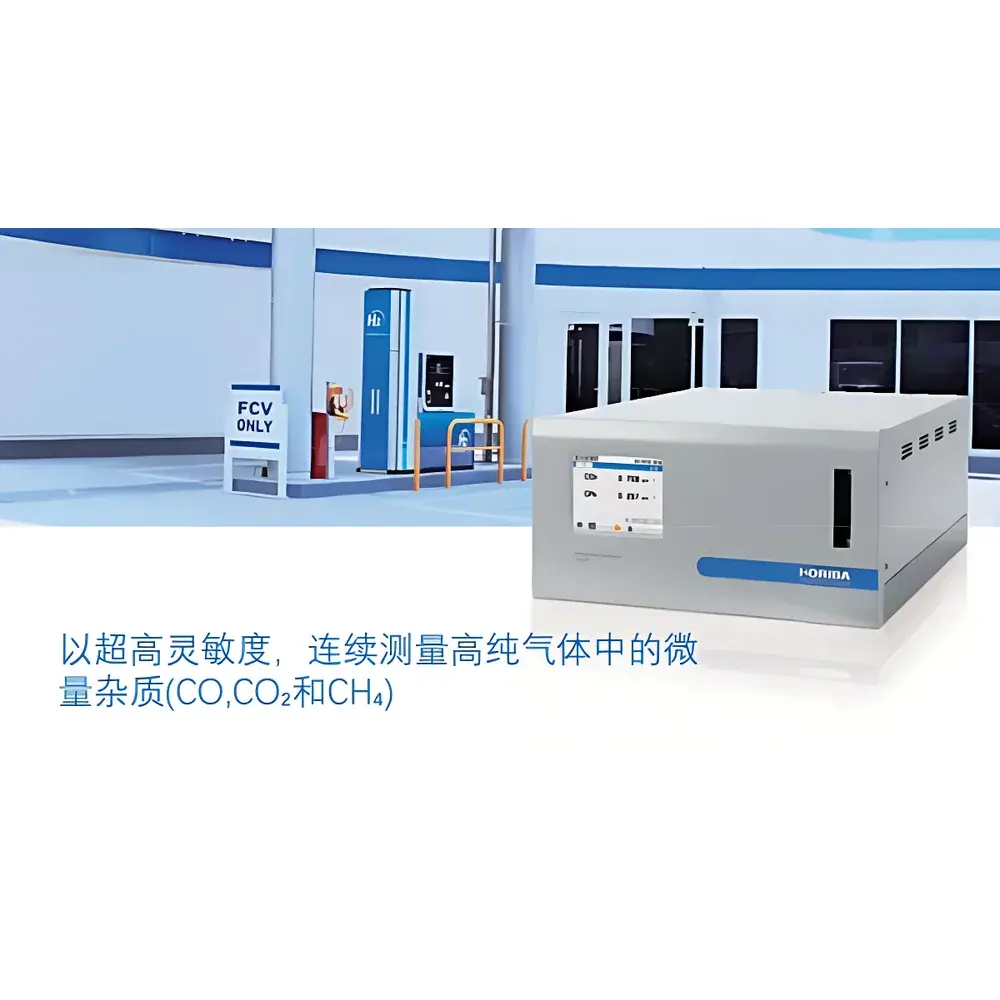
HORIBA GA-370 Trace Gas Analyzer
| Brand | HORIBA |
|---|---|
| Origin | Japan |
| Model | GA-370 |
| Measurable Gases | CO, CO₂, CH₄ |
| Background Gases | N₂, O₂, He, Ar, H₂, Air |
| Measurement Principle | Dual-beam Non-Dispersive Infrared (NDIR) with Alternating Flow Modulation |
| Detection Limit (2σ) | 10 ppb |
| Range | 0–1/2/5/10 ppm |
| Repeatability | ≤ ±2% F.S. |
| Linearity | ≤ ±2% F.S. |
| Zero Drift | ≤ ±0.02 ppm/day, ≤ ±0.03 ppm/week |
| Span Drift | ≤ ±2% F.S./day, ≤ ±3% F.S./week |
| Response Time (T90) | ≤ 180 s |
| Sample & Reference Flow Rate | ~3.5 L/min each (at 50–100 kPa) |
| Analog Outputs | Up to two isolated outputs (0–1 V, 0–10 V, 0–16 mA, 4–20 mA, or 0–20 mA) |
| Operating Temperature | 0–40 °C |
| Humidity | ≤ 85% RH (non-condensing) |
| Vibration Tolerance | ≤ 0.29 m/s² at ≤ 100 Hz |
| Dimensions (W×H×D) | 430 × 221 × 555 mm (including protrusions) |
| Weight | ~18 kg |
| Power Supply | 100–240 V AC, ±10%, max. 250 V |
Overview
The HORIBA GA-370 Trace Gas Analyzer is an industrial-grade, dual-beam non-dispersive infrared (NDIR) analyzer engineered for continuous, high-stability monitoring of trace-level impurities—specifically carbon monoxide (CO), carbon dioxide (CO₂), and methane (CH₄)—in ultra-high-purity (UHP) process gases. Designed for semiconductor manufacturing environments and air separation plants, the GA-370 addresses a critical metrological challenge: long-term zero stability in sub-ppb detection regimes. Its core innovation lies in the proprietary alternating flow modulation technique, which eliminates optical drift by dynamically switching sample and reference gas streams through a single measurement cell while maintaining identical optical path lengths and thermal conditions. Unlike conventional single-beam NDIR systems susceptible to detector aging, window fouling, or source intensity fluctuation, the GA-370’s balanced dual-beam architecture ensures signal nulling during reference cycles—effectively suppressing baseline drift without requiring periodic zero calibration or manual optical realignment. This principle enables uninterrupted operation over weeks, meeting stringent requirements for GLP-compliant gas purity certification and semiconductor fab gas delivery system (GDS) validation.
Key Features
- Zero-drift-free operation: Achieved via alternating flow modulation—no mechanical choppers or moving optical parts, eliminating zero-point instability common in trace-level IR analyzers.
- Sub-ppb sensitivity: Detection limit of 10 ppb (2σ) for CO, CO₂, and CH₄ in N₂, O₂, Ar, He, H₂, and air matrices—validated per ISO 10156 and ASTM D1946 protocols.
- Plug-and-play usability: All operational functions—including calibration, span adjustment, data logging, and alarm configuration—are accessible via intuitive touch interface on the integrated color LCD display.
- Maintenance-free optical design: No alignment tools, no consumable optical filters, and no internal purge gas required—reducing total cost of ownership and minimizing downtime in cleanroom or Class 100 environments.
- Robust environmental tolerance: Certified for continuous operation at ambient temperatures up to 40 °C and humidity ≤85% RH (non-condensing), with vibration resistance compliant with IEC 60068-2-6.
- Flexible analog interfacing: Dual isolated analog outputs support simultaneous transmission of two gas concentrations (e.g., CO and CO₂), configurable as 4–20 mA, 0–10 V, or other standard industrial signals for integration into DCS/SCADA systems.
Sample Compatibility & Compliance
The GA-370 is validated for use with high-purity carrier gases including nitrogen (N₂), oxygen (O₂), argon (Ar), helium (He), hydrogen (H₂), and synthetic air—each meeting SEMI F57-0318 purity specifications for bulk gases used in semiconductor front-end processes. It complies with key regulatory frameworks governing analytical instrumentation in regulated industries: its firmware architecture supports audit-trail-enabled operation per FDA 21 CFR Part 11 (when deployed with optional secure logging software), and its measurement uncertainty budget aligns with ISO/IEC 17025 requirements for accredited calibration laboratories. For hydrogen-rich applications (e.g., H₂ carrier gas analysis), installation must adhere to ATEX/IECEx Zone 1 guidelines—requiring external explosion-proof enclosures per EN 60079-1 and EN 60079-7. The analyzer does not incorporate intrinsic safety circuitry and must never be operated directly in hazardous atmospheres.
Software & Data Management
While the GA-370 operates autonomously via its embedded touchscreen controller, it supports optional Ethernet or RS-232 connectivity for remote monitoring and data archival. Real-time concentration values, trend graphs (up to 30-day history), diagnostic status flags (e.g., flow fault, pressure deviation, lamp intensity decay), and event logs are exportable in CSV format. When integrated into a centralized gas quality management system, the device transmits timestamped, digitally signed measurement records that satisfy ALCOA+ principles (Attributable, Legible, Contemporaneous, Original, Accurate, Complete, Consistent, Enduring, Available). Firmware updates are performed via USB stick with cryptographic signature verification to ensure integrity and traceability—critical for GMP-aligned facilities undergoing regulatory inspection.
Applications
- Continuous purity assurance of UHP nitrogen, argon, and oxygen supplied to semiconductor photolithography, CVD, and etch tools.
- In-line monitoring of feed air streams post-prepurification (e.g., after CO₂ scrubbers and desiccant dryers) in cryogenic air separation units (ASUs).
- Verification of helium and hydrogen purity in specialty gas blending stations serving MEMS fabrication and advanced packaging lines.
- Leak detection support in gas distribution networks by trending baseline CO/CH₄ spikes indicative of hydrocarbon contamination from valves, seals, or piping.
- Compliance testing against SEMI C15 (specifications for electronic grade gases) and ISO 8573-1:2010 Class 1 compressed air purity requirements.
FAQ
Does the GA-370 require daily zero calibration?
No. The alternating flow modulation design inherently cancels zero drift, enabling stable operation for ≥7 days without zero adjustment under normal conditions.
Can the GA-370 measure more than one gas simultaneously?
Yes—up to two components (e.g., CO and CO₂) can be measured concurrently, depending on background gas composition and configured measurement ranges.
Is the instrument suitable for hydrogen service?
Yes, but only when installed inside a certified explosion-proof enclosure (e.g., Type X or Type Z) due to the absence of intrinsic safety certification.
What reference and span gases are required?
User-supplied zero gas (e.g., certified 99.9999% N₂) and span gas (e.g., 5 ppm CO in N₂) must meet ISO 6142 accuracy requirements; cylinder pressure must be maintained between 50–100 kPa at the analyzer inlet.
How is measurement traceability ensured?
Each GA-370 ships with a NIST-traceable factory calibration certificate; field recalibration may be performed using certified reference materials traceable to NPL, PTB, or NMIJ standards.
What maintenance intervals are recommended?
No scheduled optical maintenance is required. Annual verification of flow controllers, pressure sensors, and detector response linearity is advised per HORIBA’s Preventive Maintenance Guide (P/N GA-370-PMG-EN).
Related Products