
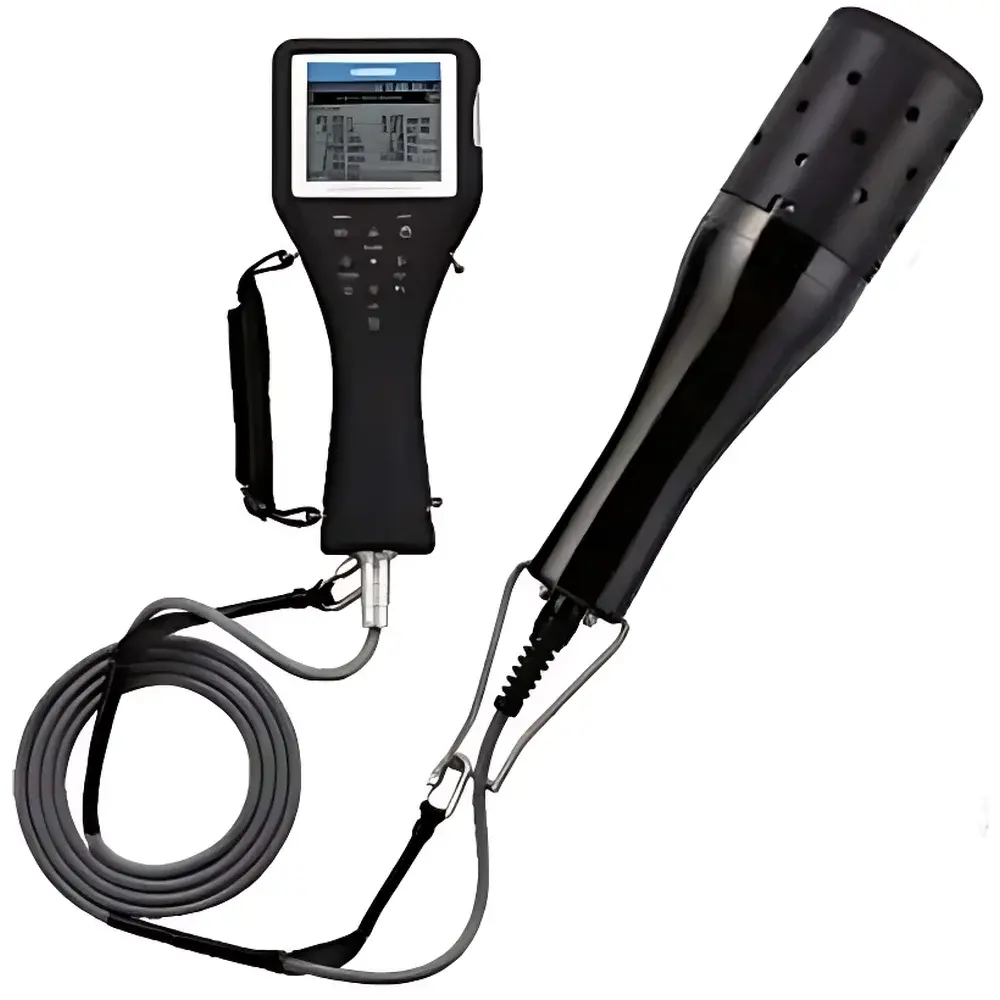
HORIBA U-50 Series Portable Multiparameter Water Quality Analyzer
| Brand | HORIBA |
|---|---|
| Origin | Japan |
| Model | U-50 Outdoor Series |
| Instrument Type | Portable / Handheld Water Quality Analyzer |
| Measured Parameters | pH, ORP, Conductivity, Dissolved Oxygen (DO), Temperature, Turbidity, Salinity, TDS, Specific Gravity (Seawater), Depth, GPS Positioning |
| Turbidity Standards | U-53 complies with US EPA Method 180.1 |
| Turbidity Resolution | 0.01 NTU |
| Operating Temperature Range | −10 to 55 °C |
| Depth Measurement Range | up to 30 m (pressure-based) |
| IP Rating | IP68 (JIS Protection Class 8 for probe |
| Battery Life | up to 70 hours (alkaline AA × 4, backlight off) |
| Data Storage | 10,000 measurement sets |
| Communication Interface | USB |
| Display | 320 × 240 monochrome LCD with backlight |
| Probe Dimensions | Ø96 mm × 340 mm (L) |
| Standard Cable Length | 2 m (optional: 10 m or 30 m) |
| Probe Material | PPS, glass, SUS316L, SUS304, FKM, PEEK, titanium, FEP membrane, POM |
| Weight | Probe ~1.8 kg |
Overview
The HORIBA U-50 Series is a rugged, field-deployable multiparameter water quality analyzer engineered for high-reliability environmental monitoring in diverse aquatic settings—including rivers, lakes, groundwater wells, wastewater treatment plants, and coastal marine zones. Built on a modular probe architecture and compliant with international regulatory measurement principles, the U-50 employs standardized electrochemical and optical sensing methodologies: pH and ORP are measured via glass and platinum electrodes following ASTM D1293 and ISO 5667-11; dissolved oxygen utilizes Clark-type polarographic detection with automatic salinity compensation and temperature correction per ISO 5814; conductivity applies AC four-electrode technology (IEC 60788) to eliminate polarization errors across high-conductivity matrices; turbidity measurements adhere strictly to either US EPA Method 180.1 (U-53 models, LED forward-scatter at 30°) or EN ISO 7027 (U-54 models, tungsten-lamp 90° nephelometry), ensuring traceable comparability with certified reference materials. The integrated pressure-based depth sensor (available on G-series variants) conforms to IEC 61000-6-2/3 for electromagnetic compatibility in outdoor deployments. All models support simultaneous real-time display of up to 11 parameters—pH, pH(mV), ORP, DO, conductivity, salinity, TDS, seawater specific gravity (δt), temperature, turbidity, and depth—with GPS geotagging (12-channel receiver) enabled on U-52G, U-53G, and U-54G configurations.
Key Features
- Ruggedized IP68-rated probe housing constructed from corrosion-resistant materials including titanium, SUS316L stainless steel, PEEK, and FEP membrane—validated for continuous submersion at depths up to 30 meters.
- Dual turbidity sensor options: U-53 probes implement US EPA-compliant LED forward-scatter optics with auto-cleaning brush mechanism; U-54 probes utilize EN ISO 7027–certified tungsten-lamp 90° nephelometric detection with identical 0.01 NTU resolution.
- Enhanced polarographic DO sensor featuring accelerated response time (<60 s to 90% step change) and simplified membrane/electrolyte maintenance—reducing field recalibration frequency without compromising accuracy.
- Multi-language interface supporting English, Japanese, Russian, Spanish, and Portuguese—optimized for multinational field teams and cross-border environmental compliance reporting.
- Automatic temperature compensation across all electrochemical parameters (pH, ORP, DO, conductivity) using integrated Pt1000-grade platinum resistance thermometer (JIS B-class accuracy: ±0.3 + 0.005|t| °C).
- Intelligent auto-ranging conductivity module with five dynamic scales (0–0.999 mS/cm to 1–9.99 S/m), minimizing manual range selection errors during rapid transitions between freshwater and hypersaline conditions.
Sample Compatibility & Compliance
The U-50 Series is validated for direct immersion in natural waters ranging from ultrapure surface runoff (conductivity 5 S/m). Its probe geometry and material selection meet ASTM D3370 requirements for grab-sampling integrity and minimize biofouling susceptibility in eutrophic environments. Turbidity modules satisfy method-specific validation criteria: U-53 achieves ±0.5 NTU absolute accuracy in the 0–10 NTU range per US EPA guidance, while U-54 maintains ±1 NTU or ±3% RSD (whichever is greater) from 10–1000 NTU under EN ISO 7027. All electrochemical sensors comply with ISO/IEC 17025 traceability frameworks when used with NIST-traceable calibration standards. The system supports GLP-compliant data logging—including operator ID, location stamp, and timestamp—and meets audit requirements for ISO 14001 environmental management systems and EPA Region 10 field protocols.
Software & Data Management
Data acquisition and post-processing are managed via HORIBA’s proprietary U-50 PC Software (Windows-compatible), which enables encrypted USB transfer of full 10,000-record datasets with metadata embedding (GPS coordinates, probe serial IDs, calibration history). The software generates ASTM-compliant report templates (D1293, D512, D859) and exports CSV/Excel files compatible with LIMS integration. Audit trails record all configuration changes, calibration events, and user logins—supporting 21 CFR Part 11 electronic signature readiness when paired with validated Windows domain authentication. Firmware updates preserve historical calibration coefficients and maintain metrological continuity across instrument generations.
Applications
- Regulatory surface water monitoring under EU Water Framework Directive (WFD) Article 8 and US Clean Water Act Section 304(h) assessment programs.
- Wastewater effluent verification at discharge points per ISO 10523 (pH), ISO 5815-1 (BOD surrogate via DO profiling), and ISO 7888 (conductivity).
- Coastal and estuarine salinity gradient mapping using synchronized TDS, specific gravity (δt), and conductivity-derived PSU units.
- Groundwater vulnerability assessments requiring simultaneous redox potential (ORP) and dissolved oxygen profiling to delineate aerobic/anaerobic zones.
- Emergency response deployment for post-spill or post-flood water safety screening—leveraging rapid turbidity/pH/DO triage capability and GPS-referenced contamination plume tracking.
FAQ
What turbidity standards does the U-50 Series comply with?
U-53 models conform to US EPA Method 180.1 (LED forward-scatter); U-54 models comply with EN ISO 7027 (tungsten-lamp 90° nephelometry). Both achieve 0.01 NTU resolution.
Is depth measurement available on all U-50 models?
Depth functionality is exclusive to G-series variants (U-52G, U-53G, U-54G) and uses pressure transduction calibrated to 0–30 m range with ±0.3 m absolute accuracy.
How is calibration traceability maintained?
All calibrations use NIST-traceable standard solutions; the instrument logs date, operator, standard lot number, and deviation values—fully auditable per ISO/IEC 17025 Clause 7.7.
Can the U-50 operate in freezing conditions?
Yes—the probe operates continuously from −10 °C to 55 °C; however, alkaline AA batteries exhibit reduced capacity below 0 °C, and ice formation on the turbidity window requires manual clearing.
What materials ensure long-term corrosion resistance in seawater?
Probe wetted parts include titanium body, SUS316L electrodes, FKM O-rings, and FEP-coated membranes—validated for >12 months’ continuous immersion in 35 ppt seawater per ASTM G48 Practice A.







