HORIBA IG-331 60° Portable Gloss Meter
| Brand | HORIBA |
|---|---|
| Origin | Japan |
| Model | IG-331 |
| Measurement Angle | 60° |
| Measurement Range | 0–100 GU |
| Resolution | 1 GU |
| Accuracy | ±5% F.S. ±1 digit |
| Spot Size | 16 × 12 mm |
| Display | LED digital |
| Power Supply | 9 V DC battery (1 pc) |
| Dimensions (W × H × D) | 78 × 189 × 58 mm |
| Calibration | Auto-calibration with reference standard recognition |
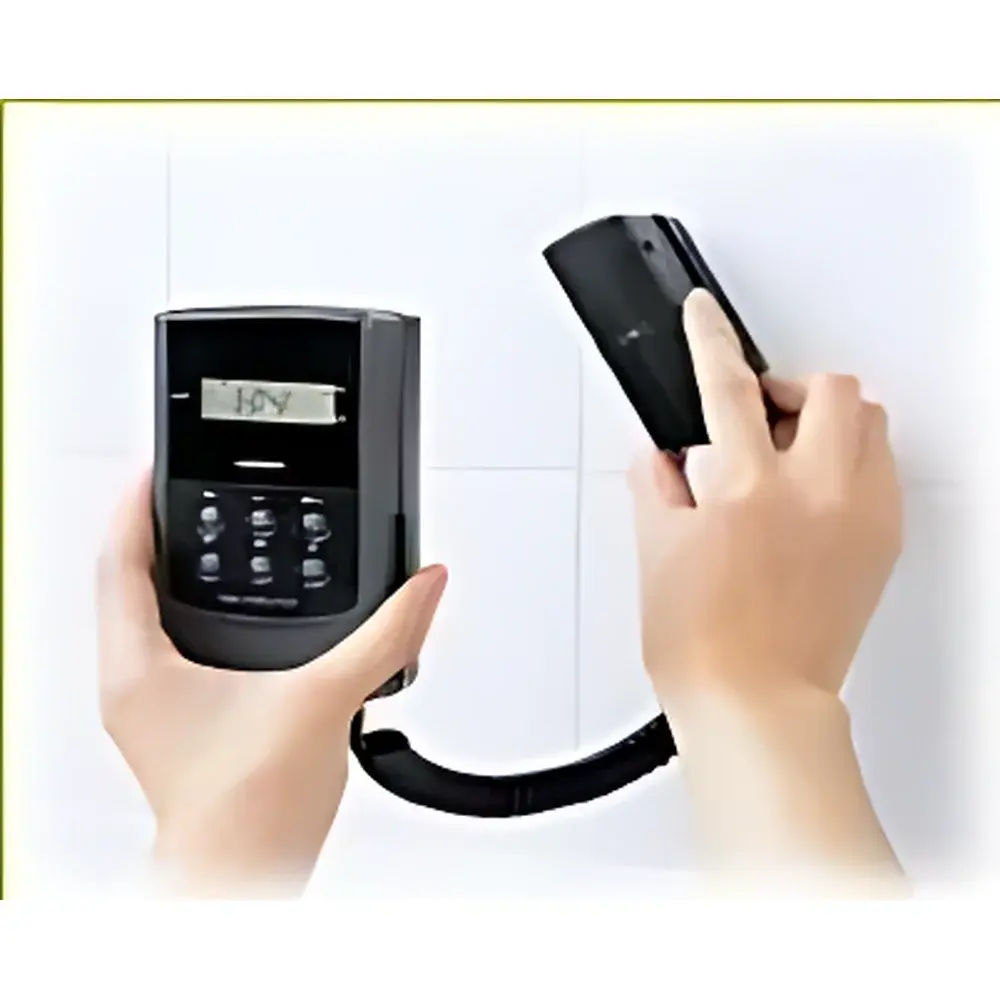
| Detector Design | Separated sensor head for flexible positioning |
| Data Memory | Stores up to 99 readings with statistical functions (mean, mean deviation) |
Overview
The HORIBA IG-331 is a precision-engineered, handheld 60° gloss meter designed for rapid, repeatable surface gloss evaluation in industrial quality control and maintenance environments. Operating on the principle of specular reflectance measurement—defined as the ratio of reflected luminous flux at the specular angle to that of a reference black glass standard (as specified in ISO 2813, ASTM D523, and DIN 67530)—the IG-331 delivers objective, numerically traceable gloss values in Gloss Units (GU). Its fixed 60° geometry aligns with international standards for medium-gloss surfaces, making it especially suitable for coatings, plastics, ceramics, stone finishes (e.g., marble, granite), and architectural materials where visual perception alone is insufficient for consistent specification compliance. Unlike subjective visual assessment—which exhibits high inter-observer variability and poor temporal reproducibility—the IG-331 eliminates ambiguity by converting optical response into calibrated digital output, supporting auditable decision-making across production, finishing, and facility management workflows.
Key Features
- Fixed 60° optical geometry compliant with ISO 2813, ASTM D523, ASTM C584, DIN 67530, JIS Z 8741, GB/T 9754, GB/T 9966, and GB/T 8807
- Compact, ergonomic handheld design (78 × 189 × 58 mm) with integrated 9 V DC battery power—no warm-up time required
- Dedicated separated sensor head enables access to confined or curved surfaces without repositioning the main unit
- LED digital display with 1 GU resolution and direct readout in real time
- Automatic calibration system utilizing built-in reference recognition—eliminates manual zeroing and reduces operator dependency
- Onboard memory stores up to 99 individual measurements with embedded statistical processing: arithmetic mean, mean deviation, and max/min tracking
- Rugged housing engineered for field use in manufacturing floors, paint shops, tile fabrication lines, and building maintenance operations
Sample Compatibility & Compliance
The IG-331 is validated for non-destructive, contact-based gloss assessment of flat or gently curved surfaces with optical homogeneity within the 16 × 12 mm measurement aperture. It supports routine verification of finish consistency for solvent-based and waterborne paints, powder coatings, laminated plastics, glazed ceramics, polished natural stone (e.g., marble, granite), and anodized aluminum. All measurement protocols adhere to internationally harmonized gloss metrology frameworks, including ISO/IEC 17025-aligned traceability principles when used with certified calibration standards. While not intrinsically compliant with FDA 21 CFR Part 11 or GLP/GMP electronic record requirements (due to absence of audit trail logging), its deterministic analog-to-digital conversion path ensures measurement integrity suitable for internal QC documentation under ISO 9001 and IATF 16949 systems.
Software & Data Management
The IG-331 operates as a standalone instrument with no proprietary software dependency. All data acquisition, storage, and statistical computation occur internally. Measurement records are retained in volatile memory until manually cleared; no USB, Bluetooth, or serial interface is provided. For integration into enterprise quality management systems (QMS), users may manually transcribe stored statistics (mean, deviation, n = 99) into spreadsheets or LIMS platforms. While lacking automated export capability, its deterministic repeatability (±5% F.S. ±1 digit) and standardized optical configuration ensure compatibility with SPC charting, process capability analysis (Cp/Cpk), and trend monitoring across shifts or production lots.
Applications
- Automotive OEM and after-market paint shop: verifying gloss uniformity post-baking and polishing
- Architectural cladding QA: validating batch-to-batch consistency of ceramic tiles, stainless steel panels, and natural stone veneers
- Plastics extrusion and injection molding: in-line gloss screening of ABS, PC, and PP components prior to packaging
- Flooring maintenance: quantifying degradation of polished concrete, terrazzo, or vinyl composite tile (VCT) surfaces over time
- Printing and packaging: assessing varnish and lamination gloss on folding cartons and labels per ISO 8254-2
- Research laboratories conducting comparative studies on coating formulation effects on surface reflectance
FAQ
What standards does the IG-331 comply with?
It conforms to ISO 2813, ASTM D523, ASTM C584, DIN 67530, JIS Z 8741, GB/T 9754, GB/T 9966, and GB/T 8807 for 60° gloss measurement.
Does the IG-331 require external calibration equipment?
No—it features automatic calibration with integrated reference standard recognition; only periodic verification using a NIST-traceable gloss standard is recommended.
Can the IG-331 measure curved or textured surfaces?
It is optimized for flat or low-curvature surfaces; measurements on highly textured or deeply curved substrates may deviate due to aperture averaging effects.
Is the memory function password-protected or exportable?
Memory is unsecured and non-exportable; data must be manually recorded from the LED display.
What is the typical battery life under normal usage?
Approximately 10,000 measurements per 9 V alkaline battery, assuming ambient temperature operation and infrequent backlight use (if equipped).