
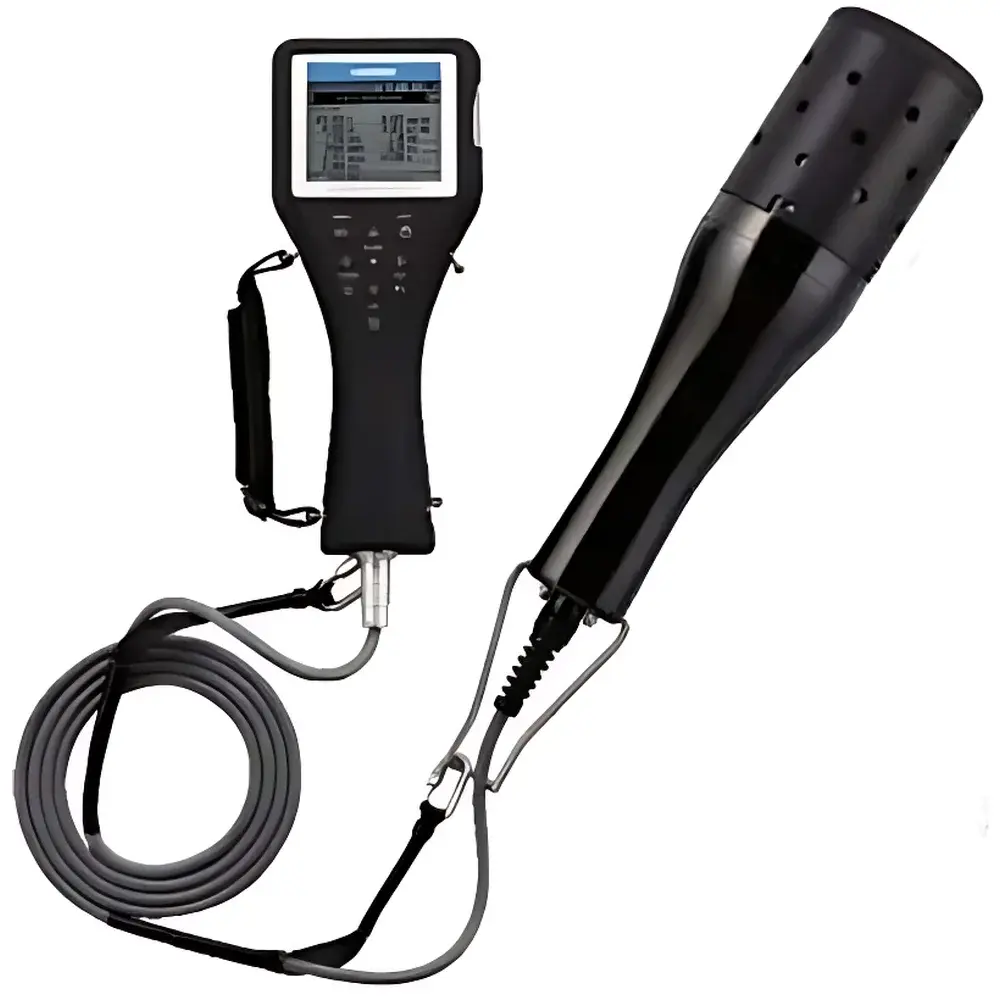
HORIBA U-50 Series Portable Multiparameter Water Quality Analyzer
| Brand | HORIBA |
|---|---|
| Origin | Japan |
| Model | U-50 Series |
| Instrument Type | Portable/Handheld Water Quality Analyzer |
| Measured Parameters | pH, ORP, Dissolved Oxygen (DO), Conductivity, Salinity, TDS, Seawater Specific Gravity, Temperature, Turbidity (NTU), Depth (m), GPS Position |
| Turbidity Standards | U-53 — US EPA Method |
| Turbidity Resolution | 0.01 NTU |
| Operating Temperature Range | −10 to 55 °C |
| Depth Measurement Range | up to 30 m |
| IP Rating | IP67 (instrument), IP68 (probe) |
| Battery Life | up to 70 hours (alkaline AA × 4, backlight off) |
| Data Storage | 10,000 measurement sets |
| Communication | USB |
| Display | 320 × 240 monochrome LCD with backlight |
Overview
The HORIBA U-50 Series is a field-deployable, multi-sensor water quality analyzer engineered for high-reliability environmental monitoring in diverse aquatic systems—including rivers, lakes, groundwater wells, wastewater treatment outfalls, and coastal zones. Based on electrochemical, optical, and pressure-based sensing principles, the U-50 platform integrates calibrated, co-located sensors into a single rugged probe assembly, enabling simultaneous acquisition of up to 11 physicochemical parameters without cross-sensor interference. Its architecture adheres to fundamental metrological requirements for field instrumentation: temperature-compensated analog signal conditioning, digital sensor fusion via embedded microcontroller, and traceable calibration protocols aligned with international reference methods. The system operates independently of external power or computing infrastructure—making it suitable for unattended spot measurements, longitudinal survey campaigns, and regulatory compliance verification under GLP-aligned workflows.
Key Features
- Simultaneous real-time measurement of pH, ORP, dissolved oxygen (DO), conductivity, salinity, TDS, seawater specific gravity (δt), temperature, turbidity, depth, and GPS coordinates (on G-series models)
- Dual-turbidity detection options: U-53 probe compliant with US EPA Method 180.1 (LED forward-scatter, 30°), U-54 probe compliant with EN ISO 7027 (LED 90° scatter); both deliver 0.01 NTU resolution and integrated mechanical cleaning brushes
- Optimized Clark-type polarographic DO sensor with accelerated response time (t90 ≤ 30 s) and simplified membrane/electrolyte maintenance
- Four-electrode AC conductivity cell with automatic range switching and temperature compensation to 25 °C per IEC 60788; supports full-range operation from fresh to hypersaline waters (0–10 S/m)
- Ruggedized probe housing constructed from PPS, titanium, SUS316L stainless steel, FKM elastomers, PEEK, and FEP membranes—rated IP68 to 30 m depth
- Host unit rated IP67; 320 × 240 monochrome LCD with adjustable backlight; USB interface for data export and firmware updates
- Multi-language UI supporting English, Japanese, Russian, Spanish, and Portuguese—designed for international field teams and multilingual regulatory reporting
- Onboard calibration management: two-point pH calibration (including auto-buffer recognition), single-point DO saturation calibration, and multi-point turbidity/conductivity verification routines
Sample Compatibility & Compliance
The U-50 Series is validated for use across natural and anthropogenically impacted waters, including low-ionic-strength freshwater (conductivity < 100 µS/cm), estuarine transition zones (1–35 ppt salinity), and marine environments (up to 70 ppt). Probe materials comply with ASTM D5116-17 (material compatibility for water contact) and EU Directive 2000/60/EC Annex V requirements for sensor inertness. Turbidity modules meet statutory method equivalency: U-53 satisfies US EPA 40 CFR Part 136 validation criteria for field turbidimeters, while U-54 conforms to EN ISO 7027:2016 for formazin-equivalent NTU traceability. All electrochemical sensors are certified to JIS Z 8401 accuracy classes and support audit-ready calibration logs required under ISO/IEC 17025-accredited laboratory field operations.
Software & Data Management
Data acquisition, visualization, and export are managed via HORIBA’s proprietary U-50 PC Utility software (Windows-compatible), which enables post-processing of time-stamped, georeferenced datasets—including depth profiles, diurnal DO cycles, and conductivity–temperature–salinity (CTS) triplots. The instrument stores up to 10,000 measurement records with full metadata (date/time, GPS coordinates, operator ID, calibration status flags). Export formats include CSV and XML, structured to align with EPA WQX 3.0 and ISO 19115-2 metadata schemas. Audit trail functionality meets FDA 21 CFR Part 11 requirements for electronic records: all calibration events, parameter edits, and firmware revisions are time-stamped, user-logged, and non-erasable. No cloud dependency—the system operates fully offline, ensuring data sovereignty in remote or regulated environments.
Applications
- Regulatory ambient water quality monitoring per national programs (e.g., US Clean Water Act Section 305(b), EU WFD Article 8)
- Wastewater effluent compliance verification at discharge points—tracking pH, DO, conductivity, and turbidity against permit limits
- Groundwater plume characterization during site remediation, including redox potential (ORP) mapping for anaerobic/aerobic boundary delineation
- Marine and estuarine ecosystem surveys—correlating DO saturation, salinity gradients, and turbidity with biological indicators
- Drinking water source protection assessments—rapid screening for contamination events using multi-parameter anomaly detection
- Educational and capacity-building deployments where robustness, battery autonomy, and multilingual operation are critical
FAQ
What turbidity standards does the U-50 Series support?
The U-53 probe complies with US EPA Method 180.1 (forward-scatter LED geometry), while the U-54 probe conforms to EN ISO 7027:2016 (90° LED scatter), both traceable to NIST SRM 2037 formazin standards.
Does the instrument support GLP-compliant calibration documentation?
Yes—each calibration event (pH, DO, turbidity, conductivity) generates an immutable log with timestamp, operator ID, standard values used, and deviation metrics, stored onboard and exportable for audit review.
Can the U-50 operate in freezing conditions?
The probe is rated for continuous operation between −10 °C and 55 °C; however, DO membrane performance degrades below 0 °C, and ice formation on the turbidity window may affect readings—pre-field warming and anti-frost probe caps are recommended.
How is depth measurement validated?
Depth is derived from absolute pressure transduction (piezoresistive silicon sensor), factory-calibrated against NIST-traceable hydrostatic columns; accuracy is ±0.3 m within 0–30 m range, with thermal drift compensated per JIS B 7505.
Is GPS positioning available on all models?
GPS functionality is exclusive to G-series variants (U-52G, U-53G, U-54G), featuring 12-channel reception with typical horizontal accuracy of < 3 m (SA-free, open-sky conditions).







