
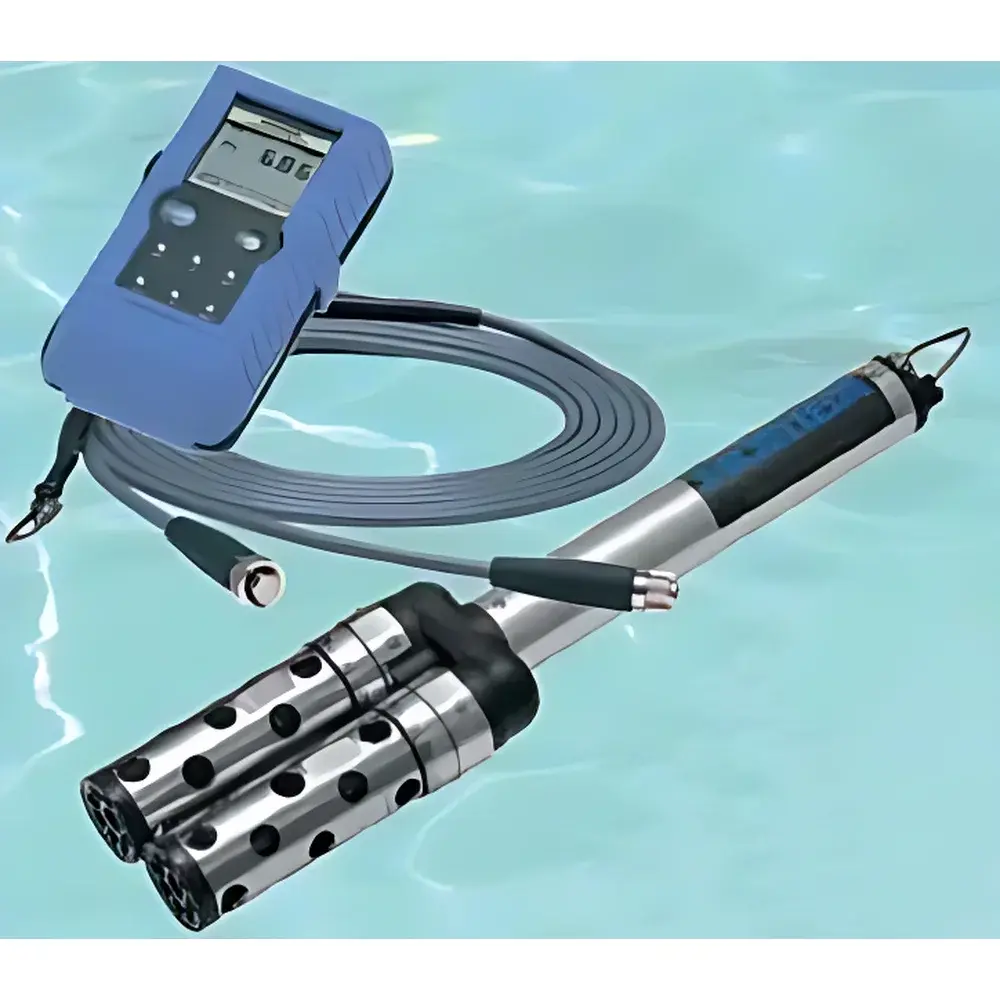
HORIBA W-20XD Series Multi-Parameter Water Quality Monitoring System
| Brand | HORIBA |
|---|---|
| Origin | Japan |
| Model | W-20XD Series |
| Instrument Type | Online Water Quality Analyzer |
| Operating Depth | Up to 100 m |
| Data Logging Duration | 30 days (2880 records, 15-min interval) |
| IP Rating | IP67 (Control Unit) |
| Simultaneous Parameters | Up to 13 |
| Temperature Range | 0–55 °C (Operation), −5–60 °C (Storage) |
| Probe Dimensions | Ø95 mm × 430 mm |
| Measurement Principles | Glass Electrode (pH), Membrane-Based Galvanic Cell (DO), AC 4-Electrode Conductivity, Pressure Transduction (Depth), Thermistor (Temperature), Nephelometric/Transmissive Turbidity, Platinum Electrode (ORP), Ion-Selective Electrodes (NO₃⁻, Cl⁻, Ca²⁺, F⁻, K⁺, NH₃) |
Overview
The HORIBA W-20XD Series is a rugged, submersible multi-parameter water quality monitoring system engineered for long-term, unattended deployment in diverse aquatic environments—including rivers, lakes, reservoirs, coastal zones, groundwater wells, municipal wastewater outfalls, industrial effluents, and aquaculture systems. Designed and manufactured in Japan, the system operates on a modular architecture comprising a waterproof control unit (IP67 rated) and interchangeable multi-sensor probes. Its core measurement methodology integrates electrochemical, physical, and optical sensing principles validated against internationally recognized standards including ISO 7888 (conductivity), ISO 5814 (dissolved oxygen), ISO 10523 (pH), and ASTM D3370 (field sampling protocols). The W-20XD functions as a true autonomous logger: once deployed without tethered cabling, it autonomously acquires, processes, time-stamps, and stores high-fidelity data at user-configurable intervals—up to 2880 measurements over 30 days at 15-minute resolution. All sensor signals undergo real-time temperature compensation and digital signal conditioning within the probe housing to minimize drift and ensure metrological integrity under variable hydrostatic pressure (up to 100 m H₂O) and ambient thermal gradients.
Key Features
- Submersible design rated for continuous operation at depths up to 100 meters, enabled by newly developed pressure-resistant electrode assemblies and hermetically sealed ceramic housings.
- Integrated non-volatile memory (2880 record capacity) eliminates dependency on external data loggers or telemetry infrastructure during initial deployment phases.
- Modular probe configuration supports up to 13 simultaneous parameters—including pH, dissolved oxygen (DO), electrical conductivity (EC), salinity, total dissolved solids (TDS), seawater specific gravity (δt, δ₀, δ₁₅), turbidity (NTU), water depth (pressure-based), temperature, oxidation-reduction potential (ORP), and six ion-selective analytes (NO₃⁻, Cl⁻, Ca²⁺, F⁻, K⁺, NH₃).
- Automatic two-point pH calibration with built-in buffer recognition logic; all electrochemical sensors feature automatic temperature compensation per NIST-traceable algorithms.
- AC 4-electrode conductivity measurement eliminates polarization errors and enables stable readings across wide EC ranges (0–9.99 S/m), critical for estuarine and hypersaline applications.
- Galvanic DO sensor employs a gas-permeable membrane and long-life electrolyte gel, delivering stable output with <±0.2 mg/L accuracy and minimal zero drift over extended deployments.
Sample Compatibility & Compliance
The W-20XD Series is validated for use in natural freshwaters, brackish estuaries, marine environments, treated and untreated wastewaters, and agricultural runoff. Its sensor suite complies with key regulatory frameworks governing environmental monitoring: conductivity and pH modules align with EPA Method 120.1 and ISO 10523; DO measurements conform to ISO 5814 and ASTM D888; turbidity adheres to ISO 7027 and EPA Method 180.1. The system’s data structure supports audit-ready traceability—each stored record includes timestamp (UTC), sensor ID, raw voltage, compensated value, QC flags, and environmental metadata (e.g., depth, temperature). While not pre-certified for FDA 21 CFR Part 11, its logging architecture permits integration into GLP/GMP-compliant workflows via secure export of CSV or binary files with embedded checksums and operator-defined metadata fields.
Software & Data Management
Data retrieval is performed via USB-C interface or optional Bluetooth 5.0 module (W-23XD variant), enabling field download without physical probe recovery. HORIBA’s proprietary AquaLink software provides visualization, statistical analysis (min/max/mean/stdev), trend overlay, and automated report generation (PDF/Excel). Raw datasets include full sensor diagnostics—electrode impedance, membrane integrity status, battery voltage, and memory write cycles—to support preventive maintenance scheduling. Export formats are compatible with third-party platforms including LabVIEW, MATLAB, and common LIMS architectures. Firmware updates are delivered through signed binary packages with SHA-256 verification to ensure system integrity.
Applications
- Long-term ecological monitoring of eutrophication indicators (nutrient ions, DO, chlorophyll-a proxy via turbidity correlation) in stratified lakes and reservoirs.
- Regulatory compliance reporting for NPDES discharge permits, requiring concurrent measurement of pH, conductivity, temperature, and heavy metal proxies (e.g., Ca²⁺/Cl⁻ ratios).
- Marine aquaculture site selection and operational optimization—real-time tracking of DO minima, salinity shifts, and ammonia accumulation thresholds.
- Groundwater contamination plume delineation using multi-ion profiling (NO₃⁻, Cl⁻, F⁻) coupled with redox potential (ORP) to infer biogeochemical zonation.
- Urban stormwater management—high-frequency turbidity and conductivity logging to correlate runoff events with TSS and chloride loading from de-icing agents.
FAQ
What is the maximum recommended deployment duration without maintenance?
The system is rated for continuous unattended operation for 30 days at 15-minute intervals. Battery life is dependent on sensor activation frequency and ambient temperature; typical alkaline cell endurance exceeds 6 months in low-power sleep mode between measurements.
Can the W-20XD be used in highly turbid or biofouling-prone waters?
Yes—the probe features a self-cleaning wiper option (accessory) and anti-fouling coatings on optical surfaces and membrane electrodes. For prolonged deployments (>7 days) in eutrophic or industrial effluent, quarterly mechanical cleaning and membrane replacement are advised per HORIBA Maintenance Protocol M-W20XD-03.
Is remote data transmission supported natively?
The base W-22XD model requires physical retrieval for data download. The W-23XD variant supports optional GSM/GPRS or LoRaWAN telemetry modules for scheduled cloud uploads—configured via AquaLink software with TLS 1.2 encryption and configurable retry logic.
How does the system handle calibration verification in the field?
Each probe includes onboard calibration memory storing date-stamped two-point pH and single-point DO/salinity calibrations. AquaLink generates deviation reports comparing post-deployment calibration checks against baseline values, flagging sensors exceeding ±5% span drift for recalibration.
Are sensor modules interchangeable between W-20XD units?
Yes—all probes use standardized mechanical and electrical interfaces compliant with HORIBA’s Multi-Sensor Interface Specification (MSIS-2.1), allowing cross-platform reuse across W-20XD, W-21XD, and legacy W-10 series controllers with firmware v3.4 or later.
Related Products







