
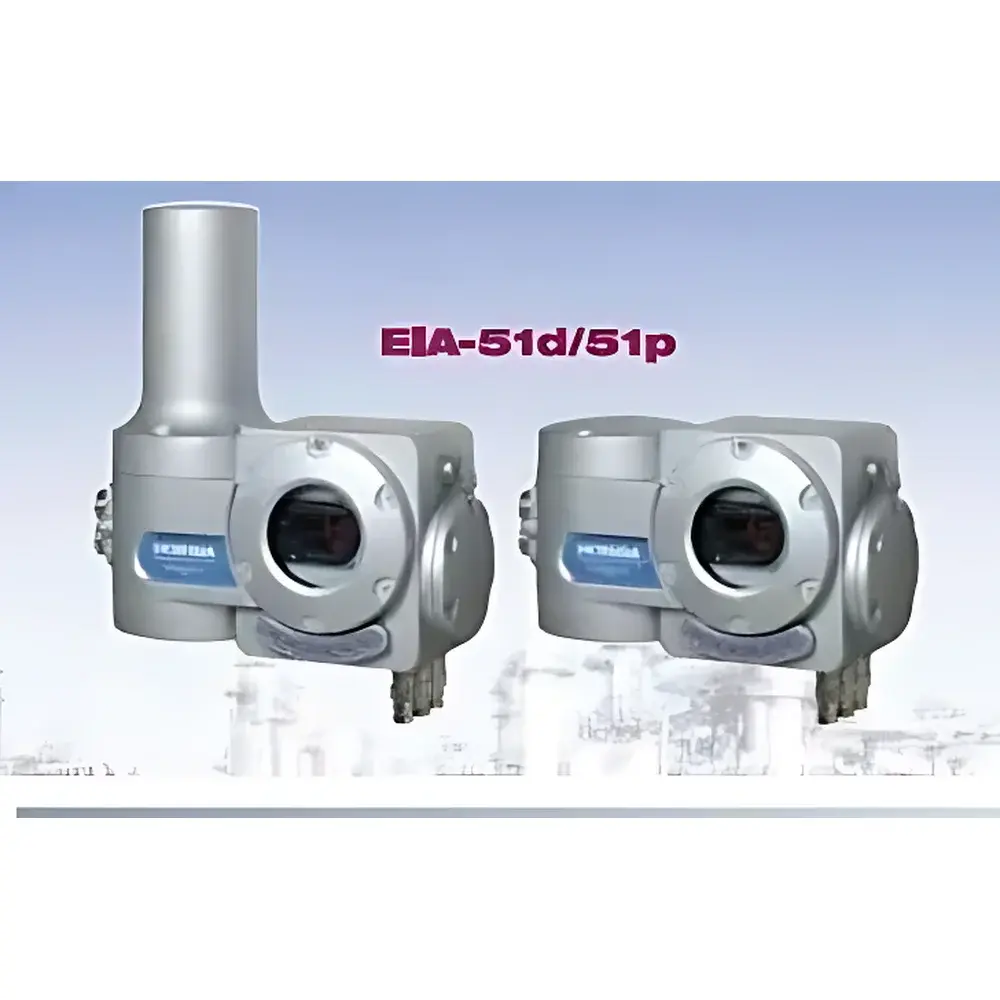
HORIBA EIA-51d / EIA-51p Intrinsically Safe and Explosion-Proof NDIR Gas Analyzer
| Brand | HORIBA |
|---|---|
| Origin | Japan |
| Model | EIA-51d / EIA-51p |
| Explosion Protection Type | Ex d IIB+H2 T4 (EIA-51d) / Ex p IIB T4 X (EIA-51p) |
| Measurement Principle | Non-Dispersive Infrared (NDIR) Absorption with Interference Compensation |
| Measured Gases | CO, CO₂, CH₄, and other hydrocarbons |
| Range | 0–0.11 vol% to 0–100 vol% (gas-dependent) |
| Repeatability | ±0.5% F.S. (zero & span, standard range) |
| Linearity | ±1.0% F.S. |
| Zero & Span Drift | ±2.0% F.S./week |
| Response Time (T90) | ≤20 s (standard), ≤40 s (optional ranges) |
| Sample Flow Rate | 500 mL/min |
| Operating Temperature | –5 to +40 °C |
| Analog Output | Isolated DC 4–20 mA (standard), optional 0–10 V / 1–5 V / 0–1 V |
| Communication | RS-485, Modbus RTU (selectable baud rates: 1200–19200 bps) |
| Wetted Materials | SUS304, SUS316, FKM, CaF₂, Au |
| Power Supply | 100–240 V AC, 50/60 Hz |
Overview
The HORIBA EIA-51d and EIA-51p are certified explosion-proof process gas analyzers engineered for continuous, high-reliability monitoring in hazardous environments classified under IEC 60079 standards. Designed specifically for Zone 1 and Division 1 installations, these analyzers employ non-dispersive infrared (NDIR) spectroscopy with proprietary interference-compensated optical architecture—enabling stable, drift-resistant quantification of combustible gases including CO, CO₂, CH₄, and other hydrocarbons in potentially explosive atmospheres. Unlike conventional single-detector NDIR systems, the EIA-51 series integrates dual parallel detection channels: one dedicated to primary absorption measurement and another optimized for real-time correction of spectral interference from co-existing gases, optical misalignment, mechanical vibration, and long-term source/detector aging. This dual-path compensation ensures metrological integrity across extended operational cycles without frequent recalibration—critical for unattended operation in petrochemical plants, biogas upgrading facilities, chemical synthesis units, and confined-space ventilation control systems.
Key Features
- Explosion protection certified to international standards: EIA-51d complies with Ex d IIB+H₂ T4 (flameproof enclosure), while EIA-51p meets Ex p IIB T4 X (pressurized enclosure with special conditions), both conforming to IEC 60079-0, -1, and -2.
- Interference-compensated NDIR optical system with dual-detector configuration minimizes cross-sensitivity effects from H₂O vapor, CO₂ background, or hydrocarbon mixtures—delivering high specificity even in complex sample matrices.
- Robust thermal and mechanical design: operating ambient temperature range of –5 to +40 °C; vibration tolerance ≤0.3 m/s² at 100 Hz; humidity resistance up to 90% RH (non-condensing).
- Configurable analog output (DC 4–20 mA standard) with full-scale programmability and alarm thresholds spanning –10% to +110% of signal range—supporting integration into DCS, PLC, and SCADA architectures.
- Optional RS-485 interface with Modbus RTU protocol enables remote parameter configuration, real-time concentration streaming, and diagnostic status reporting—facilitating predictive maintenance and audit-ready data logging.
- Wetted materials selected for chemical compatibility and corrosion resistance: 316 stainless steel (SUS316), fluorocarbon elastomer (FKM), calcium fluoride (CaF₂) optical windows, and gold-coated reflective surfaces.
Sample Compatibility & Compliance
The EIA-51d/51p is validated for use with dry, particulate-free sample streams containing ≤21% O₂ and no condensable vapors. It is not intended for direct measurement in corrosive, acidic, or highly humid gas streams without upstream conditioning (e.g., Nafion dryers, particulate filters, or catalytic scrubbers). Per IEC 60079-26, the analyzer requires installation in accordance with manufacturer-specified mounting orientation, grounding protocols, and cable entry sealing practices. It supports compliance with functional safety frameworks when integrated into SIL 2-capable loops (IEC 61511), and its analog outputs meet EMC requirements per IEC 61326-1 (industrial environment). While not inherently FDA 21 CFR Part 11 compliant, audit trails and calibration records may be maintained externally via compatible SCADA or LIMS platforms supporting electronic signature and change control.
Software & Data Management
No embedded touchscreen or onboard software is provided; configuration and diagnostics are performed via front-panel push-button interface or external host systems using Modbus RTU commands. All calibration parameters—including zero/span values, gain coefficients, and interference correction factors—are stored in non-volatile memory with write-protection logic. Optional auto-calibration modules (not included by default) support periodic injection of certified reference gases via solenoid-valve manifolds—enabling automated verification per ISO 14644-3 or EPA Method 205 protocols. Data export is achieved through polling-based Modbus registers mapping concentration values, status flags (e.g., sensor fault, flow alarm, pressure low), and uptime counters—compatible with historian systems such as OSIsoft PI, Inductive Automation Ignition, or Siemens Desigo CC.
Applications
- Continuous monitoring of flare gas composition and combustion efficiency in oil refineries and LNG terminals.
- Safety interlock control for hydrogen production units and fuel cell feedstock purification lines.
- Real-time methane concentration tracking in landfill gas recovery systems and anaerobic digestion plants.
- Process optimization in syngas generation (CO/CO₂ ratio control) and Fischer–Tropsch synthesis reactors.
- Confined space entry pre-checks and ventilation validation in pharmaceutical clean utility tunnels and solvent handling areas.
- Regulatory reporting for VOC emissions compliance under EU Directive 2010/75/EU (IED) and US EPA Subpart Ja.
FAQ
What explosion protection categories does the EIA-51d support?
The EIA-51d is certified Ex d IIB+H₂ T4, permitting use in environments where Group IIB gases (e.g., ethylene) or hydrogen-air mixtures may be present, with surface temperatures limited to ≤135 °C.
Can the EIA-51p measure hydrogen directly?
No—hydrogen is not detectable via NDIR absorption; however, the EIA-51p’s pressurized enclosure allows safe deployment adjacent to hydrogen-handling zones where indirect monitoring (e.g., CH₄ leak detection upstream of H₂ compressors) is required.
Is automatic zero calibration available as a factory option?
Yes—optional automatic calibration kits include solenoid manifolds, reference gas cylinders (N₂-balanced CO/CH₄ standards), and timing logic for scheduled zero/span checks per user-defined intervals.
What sample conditioning is recommended prior to analysis?
A heated sample line (maintained >60 °C), particulate filter (≤0.3 µm), and membrane dryer (e.g., PermaPure MD-110) are strongly advised to prevent condensation, fouling, or spectral interference from water vapor.
Does the analyzer comply with MODBUS TCP or only MODBUS RTU?
Only MODBUS RTU over RS-485 is supported; Ethernet/IP or TCP/IP gateways must be implemented externally if network-level integration is required.
Related Products







