
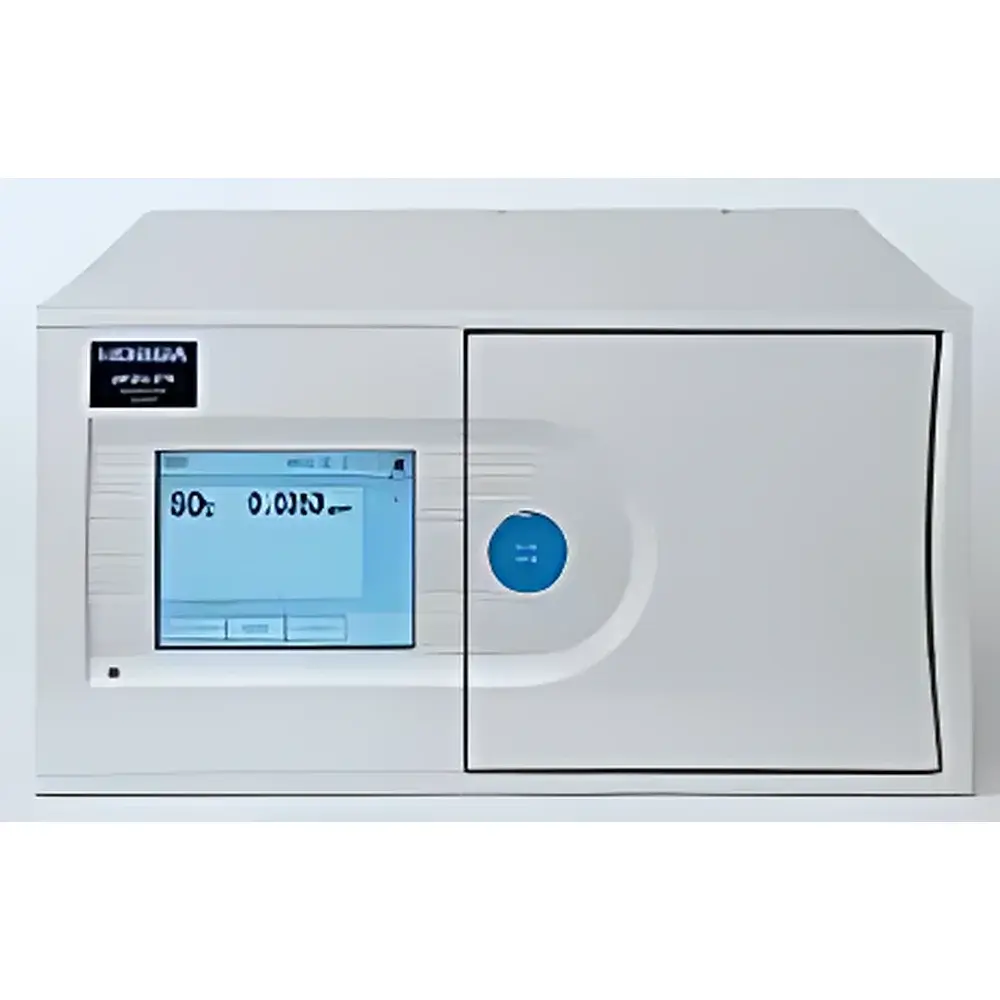
HORIBA APOA-370 Advanced UV Absorption Ozone Monitor for Ambient Air Quality Monitoring
| Brand | HORIBA |
|---|---|
| Origin | Japan |
| Model | APOA-370 |
| Measurement Principle | Non-Dispersive Ultraviolet (NDUV) Absorption |
| Range | 0–0.1 / 0.2 / 0.5 / 1.0 ppm (standard) |
| Detection Limit | 0.5 ppb (2σ, ≤0.2 ppm range) or 0.5% F.S. (2σ, >0.2 ppm range) |
| Repeatability | ±1.0% F.S. |
| Linearity | ±1.0% F.S. |
| Zero Drift | ±1.0% F.S./day, ±2.0% F.S./week |
| Span Drift | ±1.0% F.S./day, ±2.0% F.S./week |
| Response Time (T90) | ≤120 s |
| Sample Flow Rate | ~0.7 L/min |
| Operating Temperature | 5–40 °C |
| Power Supply | 100–240 VAC, 50/60 Hz (configurable) |
| Dimensions | 430 × 550 × 221 mm (W×D×H) |
| Weight | ~20 kg |
Overview
The HORIBA APOA-370 is a high-precision, laboratory-grade ambient ozone (O3) monitor engineered for continuous, trace-level measurement in regulatory air quality monitoring networks, research stations, and urban background sites. It employs the internationally recognized non-dispersive ultraviolet (NDUV) absorption principle—operating at the characteristic 254 nm absorption band of ozone—to deliver metrologically traceable concentration data. Unlike conventional UV photometers susceptible to interferences from humidity, hydrocarbons, or nitrogen dioxide, the APOA-370 integrates HORIBA’s proprietary heated catalytic ozone decomposer. This module thermally dissociates ozone in the reference gas stream while preserving interferent stability, enabling true differential measurement without chemical scrubbers or permeation membranes. As a result, zero stability is decoupled from ambient moisture fluctuations, significantly reducing drift and extending calibration intervals. All wetted surfaces—including sample lines, reaction cells, and flow paths—are constructed exclusively from inert materials: high-purity quartz glass and PTFE. This design ensures long-term chemical resistance, minimal memory effects, and compliance with stringent EPA Reference Method EQOA-01 and EN 14625 requirements for ambient O3 analyzers.
Key Features
- Heated catalytic ozone decomposer for stable, moisture-insensitive reference generation
- Automatically selectable or remotely configurable multi-range operation (0–0.1 to 0–10 ppm in four user-defined steps)
- Optimized optical path with temperature-stabilized UV lamp and dual-beam detection architecture for enhanced signal-to-noise ratio
- Real-time diagnostics: continuous monitoring of lamp intensity, decomposer temperature, zero/span calibration status, and flow integrity
- Modular I/O architecture supporting analog outputs (0–1 V, 0–10 V, 4–20 mA), relay contacts, and RS-232C serial interface
- Optional Ethernet port and LAN compatibility for seamless integration into SCADA, EPA AQS, or EEA AirBase-compliant data acquisition systems
- Removable industrial-grade CF card for local data logging (up to 1 year of 1-minute averaged data), firmware updates, and remote maintenance
Sample Compatibility & Compliance
The APOA-370 is validated for direct analysis of unmodified ambient air without pre-filtration (except for particulate removal per ISO 12103-1 A2). Its robust construction tolerates variable RH (10–90% non-condensing) and ambient temperatures from 5 to 40 °C. The instrument meets the performance specifications outlined in ISO 13964:2022 (Ambient air—Determination of ozone—UV photometric method), U.S. EPA Reference Method EQOA-01, and EU Directive 2008/50/EC Annex IX. It supports full auditability under GLP and GMP frameworks through time-stamped event logs, electronic signature-capable calibration records, and optional 21 CFR Part 11-compliant software modules (available via HORIBA’s optional DataStation Suite).
Software & Data Management
The embedded firmware provides multilingual operator interface (English, German, French, Japanese) with intuitive navigation and real-time parameter visualization. Data output supports both instantaneous values and dynamically calculated rolling averages (1-, 8-, or 24-hour). When connected to a network, the APOA-370 functions as an HTTP-enabled device, permitting secure read-only access to live measurements, diagnostic flags, and historical logs via standard web browsers. Optional HORIBA DataStation software enables automated report generation compliant with EEA reporting templates (AQ e-Reporting), statistical validation (e.g., data completeness per EU Regulation 2011/81/EU), and trend analysis with uncertainty propagation modeling.
Applications
- Federal and municipal ambient air quality monitoring networks (AQN) requiring certified O3 data for regulatory reporting
- Long-term atmospheric chemistry studies assessing photochemical ozone production and transport
- Calibration transfer laboratories validating secondary ozone standards against primary NIST-traceable sources
- Indoor air quality assessment in sensitive environments (e.g., cleanrooms, hospitals, museums) where low-level ozone must be controlled
- Mobile monitoring platforms (e.g., van-mounted AQMS) leveraging its compact footprint and vibration-resistant optical design
FAQ
Does the APOA-370 require periodic zero/span calibration? How frequently?
Yes—daily automatic zero checks are recommended; span calibration every 7–14 days depending on site conditions and regulatory requirements. The instrument logs all calibration events with timestamps and operator IDs.
Can the APOA-370 operate unattended for extended periods?
Yes. With CF card logging enabled and optional UPS integration, it supports fully autonomous operation for >30 days without intervention, including power-loss recovery and self-diagnostic alerts.
Is the heated ozone decomposer serviceable in the field?
The catalytic module is a sealed, lifetime component with no consumables or scheduled replacement; HORIBA certifies ≥5 years operational life under typical ambient conditions.
How does the APOA-370 handle cross-sensitivity to NO2 or SO2?
NDUV at 254 nm exhibits negligible absorption by NO2 and SO2; the dual-beam compensation and thermal decomposer further suppress residual spectral overlap, yielding interference <0.2% F.S. for 1 ppm NO2.







