
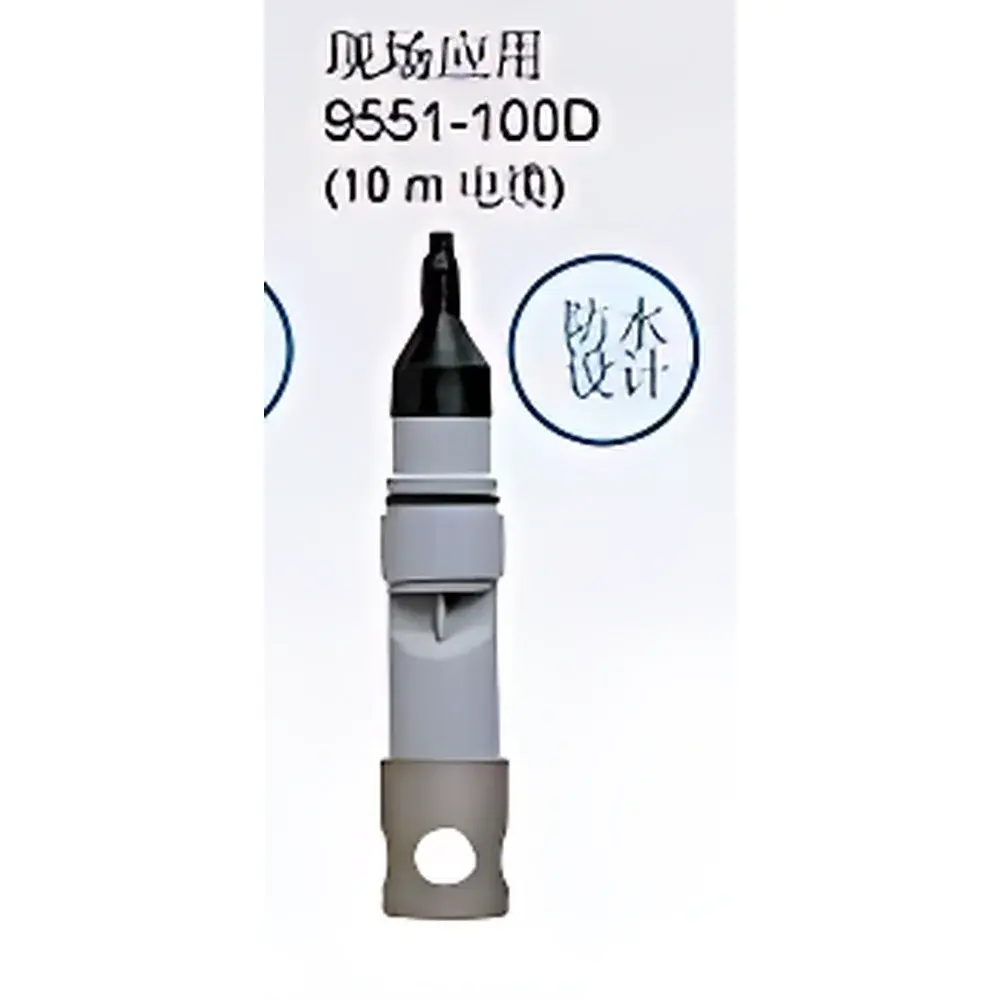
HORIBA 9551-100D Waterproof Dissolved Oxygen Electrode
| Brand | HORIBA |
|---|---|
| Origin | Japan |
| Model | 9551-100D |
| Cable Length | 10 m |
| Operating Temperature Range | 0–40 °C |
| IP Rating | IP68 (submersible) |
| Electrode Type | Clark-type polarographic DO sensor |
| Compatibility | Designed for use with HORIBA LAQUA DO meters (e.g., LAQUA twin, LAQUA DO-110/210 series) |
| Calibration | Two-point (zero O₂ and air-saturated water) or single-point (air-saturation) |
| Response Time (t₉₀) | < 30 s in stirred water |
| Membrane | Replaceable Teflon® (PTFE) cap |
| Electrolyte | KCl-based aqueous electrolyte |
| Storage Condition | Wet storage in DO electrode storage solution or saturated KCl solution |
Overview
The HORIBA 9551-100D is a submersible, polarographic dissolved oxygen (DO) electrode engineered for high-reliability field deployment in environmental water quality monitoring. Based on the classic Clark cell principle, it employs a cathodically polarized noble metal working electrode (typically gold or platinum), a silver/silver chloride reference electrode, and an oxygen-permeable PTFE membrane that selectively allows molecular oxygen diffusion into the electrolyte-filled chamber. The resulting Faradaic current—linearly proportional to the partial pressure of dissolved oxygen—is converted to concentration units (mg/L or % saturation) via temperature-compensated algorithms in compatible HORIBA DO meters. With its 10-meter waterproof cable and IP68-rated housing, the 9551-100D is optimized for long-term immersion in rivers, lakes, reservoirs, wastewater channels, and aquaculture systems where cable reach and mechanical robustness are critical. Its operational range of 0–40 °C aligns with standard ambient freshwater and municipal effluent conditions, supporting compliance with ISO 5814:2012 (water quality — determination of dissolved oxygen — electrochemical probe method) and ASTM D888-22 (standard test methods for dissolved oxygen in water).
Key Features
- 10-meter integrated polyurethane-jacketed cable with strain relief and UV-resistant insulation—designed for repeated deployment in harsh outdoor environments
- Replaceable PTFE sensing membrane and user-serviceable electrolyte chamber enabling field recalibration and extended service life
- Polarographic operation with stable zero-current baseline and minimal drift (< 0.1 mg/L/24 h under controlled conditions)
- Integrated NTC thermistor for automatic temperature compensation (0.1 °C resolution) across full operating range
- Stainless steel 316L body and epoxy-sealed internal electronics ensuring corrosion resistance in brackish and freshwater matrices
- Direct compatibility with HORIBA LAQUA DO-series handheld and benchtop meters—including DO-110, DO-210, and LAQUA twin—via standardized BNC connector
Sample Compatibility & Compliance
The 9551-100D is validated for use in natural waters (surface, groundwater), treated and untreated wastewater, industrial process streams, and aquaculture ponds. It exhibits minimal interference from common ions (Cl⁻, NO₃⁻, SO₄²⁻) and low sensitivity to flow velocity above 10 cm/s—making it suitable for both static and flowing applications. While not intended for seawater (>35 ppt salinity) without salinity correction input, it supports manual or meter-based compensation per Winkler-derived salinity factors. The electrode conforms to GLP documentation requirements when used with HORIBA meters equipped with audit-trail logging (e.g., LAQUA DO-210 with optional data export). Its design and performance metrics support alignment with EPA Method 360.1, ISO 5814, and JIS K 0102 for routine DO analysis in regulatory and research-grade environmental laboratories.
Software & Data Management
When paired with HORIBA LAQUA DO-series instruments, the 9551-100D leverages embedded firmware supporting real-time temperature-compensated DO output in mg/L, % saturation, and partial pressure (kPa or mmHg). Meters with USB or Bluetooth connectivity (e.g., LAQUA DO-210) enable direct transfer of timestamped measurement sets—including calibration history, electrode status flags, and ambient temperature—to PC-based HORIBA LAQUA Link software. This platform supports CSV export, trend visualization, and batch report generation compliant with internal QA/QC protocols. For networked deployments, integration with SCADA-compatible Modbus RTU gateways (via optional analog output adapters) permits continuous DO telemetry in centralized water quality monitoring systems—fully traceable under 21 CFR Part 11 when configured with electronic signature and access control.
Applications
- Long-term in-situ monitoring of DO profiles in eutrophic lakes and hypolimnetic zones
- Effluent discharge compliance verification at WWTP outfalls per NPDES permit requirements
- Real-time aeration control in activated sludge basins using feedback-loop integration
- Benthic respiration studies requiring extended submersion and cable slack management
- Environmental impact assessments (EIAs) for hydroelectric or irrigation infrastructure projects
- Educational fieldwork in limnology and environmental science curricula
FAQ
What is the recommended calibration frequency for the 9551-100D in field use?
Calibration is advised before each deployment cycle or at least daily for continuous monitoring; zero-point verification using sodium sulfite solution and two-point calibration with air-saturated water are standard practice.
Can the 9551-100D be used in saline or estuarine waters?
Yes—with salinity input enabled on the host meter; accuracy degrades above 35 ppt without correction due to oxygen solubility dependence on ionic strength.
How often should the PTFE membrane and electrolyte be replaced?
Typical replacement interval is every 2–3 months under weekly field use; more frequent changes are required in turbid, organic-rich, or sulfide-laden waters.
Is the electrode compatible with non-HORIBA meters?
It outputs a standard polarographic current signal (nA range) and may interface with third-party meters supporting Clark-cell input, though temperature compensation and unit conversion require manual configuration.
Does the 9551-100D support automatic pressure compensation?
No—barometric pressure must be entered manually or sourced externally; the electrode itself measures oxygen partial pressure, not concentration directly.
Related Products







