
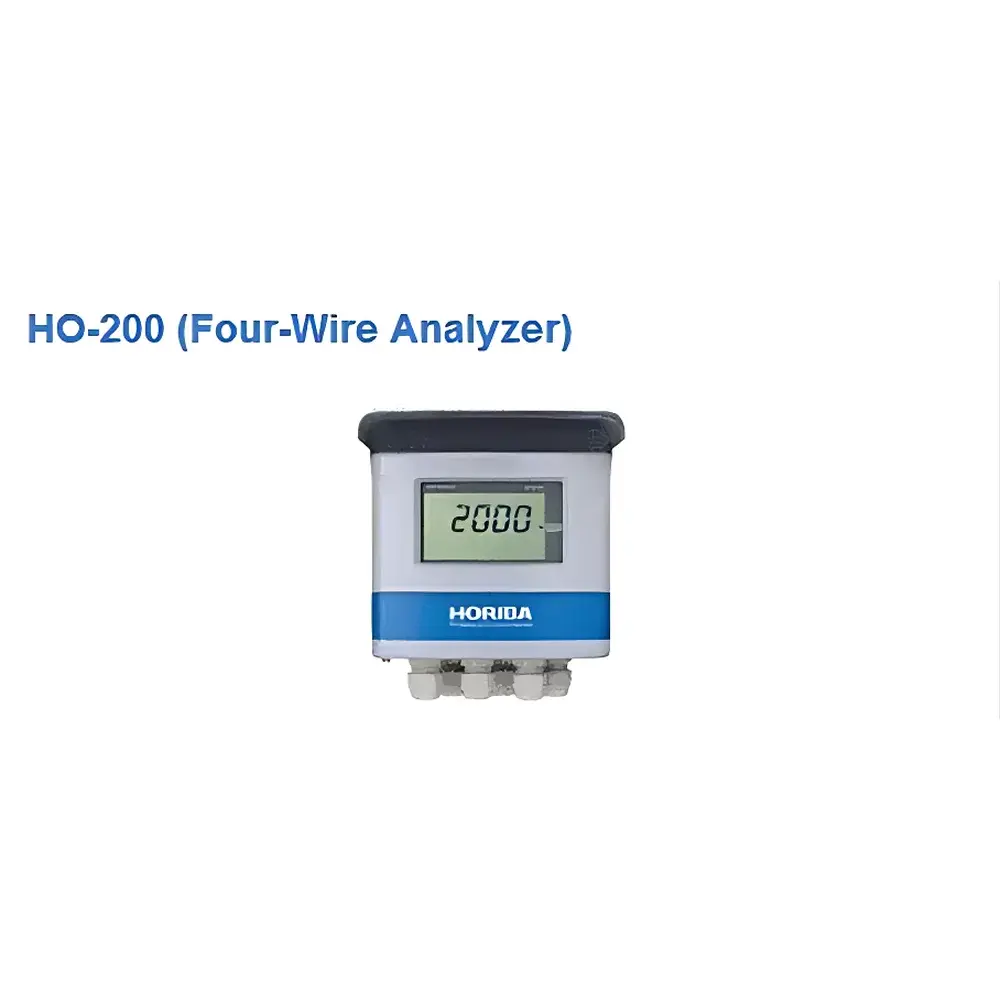
HORIBA HO-200 Industrial Online ORP Monitor
| Brand | HORIBA |
|---|---|
| Origin | Japan |
| Model | HO-200 |
| ORP Range | −2000 to +2000 mV |
| ORP Resolution | 1 mV |
| Temperature Range | 0–100 °C |
| Temperature Resolution | 0.1 °C |
| ORP Repeatability | ±5 mV (max) |
| ORP Linearity | ±5 mV (max) |
| Temperature Accuracy | ±0.3 °C (equivalent input) |
| Output | Two isolated 4–20 mA DC outputs (max load: 900 Ω) |
| Relay Outputs | 3 SPDT (1c) contact points |
| Digital Interface | RS-485 (2-wire, input/output isolated) |
| Enclosure Rating | IP65 |
| Power Supply | 90–264 V AC, 50/60 Hz |
| Power Consumption | ≤15 VA |
| Operating Ambient Temperature | −20 to +55 °C |
| Housing Material | Aluminum alloy |
| Mounting | Wall or 50A pipe column |
| Weight | ~4.5 kg |
Overview
The HORIBA HO-200 is an industrial-grade, outdoor-rated online oxidation-reduction potential (ORP) monitor engineered for continuous, real-time water quality assessment in demanding process and environmental applications. Based on the robust H-1 series platform, the HO-200 employs a stable metal reference electrode system—typically platinum or redox-sensitive noble metal electrodes—to measure the electrochemical potential difference between a sensing electrode and a reference electrode immersed in aqueous solution. This potential, expressed in millivolts (mV), reflects the net oxidizing or reducing capacity of the sample and serves as a critical surrogate parameter for disinfection efficacy, redox-controlled biological treatment stages (e.g., denitrification), chemical dosing control (e.g., chlorine, ozone, permanganate), and corrosion monitoring in cooling water systems. Designed for permanent field deployment, the HO-200 operates without reagent consumption and delivers high reproducibility under fluctuating temperature and flow conditions, with built-in Pt1000-based automatic temperature compensation (0–100 °C) ensuring measurement integrity across wide thermal gradients.
Key Features
- IP65-rated aluminum alloy enclosure for reliable outdoor operation in harsh industrial environments—including exposure to rain, dust, and temperature extremes (−20 to +55 °C ambient)
- Large, high-contrast digital display enabling at-a-glance verification of ORP (−2000 to +2000 mV) and temperature (0–100 °C) values, with simultaneous dual-parameter readout
- Three programmable SPDT relay outputs supporting configurable alarm logic (high/low limit, fault, cleaning cycle trigger) and discrete control functions (e.g., pump activation, valve switching)
- Two fully isolated 4–20 mA analog outputs with selectable scaling, compatible with DCS, PLC, and SCADA systems; maximum load resistance: 900 Ω
- RS-485 Modbus RTU interface (2-wire, input/output isolated) for bidirectional communication, remote configuration, and data logging integration
- Comprehensive self-diagnostic capability including electrode health monitoring, open-circuit detection, short-circuit identification, and analyzer hardware fault reporting
- Manual mV offset adjustment (−200 to +200 mV) and sensitivity calibration (0.500–1.500) to accommodate aging electrodes or non-standard reference systems
- Compliance with CE marking (EMC & LVD directives), FCC Part 15 Class B, RoHS, and WEEE directives—supporting global deployment in regulated infrastructure
Sample Compatibility & Compliance
The HO-200 is validated for continuous immersion or flow-through measurement in municipal wastewater effluents, industrial process streams (e.g., electroplating rinse waters, semiconductor ultrapure water loops), cooling tower circuits, and potable water distribution networks. It supports direct connection to standard 12 mm or 16 mm diameter ORP sensors with BNC or DIN connectors. The instrument meets functional safety expectations for Level 1 process monitoring per IEC 61508 and is routinely deployed in facilities adhering to ISO 9001, ISO 14001, and ISO/IEC 17025-accredited QA/QC protocols. While not intrinsically safe, its design enables use in non-hazardous area classifications (Zone 2 / Class I, Division 2) when installed per local electrical codes. Calibration traceability aligns with NIST-traceable standards via certified buffer solutions (e.g., quinhydrone, Zobell’s solution).
Software & Data Management
Configuration, calibration history, and diagnostic logs are accessible locally via front-panel navigation or remotely via Modbus register mapping. The HO-200 stores up to 100 calibration events with timestamps, electrode offset values, and user-defined notes—enabling audit-ready documentation for GLP and GMP environments. When integrated into centralized SCADA platforms, raw ORP and temperature data streams support time-series trending, statistical process control (SPC) charting, and automated threshold-based incident reporting. Though the device lacks embedded web server functionality, its RS-485 output facilitates seamless ingestion into third-party historian systems (e.g., Ignition, Siemens Desigo, Emerson DeltaV) compliant with ISA-95 and ISA-88 data models.
Applications
- Real-time monitoring of chlorine residual efficacy in drinking water disinfection basins
- Control of sodium hypochlorite or hydrogen peroxide dosing in membrane pre-treatment systems
- Redox endpoint detection during electrochemical wastewater treatment (e.g., Cr(VI) reduction, cyanide oxidation)
- Corrosion potential tracking in closed-loop cooling water systems to optimize inhibitor dosing
- Process validation in pharmaceutical water-for-injection (WFI) and pure steam generation cycles
- Regulatory compliance reporting for EPA NPDES permits requiring continuous ORP surveillance
FAQ
What electrode types are compatible with the HO-200?
The HO-200 accepts standard ORP electrodes with BNC or DIN connectors, including platinum, gold, and ruthenium oxide sensing elements paired with Ag/AgCl or calomel reference systems.
Does the HO-200 support automatic temperature compensation?
Yes—it integrates Pt1000 RTD input and supports optional external thermistor inputs (500 Ω, 6.8 kΩ, or 10 kΩ at 25 °C) for precise, sample-specific compensation across 0–100 °C.
Can the analog outputs be configured independently?
Yes—each 4–20 mA channel can be scaled separately to ORP, temperature, or derived parameters (e.g., mV deviation from setpoint).
Is the HO-200 suitable for explosive atmospheres?
No—the unit is not certified for hazardous locations; it must be installed in non-classified zones per NEC Article 500 or IEC 60079-14.
How is calibration verified in the field?
Calibration is performed manually using certified ORP standard solutions; the analyzer records date, operator ID (if entered), offset value, and sensitivity factor for full traceability.







