
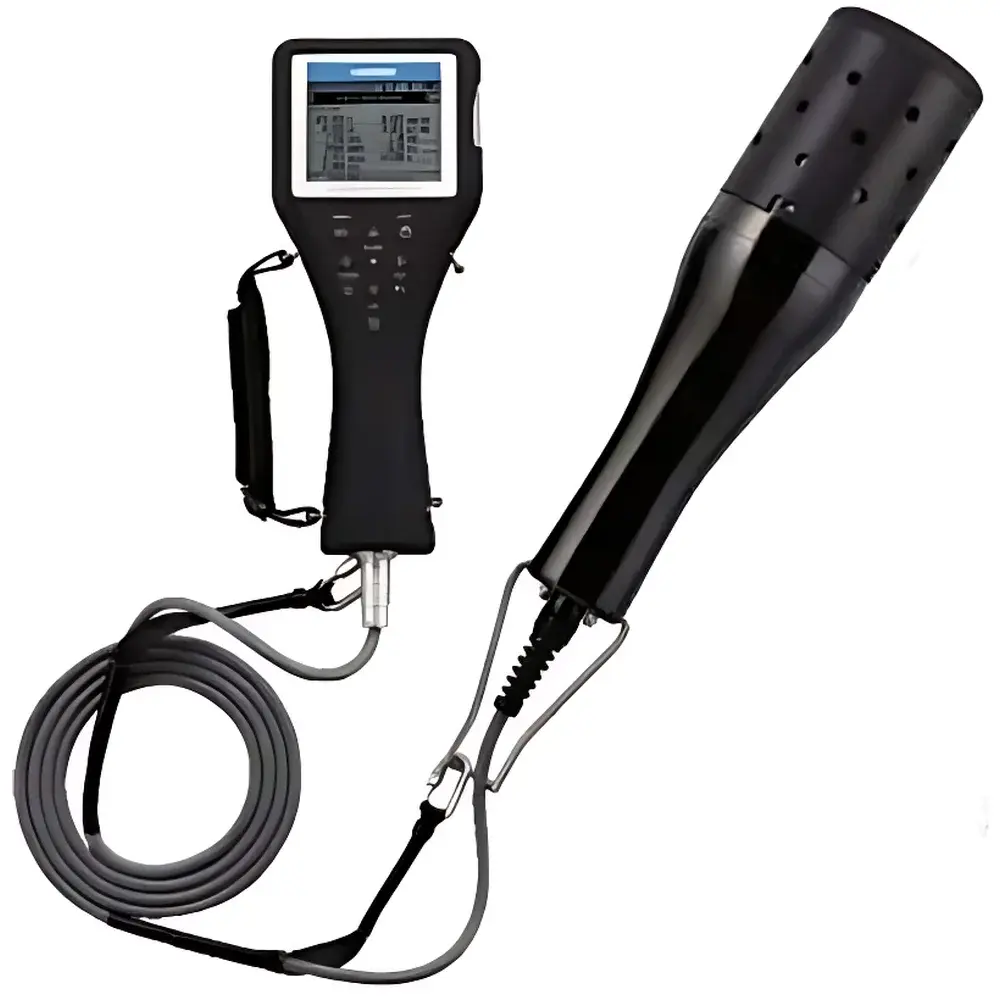
HORIBA U-50 Series Portable Multi-Parameter Water Quality Analyzer
| Brand | HORIBA |
|---|---|
| Origin | Japan |
| Model | U-50 (Portable) |
| Instrument Type | Portable / Handheld Water Quality Analyzer |
| Measured Parameters | pH, ORP, Dissolved Oxygen (DO), Electrical Conductivity (EC), Temperature, Salinity, TDS, Specific Gravity (Seawater), Turbidity (NTU), Depth (m), GPS Positioning |
| Turbidity Standards | U-53 — US EPA Method |
| Operating Temperature Range | −10 to 55 °C |
| Electrode Diameter | ~96 mm |
| Electrode Length | ~340 mm |
| Standard Cable Length | 2 m (optional: 10 m / 30 m) |
| Weight (Electrode) | ~1800 g |
| Weight (Host Unit) | ~800 g |
| Display | 320 × 240 monochrome LCD with backlight |
| Data Storage | Up to 10,000 measurement sets |
| Power | Four AA alkaline batteries |
| Battery Life | Up to 70 hours (U-51/U-52/U-54 series, no backlight) |
| IP Rating | IP68 (JIS Protection Class 8 for electrode |
| Materials | PPS, glass, SUS316L/SUS304 stainless steel, FKM, PEEK, titanium, FEP membrane, POM |
Overview
The HORIBA U-50 Series Portable Multi-Parameter Water Quality Analyzer is an engineered field instrument designed for high-reliability in-situ environmental monitoring of surface water, groundwater, wastewater, and marine environments. Based on electrochemical, optical scattering, and pressure-based physical measurement principles, the U-50 platform integrates calibrated sensor modules—including glass electrode (pH), platinum redox electrode (ORP), Clark-type polarographic DO sensor, four-electrode AC conductivity cell, and dual-wavelength turbidity detectors—into a single ruggedized probe assembly. Its modular architecture supports configuration-specific variants (U-51 through U-54G), enabling tailored deployment across regulatory compliance workflows, ecological surveys, and industrial effluent verification. The system operates under ambient temperature conditions from −10 °C to 55 °C and maintains measurement integrity at depths up to 30 m via pressure-compensated depth sensing. All models comply with JIS C 0920 (IP68/IP67) for submersible operation and are constructed using chemically inert, corrosion-resistant materials including SUS316L, titanium, FEP, and PEEK—critical for long-term stability in saline or aggressive matrices.
Key Features
- Simultaneous real-time measurement of up to 11 parameters: pH, pH (mV), ORP, dissolved oxygen (DO), electrical conductivity (EC), salinity, total dissolved solids (TDS), seawater specific gravity (δt), temperature, turbidity (NTU), and depth (m).
- Multi-standard turbidity detection: U-53 probe conforms to US EPA Method 180.1 (LED forward-scatter, 30°); U-54 probe complies with EN ISO 7027 (LED 90° scatter), both offering 0.01 NTU resolution and integrated mechanical cleaning brushes to mitigate biofouling.
- Enhanced polarographic DO sensor with accelerated response time (<60 s to 90% step change) and simplified membrane/electrolyte maintenance protocol.
- GPS-enabled models (U-52G, U-53G, U-54G) feature 12-channel reception for geotagged data logging—essential for spatially referenced watershed mapping and regulatory reporting.
- Five-language UI support (English, Japanese, Russian, Spanish, Portuguese) and intuitive monochrome LCD (320 × 240) with adjustable backlight for low-light field use.
- Auto-ranging conductivity module with automatic temperature compensation to 25 °C and selectable TDS conversion factors (0.4–1.0). Salinity and seawater specific gravity calculated per standard PSS-78 algorithms.
- Robust mechanical design: IP68-rated probe housing (JIS Class 8), IP67-rated host unit (with cable connected), and chemical resistance validated for continuous immersion in freshwater, estuarine, and seawater environments.
Sample Compatibility & Compliance
The U-50 Series is validated for direct immersion in natural and anthropogenic aqueous media—including rivers, lakes, aquifers, municipal wastewater, industrial discharge streams, and coastal marine zones. Sensor calibration protocols align with internationally recognized reference methods: pH per ASTM D1293 and ISO 10523; ORP per ASTM D3693; DO per ISO 5814 and APHA 4500-O; EC and salinity per ISO 7888 and ASTM D1125; turbidity per US EPA 180.1 (U-53) and EN ISO 7027 (U-54). All instruments support GLP-compliant data capture with timestamped, location-stamped records suitable for regulatory submissions under EPA, EU WFD, and national water quality directives. Data integrity is preserved via non-volatile internal memory (10,000 entries) and USB export without proprietary software dependency.
Software & Data Management
Data acquisition and post-processing are supported via HORIBA’s standardized PC application (compatible with Windows 10/11), which enables batch download, spectral visualization, statistical summary (min/max/avg/stdev), and CSV export for integration into LIMS or GIS platforms. Each logged record includes UTC timestamp, GPS coordinates (latitude/longitude/altitude), sensor ID, calibration status flags, and operator-defined site codes. Audit trails record calibration events (date, time, buffer values, slope/offset), battery voltage, and firmware version—meeting traceability requirements under ISO/IEC 17025 and FDA 21 CFR Part 11 (when used with validated system configuration). No cloud dependency: all operations occur locally, ensuring data sovereignty and operational continuity in remote or offline deployments.
Applications
- Regulatory environmental monitoring programs requiring multi-parameter compliance with EPA NPDES, EU Water Framework Directive, or China’s GB 3838 standards.
- Rapid assessment of drinking water source vulnerability, including seasonal pH/DO fluctuations and conductivity-driven salinity intrusion tracking.
- Wastewater treatment plant (WWTP) process control—real-time DO profiling in aeration basins, ORP-guided denitrification, and EC-based load balancing.
- Ecological field studies: benthic zone profiling, hypolimnetic oxygen depletion analysis, and turbidity-driven sediment transport modeling.
- Marine and estuarine research: salinity stratification mapping, specific gravity correction for density-driven circulation, and turbidity plume dispersion monitoring.
- Emergency response: post-spill or flood event characterization, where portability, rapid startup (<30 s), and multi-parameter cross-validation reduce decision latency.
FAQ
What turbidity standards does the U-50 support, and how do U-53 and U-54 differ?
The U-53 probe implements US EPA Method 180.1 (LED forward-scatter at 30°), while the U-54 probe conforms to EN ISO 7027 (LED 90° scatter). Both achieve 0.01 NTU resolution and include motorized cleaning brushes.
Does the U-50 require external power or PC connection for basic operation?
No—fully self-contained with four AA alkaline batteries; all measurements, display, storage, and GPS functions operate autonomously in the field.
How is temperature compensation applied across parameters?
Automatic temperature compensation (ATC) is applied per parameter-specific algorithms: Nernstian for pH, thermistor-based for DO and EC, and Pt100-class for temperature itself (JIS B-grade accuracy).
Can calibration be performed in the field, and what buffers are required?
Yes—two-point pH calibration uses standard pH 4.01 and 7.00 (or 10.01) buffers; DO calibration employs air-saturation or zero-oxygen solution; EC uses KCl standards (e.g., 1413 µS/cm). All calibrations are stored per sensor module.
Is the U-50 compliant with FDA 21 CFR Part 11 for regulated pharmaceutical or food processing applications?
When deployed within a validated IT environment—including controlled user access, electronic signatures, and audit-trail-enabled software—the U-50 meets foundational data integrity requirements for GxP-aligned water system monitoring.
Related Products







