
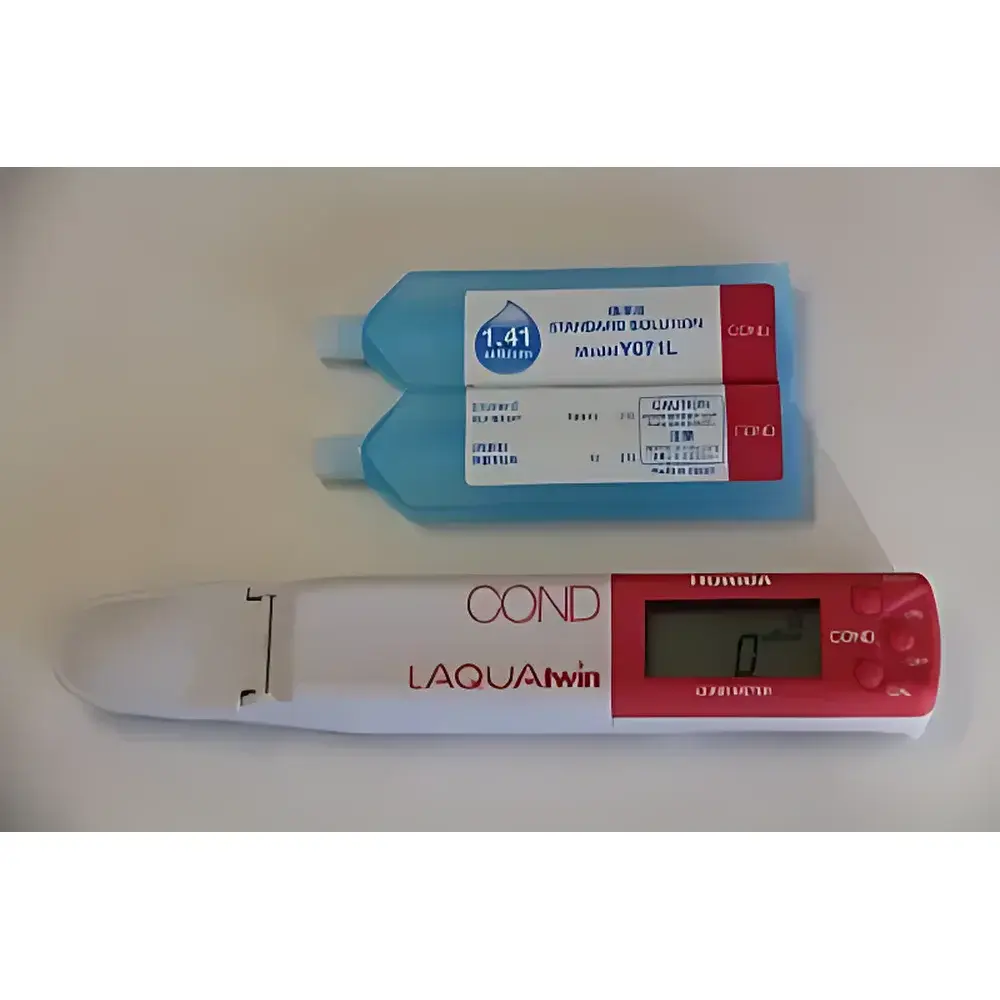
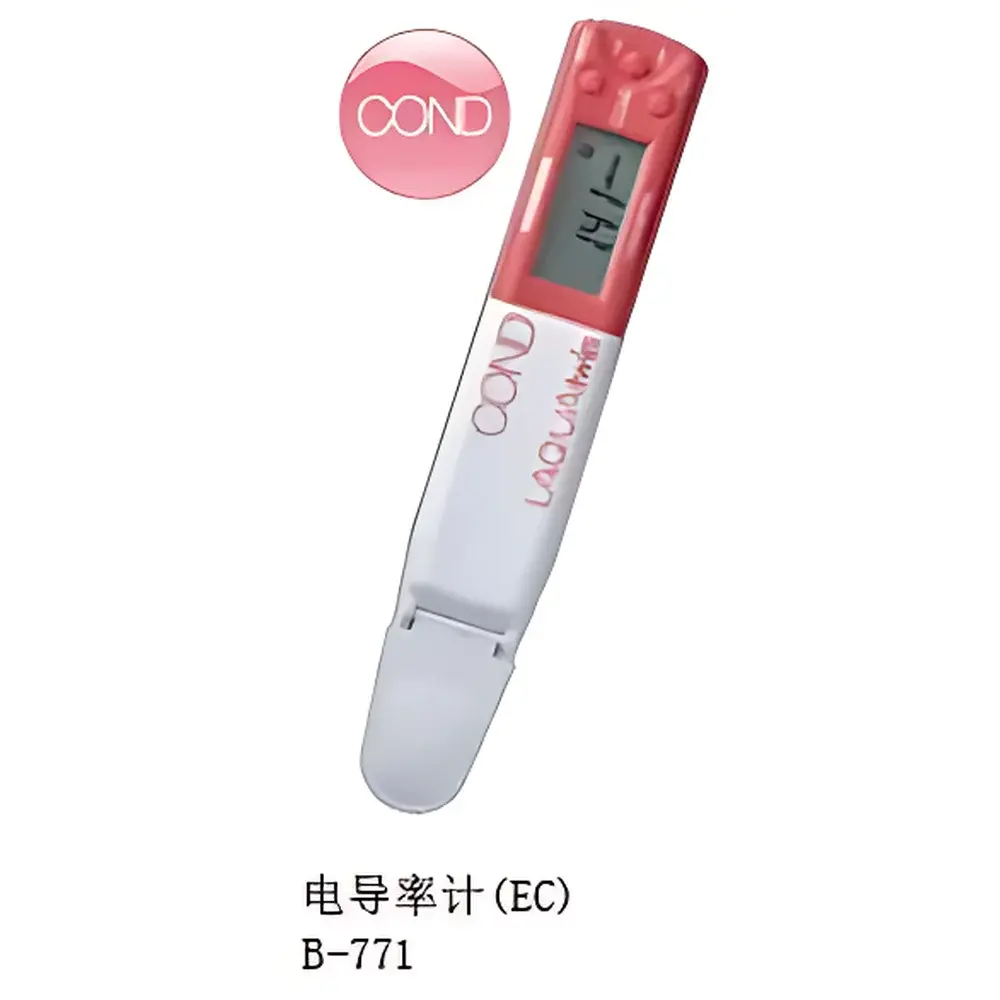
HORIBA B-771 Portable Conductivity/TDS/Salinity Pen Meter
| Brand | HORIBA |
|---|---|
| Origin | Japan |
| Model | B-771 |
| Detection Parameter | Single (Conductivity) |
| Portability | Pen-type |
| Conductivity Range | 0–19.9 mS/cm |
| TDS Range | 0–9900 ppm |
| Salinity Range | 0–1.1% NaCl |
| Temperature Range | 5–40 °C |
| Accuracy | ±2% F.S. ±1 digit |
| Resolution | 0.1 mS/cm, 0.1 ppm, 0.01% |
| Measurement Principle | Two-electrode AC method |
| Sample Volume | ≥0.12 mL |
| Temperature Compensation | Fixed 2%/°C |
| IP Rating | IP67 |
| Power | Two CR2032 batteries |
| Dimensions | 164 × 29 × 20 mm |
| Weight | ~45 g (instrument only) |
Overview
The HORIBA B-771 is a compact, handheld conductivity pen meter engineered for rapid, field-deployable measurement of electrical conductivity (EC), total dissolved solids (TDS), and salinity in aqueous solutions. It employs a two-electrode alternating current (AC) measurement principle to eliminate polarization effects and ensure stable readings across varying ionic strengths. Designed for routine quality control, environmental monitoring, hydroponics, aquarium management, and educational laboratory use, the B-771 delivers reliable single-parameter analysis without requiring complex calibration protocols or external power sources. Its lightweight, ergonomic pen form factor enables one-handed operation and immediate on-site assessment—critical for applications where portability, speed, and ruggedness are essential. The instrument features automatic temperature compensation (ATC) with a fixed coefficient of 2%/°C, aligned with standard conversion practices for NaCl-based solutions per ASTM D1125 and ISO 7888.
Key Features
- IP67-rated enclosure for full dust ingress protection and immersion resistance up to 1 m for 30 minutes—suitable for humid, outdoor, or splash-prone environments.
- Two-point calibration capability using standardized KCl reference solutions (e.g., 1413 µS/cm and 12.88 mS/cm), supporting traceable accuracy compliant with GLP documentation requirements.
- Auto-hold function freezes the stabilized reading on-screen, minimizing operator-induced variability during manual sampling.
- Low sample volume requirement (≥0.12 mL) enables testing in confined vessels, microcosms, or small-volume process streams without dilution or waste.
- Integrated temperature sensor (5–40 °C operating range) ensures real-time thermal correction, with display of both measured conductivity and compensated value.
- CR2032 coin-cell battery power (2 × 3 V) provides >10,000 measurements per set under typical usage, with low-battery indicator and auto-power-off after 10 minutes of inactivity.
Sample Compatibility & Compliance
The B-771 is validated for use with freshwater, brackish water, nutrient solutions, cooling tower water, and low-conductivity industrial effluents. It is not intended for high-viscosity, suspended-solids-laden, or strongly oxidizing media that may foul or degrade the platinum-coated stainless-steel electrodes. Electrode geometry and AC excitation frequency (typically 1–10 kHz) minimize electrode fouling and reduce errors from surface film formation. The device conforms to IEC 60529 (IP67), RoHS Directive 2011/65/EU, and meets electromagnetic compatibility standards per EN 61326-1:2013 for laboratory and field use. While not certified for FDA 21 CFR Part 11 compliance out-of-the-box, its calibration logs (recorded manually or via optional data logging accessories) support audit-ready documentation under ISO/IEC 17025-accredited quality systems.
Software & Data Management
The B-771 operates as a standalone instrument with no onboard memory or Bluetooth connectivity. All measurement data must be recorded manually or transcribed into LIMS or Excel-based tracking systems. For regulated environments requiring electronic records, users may pair the B-771 with external dataloggers compatible with analog voltage output (if equipped with optional adapter) or adopt paper-based calibration logs adhering to ALCOA+ principles (Attributable, Legible, Contemporaneous, Original, Accurate, Complete, Consistent, Enduring, Available). Calibration certificates, certificate of conformance, and manufacturer’s declaration of conformity are supplied with each unit to support IQ/OQ validation protocols.
Applications
- Environmental field surveys: Surface water EC screening for watershed health assessment and pollution source identification.
- Aquaculture & hydroponics: Daily monitoring of nutrient solution conductivity to maintain optimal ion availability and prevent osmotic stress.
- Drinking water safety checks: Rapid verification of TDS levels against WHO Guidelines for Drinking-water Quality (≤1000 ppm).
- Education labs: Student experiments on ionic strength effects, solution dilution series, and temperature dependence of conductivity.
- Facility maintenance: Spot-checking boiler feedwater, reverse osmosis permeate, or deionized water rinse stages in semiconductor or pharmaceutical cleanrooms.
FAQ
What calibration standards are recommended for the B-771?
Standard KCl solutions at 1413 µS/cm (0.01 mol/L) and 12.88 mS/cm (0.1 mol/L) are recommended for two-point calibration per ISO 7888 Annex A.
Does the B-771 support linear or non-linear temperature compensation?
It applies fixed 2%/°C linear compensation, optimized for NaCl-dominated matrices; it does not support adjustable β-coefficients or multi-salt algorithms.
Can the electrode be cleaned if contaminated?
Yes—gently wipe the electrode tip with soft tissue moistened with deionized water; avoid abrasive cleaners or organic solvents that may damage the platinum coating.
Is the B-771 suitable for seawater analysis?
It covers up to 1.1% salinity (~19 mS/cm), which corresponds to approximately 50% of typical open-ocean seawater (3.5% NaCl); for full-range marine work, a higher-range meter (e.g., 0–200 mS/cm) is advised.
How often should calibration be performed?
Daily calibration is recommended for critical applications; for general-purpose use, calibration before first use and after prolonged storage or exposure to extreme temperatures is sufficient.
Related Products





