
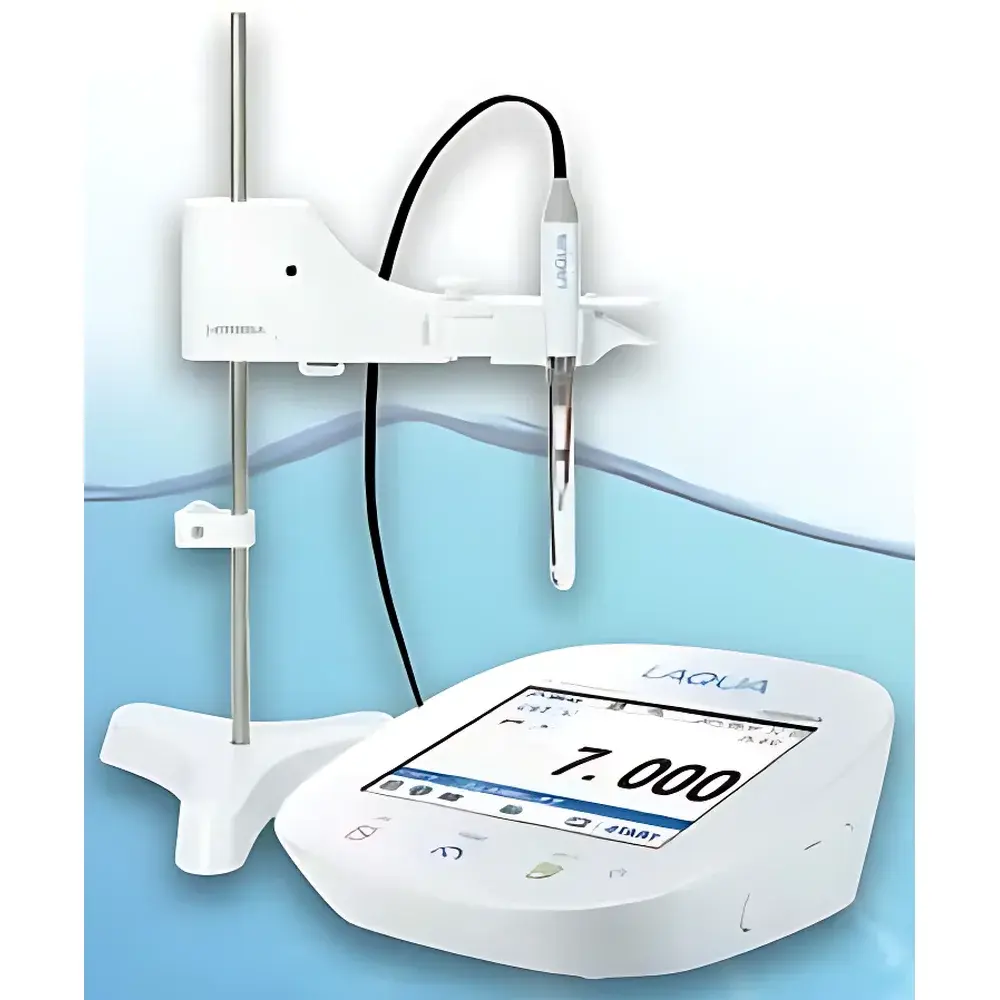
HORIBA F-74BW Benchtop Multi-Parameter Water Quality Analyzer
| Brand | HORIBA |
|---|---|
| Origin | Japan |
| Model | F-74BW |
| Instrument Type | Benchtop Laboratory Water Quality Analyzer |
| Measured Parameters | pH, ORP, Ion Concentration, Conductivity, Resistivity, Salinity, TDS, Temperature |
| Display | Dual-channel capacitive touchscreen |
| Data Storage | 999 measurement records |
| Compliance | JIS, USP <645>, EP 2.2.38, JP XVIII, ChP |
| Language Support | English, Japanese, Korean, Chinese |
| Power Supply | AC adapter 100–240 V, 50/60 Hz |
| Power Consumption | ~0.7 VA |
| Weight | ~500 g |
Overview
The HORIBA F-74BW is a high-precision benchtop multi-parameter water quality analyzer engineered for regulated laboratory environments requiring traceable, reproducible measurements across critical water quality parameters. It operates on well-established electrochemical and conductometric principles: pH and ORP are measured using standardized glass and noble-metal reference electrodes; ion concentration is determined via selective ion electrode (ISE) potentiometry; and conductivity is acquired using a dual-electrode AC excitation method—eliminating polarization effects and ensuring stability across wide dynamic ranges. Resistivity, salinity, and total dissolved solids (TDS) are derived algorithmically from conductivity data using NIST-traceable temperature compensation models (e.g., linear, non-linear, or user-defined curves). Designed to meet the stringent metrological requirements of pharmaceutical, environmental, and academic laboratories, the F-74BW supports full auditability under GLP and GMP frameworks through time-stamped data logging, user authentication, and calibration history retention.
Key Features
- Dual-channel capacitive touchscreen interface with intuitive navigation—enables simultaneous real-time display of two independent parameter sets (e.g., pH/ORP/ION on Channel 1; conductivity/resistivity/salinity/TDS on Channel 2)
- Comprehensive compliance guidance: On-screen check navigation for electrode verification, system performance checks, and calibration validation aligned with JIS Z 8401, USP , European Pharmacopoeia 2.2.38, Japanese Pharmacopoeia XVIII, and Chinese Pharmacopoeia
- Integrated fault-diagnostic engine: Context-sensitive troubleshooting prompts appear during calibration failure, electrode drift detection, or out-of-range readings—reducing operator dependency and minimizing downtime
- Modular electrode architecture: Quick-release glass pH electrodes with integrated temperature sensors (ATC), compatible with standard BNC and DIN connectors; optimized for cleaning, storage, and long-term stability
- Regulatory-ready data management: Supports GLP/GMP-compliant USB export to external drives and direct PC connection via virtual COM port; all stored records include timestamp, operator ID, electrode serial number, and calibration status flags
- Multi-language firmware: English, Japanese, Korean, and Simplified Chinese UI options—facilitating global deployment without localization overhead
Sample Compatibility & Compliance
The F-74BW is validated for use with aqueous samples ranging from ultrapure water (resistivity up to 18.2 MΩ·cm) to highly conductive industrial effluents (conductivity up to 199.9 S/m, depending on cell constant). Its measurement algorithms apply automatic temperature compensation per ISO 7888 and ASTM D1125 standards. For pharmaceutical applications, the instrument satisfies USP requirements for conductivity measurement of Purified Water and Water for Injection—including automatic temperature correction to 25 °C, conductivity limit evaluation, and alarm-triggered retest protocols. All calibration and measurement procedures adhere to ISO/IEC 17025 documentation practices, and the device maintains full traceability to national standards (e.g., NIST SRM buffers, certified conductivity standards).
Software & Data Management
Data acquisition and reporting are governed by an embedded firmware architecture that enforces ALCOA+ principles (Attributable, Legible, Contemporaneous, Original, Accurate, Complete, Consistent, Enduring, Available). Each stored record (max. 999 entries) contains: date/time stamp, parameter values with units and uncertainty indicators, electrode identification, calibration coefficients, ambient temperature, and operator login ID. USB connectivity enables secure export in CSV format compatible with LIMS and statistical analysis platforms (e.g., JMP, Minitab). The device does not require proprietary software—configuration and data retrieval operate natively via standard CDC ACM serial emulation. Audit trail functionality logs all configuration changes, calibration events, and user logins with immutable timestamps—fully compliant with FDA 21 CFR Part 11 when paired with appropriate organizational controls.
Applications
- Pharmaceutical QC labs performing routine conductivity testing of Purified Water and Water for Injection per USP and EP 2.2.38
- Environmental monitoring programs assessing surface water, groundwater, and wastewater for regulatory reporting (e.g., EPA Method 120.1, ISO 7888)
- Academic research requiring high-resolution ion quantification (e.g., nitrate, fluoride, ammonium) using ISEs with sub-ppb detection capability
- Power plant chemistry labs monitoring boiler feedwater purity and condensate resistivity trends
- Food & beverage facilities verifying rinse water conductivity and sanitizer concentration
- Calibration laboratories performing inter-laboratory comparisons and reference electrode verification
FAQ
Does the F-74BW support GLP/GMP-compliant data integrity requirements?
Yes—the instrument implements time-stamped, user-authenticated data logging with immutable audit trails, calibration history retention, and exportable CSV records meeting ALCOA+ criteria. When deployed with documented SOPs and access controls, it satisfies FDA 21 CFR Part 11 and EU Annex 11 expectations.
What conductivity cell constants are supported, and how are they selected?
The F-74BW accommodates three standard cell constants: 0.01 cm⁻¹ (10 m⁻¹), 0.1 cm⁻¹ (100 m⁻¹), and 1.0 cm⁻¹ (1000 m⁻¹). Cell constant is manually entered during setup and used to scale raw conductance readings into SI units (S/m); auto-ranging ensures optimal resolution across the full 0.001 µS/m to 199.9 S/m span.
Can the F-74BW perform automatic temperature compensation for all parameters?
Yes—integrated ATC (Automatic Temperature Compensation) applies NIST-certified algorithms for pH, conductivity, resistivity, salinity, and TDS. Users may select linear, non-linear (e.g., CaCl₂ or KCl-based), or custom polynomial compensation curves per application need.
Is external software required for data analysis or report generation?
No—raw data export via USB mass storage or virtual COM port provides native CSV files readable in Excel, Python pandas, or LIMS systems. No proprietary drivers or cloud dependencies are required.
How is electrode health monitored during operation?
The instrument continuously evaluates electrode slope (% recovery), asymmetry potential, and impedance. Deviations beyond configurable thresholds trigger on-screen alerts and optional logging entries—supporting predictive maintenance and ICH Q5C stability assessment protocols.







