
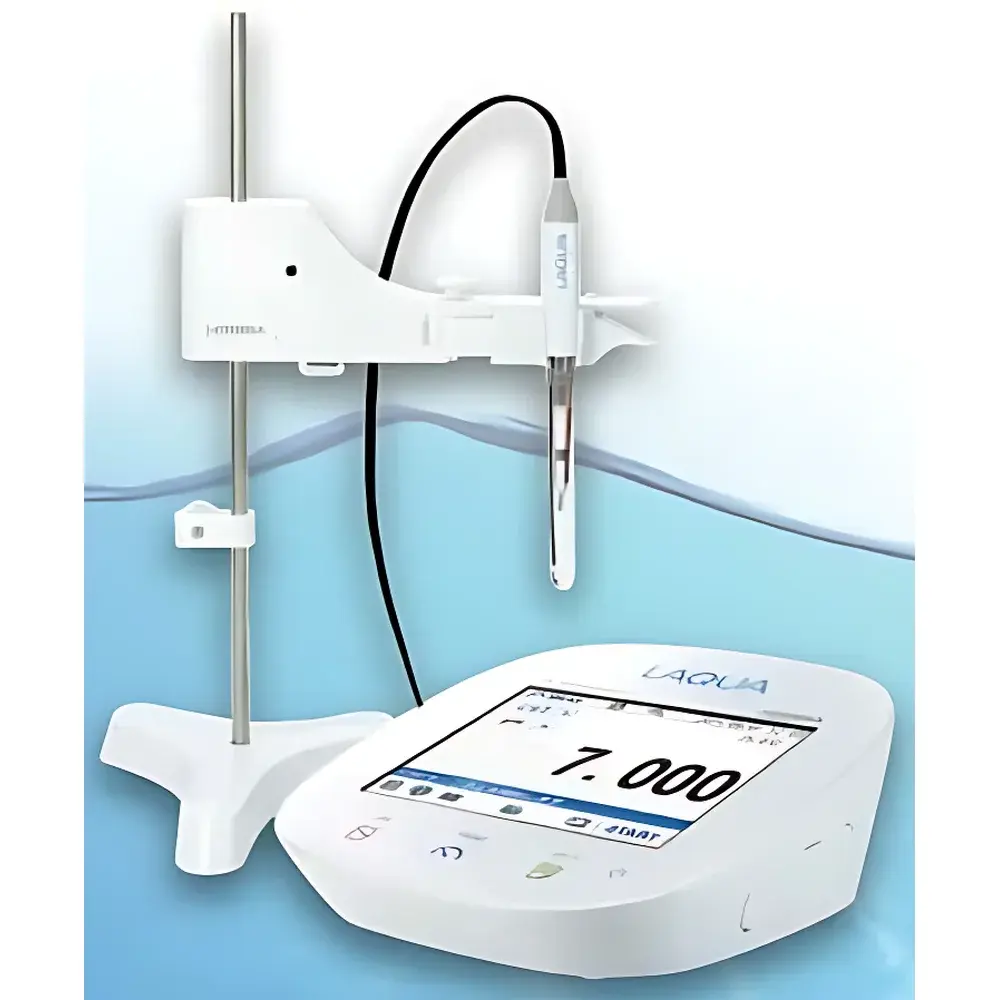
HORIBA F-71 Desktop Multi-Parameter Water Quality Analyzer
| Brand | HORIBA |
|---|---|
| Origin | Japan |
| Model | F-71 |
| Instrument Type | Laboratory Water Quality Analyzer |
| Measurable Parameters | pH, ORP, Temperature |
| pH Range | 0.000–14.000 |
| pH Resolution | 0.001 |
| ORP Range | ±1999.9 mV |
| ORP Resolution | 0.1 mV |
| Temperature Range (Display) | 0.0–100.0 °C (Extended: −30.0–130.0 °C) |
| Temperature Resolution | 0.1 °C |
| pH Repeatability | ±0.005 pH ±1 digit |
| ORP Repeatability | ±0.1 mV ±1 digit |
| Temperature Repeatability | ±0.1 °C ±1 digit |
| Data Storage Capacity | 999 measurements |
| Power Supply | AC adapter, 100–240 V, 50/60 Hz |
| Power Consumption | ~0.7 VA |
| Weight | ~500 g |
Overview
The HORIBA F-71 Desktop Multi-Parameter Water Quality Analyzer is a precision-engineered laboratory instrument designed for reliable, traceable, and standards-compliant measurement of critical water quality parameters—including pH, oxidation-reduction potential (ORP), and temperature. Built upon HORIBA’s legacy in electrochemical sensor technology, the F-71 employs a high-stability glass pH electrode with low-drift characteristics and optimized junction design to ensure reproducible readings across diverse aqueous matrices. Its measurement architecture conforms to fundamental potentiometric principles defined in ISO 7888, ASTM D1293, and USP , enabling direct voltage-to-pH conversion via Nernst equation-based calibration. Unlike portable or field-grade analyzers, the F-71 is purpose-built for controlled lab environments where measurement integrity, audit readiness, and long-term electrode stability are non-negotiable—making it especially suitable for QC labs supporting pharmaceutical water systems (Purified Water, Water for Injection), environmental compliance testing, and academic research requiring GLP-aligned data capture.
Key Features
- High-resolution pH measurement (0.001 pH unit) with ±0.005 pH repeatability and automatic temperature compensation (ATC) using integrated Pt1000 sensor
- Wide-range ORP measurement (±1999.9 mV, 0.1 mV resolution) supporting redox monitoring in disinfection validation, wastewater treatment, and corrosion studies
- Temperature display range from 0.0 to 100.0 °C (extendable to −30.0 to 130.0 °C), calibrated per ITS-90 reference standard
- Dedicated electrode diagnostics and guided calibration wizard—providing step-by-step visual prompts for slope/mV offset verification and electrode health assessment
- Onboard memory stores up to 999 measurement records with timestamp, parameter values, and operator ID (where configured)
- USB interface compliant with USB 2.0 full-speed protocol for bidirectional communication with Windows/macOS systems; supports CSV export and firmware updates
- Compact benchtop footprint (~500 g mass) with low power draw (~0.7 VA), compatible with universal AC input (100–240 V, 50/60 Hz)
Sample Compatibility & Compliance
The F-71 is validated for use with deionized water, purified water (PW), water for injection (WFI), tap water, surface water, and buffered standard solutions. Its glass pH electrode features a clog-resistant ceramic junction and easy-clean bulb geometry—reducing maintenance downtime and minimizing carryover risk between samples. The analyzer meets essential regulatory expectations for laboratory instrumentation: calibration traceability to NIST-traceable pH buffers, documented measurement uncertainty budgets, and support for JIS T 1201, USP , EP 2.2.3, and JP XVIII general chapters on pH measurement. While the F-71 itself does not include built-in GLP/GMP audit trail functionality (a feature reserved for higher-tier F-74BW and DS-series models), its data export capability enables integration into validated LIMS or ELN platforms compliant with FDA 21 CFR Part 11 when paired with appropriate system controls.
Software & Data Management
Data acquisition and reporting are streamlined via native USB connectivity—no proprietary drivers required. Measurement logs export as plain-text CSV files containing date/time stamps, measured values, units, electrode ID (if encoded), and user-defined sample IDs. For laboratories operating under ISO/IEC 17025 or pharmaceutical QA frameworks, the F-71 supports external documentation of calibration certificates, electrode history, and preventive maintenance logs. Though it lacks onboard multi-language UI (a capability introduced in F-72+ models), English-language operation is fully supported through intuitive icon-driven menus and context-sensitive help overlays accessible during calibration and troubleshooting sequences.
Applications
- Pharmaceutical water system qualification (PW/WFI pH monitoring per USP and EU Annex 1)
- Environmental laboratory analysis of surface and groundwater per EPA Method 150.1 and ISO 10523
- Academic and industrial research requiring stable, low-noise pH and ORP baselines for kinetic or equilibrium studies
- Calibration verification of inline process sensors used in bioreactors or purification skids
- Teaching laboratories demonstrating fundamental electrochemical measurement principles and Nernstian behavior
FAQ
Does the F-71 support automatic calibration recognition (e.g., auto-buffer detection)?
No—the F-71 requires manual buffer selection during calibration. Auto-detection is available only on F-72 and later models.
Can the F-71 measure conductivity or TDS?
No—F-71 is dedicated to pH, ORP, and temperature only. Conductivity, salinity, resistivity, and TDS functions are exclusive to F-72, F-73, and F-74 variants.
Is the included pH electrode refillable or replaceable?
Yes—the standard glass electrode (e.g., 9615S-10D) is a refillable, double-junction type with removable electrolyte fill port and replaceable reference element.
What is the recommended recalibration frequency for routine QC use?
Per USP , daily calibration is advised before first use and after major environmental shifts; additional intermediate checks using a second buffer are recommended for high-precision applications.
Does the F-71 comply with FDA 21 CFR Part 11 requirements?
The device itself does not provide electronic signatures, audit trails, or role-based access control—but exported CSV data may be incorporated into a validated Part 11–compliant ecosystem when governed by procedural controls and metadata management protocols.







