
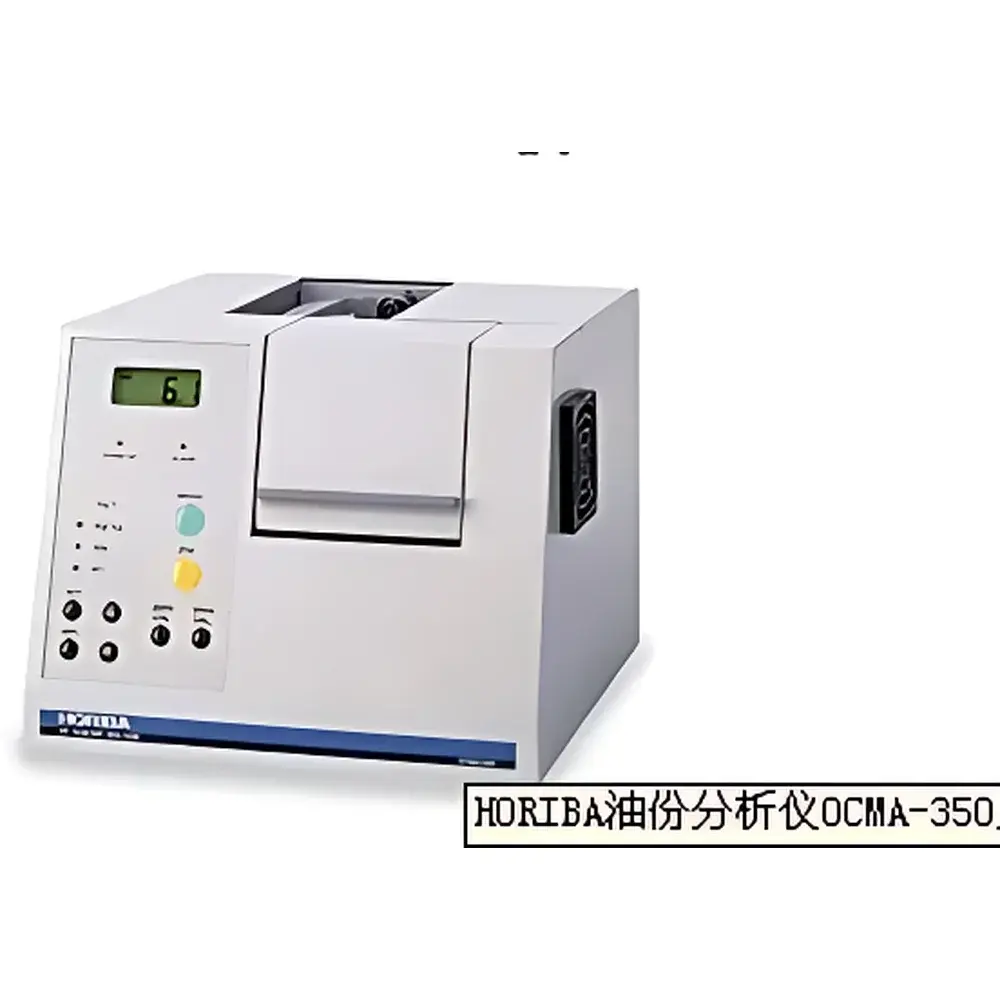
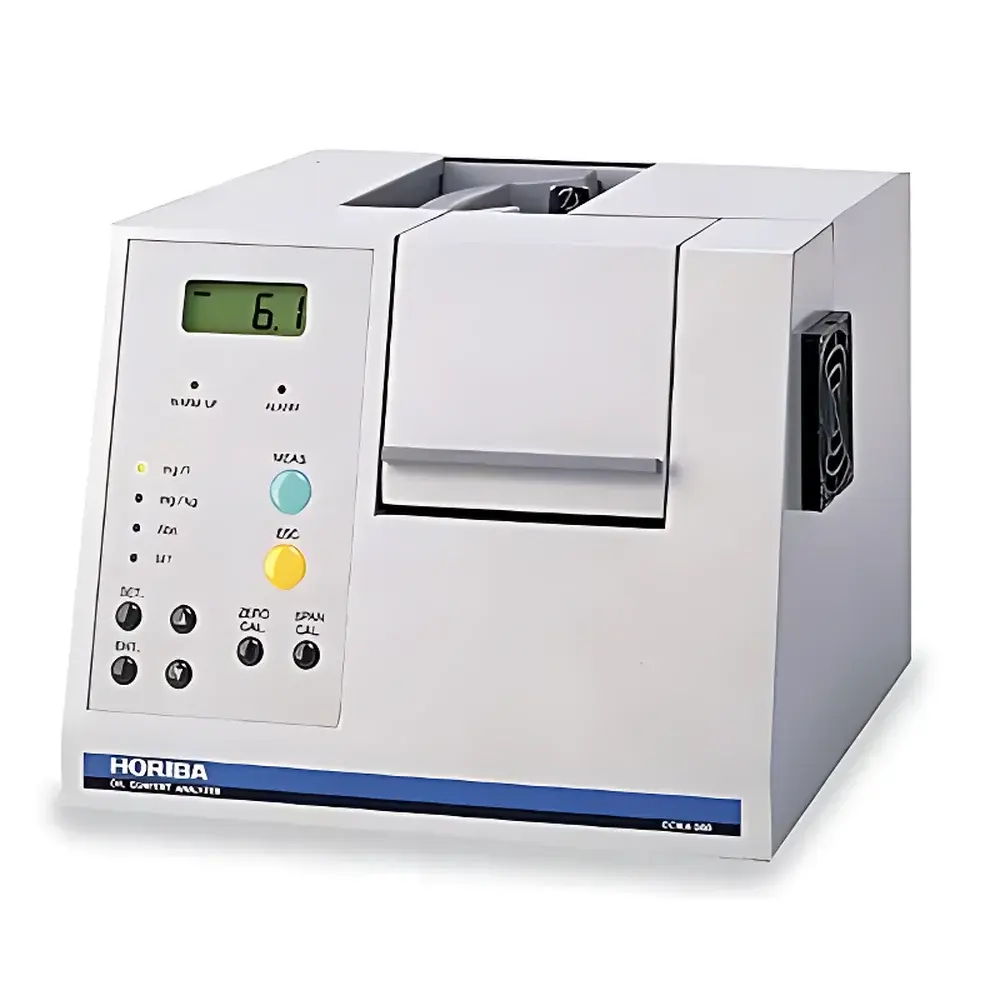
HORIBA OCMA-350/355 Oil Content Analyzer
| Brand | HORIBA |
|---|---|
| Origin | Japan |
| Model | OCMA-350/355 |
| Detection Method | Non-Dispersive Infrared (NDIR) Absorption |
| Extractant | S-316 (OCMA-350) / H-997 (OCMA-355) |
| Measurement Range | 0–200 mg/L, 0–1000 mg/kg, 0–1 Abs |
| Repeatability | ±0.4 mg/L (0–9.9 mg/L), ±2.0 mg/L (10.0–99.9 mg/L), ±4 mg/L (100–200 mg/L), ±1% F.S. (0–1 Abs) |
| Sensitivity | 1% of full-scale lower limit |
| Optical Detector | Thermoelectric sensor |
| Display | Backlit LCD with timestamping |
| Interface | RS-232C port & parallel printer port |
| Power Supply | 230 V AC, 50 Hz |
| Dimensions | 250 × 200 × 285 mm (W × H × D) |
| Sample Cell | 200-mm pathlength quartz cuvette |
Overview
The HORIBA OCMA-350 and OCMA-355 are benchtop oil content analyzers engineered for high-precision quantification of hydrocarbon contaminants in aqueous, solid, and surface-bound matrices. Both instruments operate on the principle of non-dispersive infrared (NDIR) absorption spectroscopy—specifically targeting the C–H stretching vibration band near 3.4 µm (2940 cm⁻¹), a spectral region where aliphatic hydrocarbons exhibit strong, characteristic absorbance. Unlike broad-spectrum UV-Vis methods, NDIR ensures selectivity for petroleum-based oils while minimizing interference from organic solvents, humic substances, or suspended solids. The OCMA-350 employs S-316 (1,1,2-trichloro-1,2,2-trifluoroethane) as the extraction solvent, whereas the OCMA-355 utilizes H-997 (a proprietary chlorinated fluorocarbon alternative compliant with evolving environmental regulations). Critically, both solvents exhibit negligible IR absorbance at the measurement wavelength, enabling direct photometric quantification of extracted oil without spectral baseline correction or complex chemometric modeling. This architecture delivers trace-level sensitivity down to 0.1 ppm (µg/L) in water and supports standardized reporting across three orthogonal units: mg/L (aqueous phase), mg/kg (soil/solid matrix), and absorbance (Abs)—all traceable to primary calibration standards.
Key Features
- Triple-unit display capability: switch seamlessly between mg/L, mg/kg, and Abs for cross-matrix comparability and regulatory reporting alignment.
- Integrated timestamping and data logging: each measurement is automatically annotated with date/time stamp for GLP-compliant recordkeeping.
- Thermoelectric (TE) infrared detector: provides stable, drift-free signal acquisition without liquid nitrogen cooling or mechanical choppers—ensuring long-term reproducibility under routine lab conditions.
- Backlit LCD interface with intuitive menu navigation: designed for operation in field-deployed or industrial QC environments with variable ambient lighting.
- Dual communication interfaces: RS-232C serial output for integration into LIMS or SCADA systems, plus parallel printer port for immediate hardcopy documentation.
- Pre-calibrated optical path: 200-mm quartz flow cell optimized for maximum sensitivity in low-concentration measurements per ASTM D7066 and ISO 9377-2.
Sample Compatibility & Compliance
The OCMA-350/355 is validated for use with diverse sample types requiring regulatory-grade oil-in-water or oil-on-surface analysis—including wastewater effluents, groundwater monitoring wells, soil cores from brownfield sites, metal parts after degreasing, textile rinse baths, and semiconductor wafer cleaning rinse streams. Its methodology aligns with multiple international standards: ASTM D7066 (Standard Test Method for Determination of Oil and Grease and Selected Petroleum Hydrocarbons in Water by Solvent Extraction and Infrared Spectrophotometry), ISO 9377-2 (Water quality — Determination of hydrocarbon oil index — Part 2: Infrared spectrometric method), and EPA Method 1664B (for n-hexane extractable material, when adapted with S-316/H-997). The instrument’s automatic zeroing and reference calibration sequence satisfies FDA 21 CFR Part 11 requirements for electronic records when paired with audit-trail-enabled data acquisition software.
Software & Data Management
While the OCMA-350/355 operates as a standalone analyzer with embedded firmware, its RS-232C interface enables bidirectional communication with external PCs running HORIBA’s optional OCMA Data Manager software (v3.2+). This application supports automated batch reporting, statistical process control (SPC) charting, calibration curve archiving, and export to CSV or PDF formats compatible with ISO/IEC 17025-accredited laboratories. All measurement events—including calibration status, solvent lot tracking (via user-entered ID), and operator login tags—are stored in non-volatile memory with tamper-evident timestamps. When connected to networked laboratory infrastructure, data can be routed to enterprise LIMS platforms via ASCII protocol mapping without proprietary drivers.
Applications
- Environmental site assessment: rapid screening of groundwater, leachate, and soil extracts for total petroleum hydrocarbons (TPH) during Phase II investigations.
- Industrial pretreatment compliance: continuous verification of oil removal efficiency in electroplating, machining, and metal finishing wastewater streams prior to municipal discharge.
- Pharmaceutical and semiconductor manufacturing: validation of ultraclean surface cleanliness following solvent-based degreasing—critical for adhesion testing and particle control.
- Textile and automotive component QA: quantification of residual lubricants on fabrics or stamped metal parts prior to coating or assembly.
- Regulatory reporting: generation of auditable datasets for NPDES permits, RCRA corrective action plans, and ISO 14001 environmental management system documentation.
FAQ
What extraction solvents are compatible with the OCMA-350 and OCMA-355?
The OCMA-350 requires S-316 (1,1,2-trichloro-1,2,2-trifluoroethane), while the OCMA-355 uses H-997—a regulated-substance alternative developed by HORIBA to meet evolving ODS (ozone-depleting substance) restrictions.
Can the instrument measure emulsified or dissolved oil fractions?
No—the method quantifies only solvent-extractable, non-polar hydrocarbon material. Emulsified or surfactant-stabilized oil must first undergo phase separation or acidification prior to extraction.
Is calibration traceable to NIST standards?
Yes. HORIBA supplies certified B-grade heavy oil reference standards (traceable to NIST SRM 2781), and users may establish secondary working standards following ISO Guide 34 and ISO/IEC 17025 procedures.
Does the analyzer support multi-point calibration curves?
The instrument performs single-point calibration using factory-provided standard; however, external software (OCMA Data Manager) supports multi-point curve fitting and polynomial regression for extended dynamic range applications.
What maintenance is required for long-term operational stability?
Annual verification of optical path integrity and detector responsivity is recommended. Quartz cuvettes require periodic cleaning with methanol and lint-free wipes; no consumable optics or lamps are used in the NDIR optical train.
Related Products







