
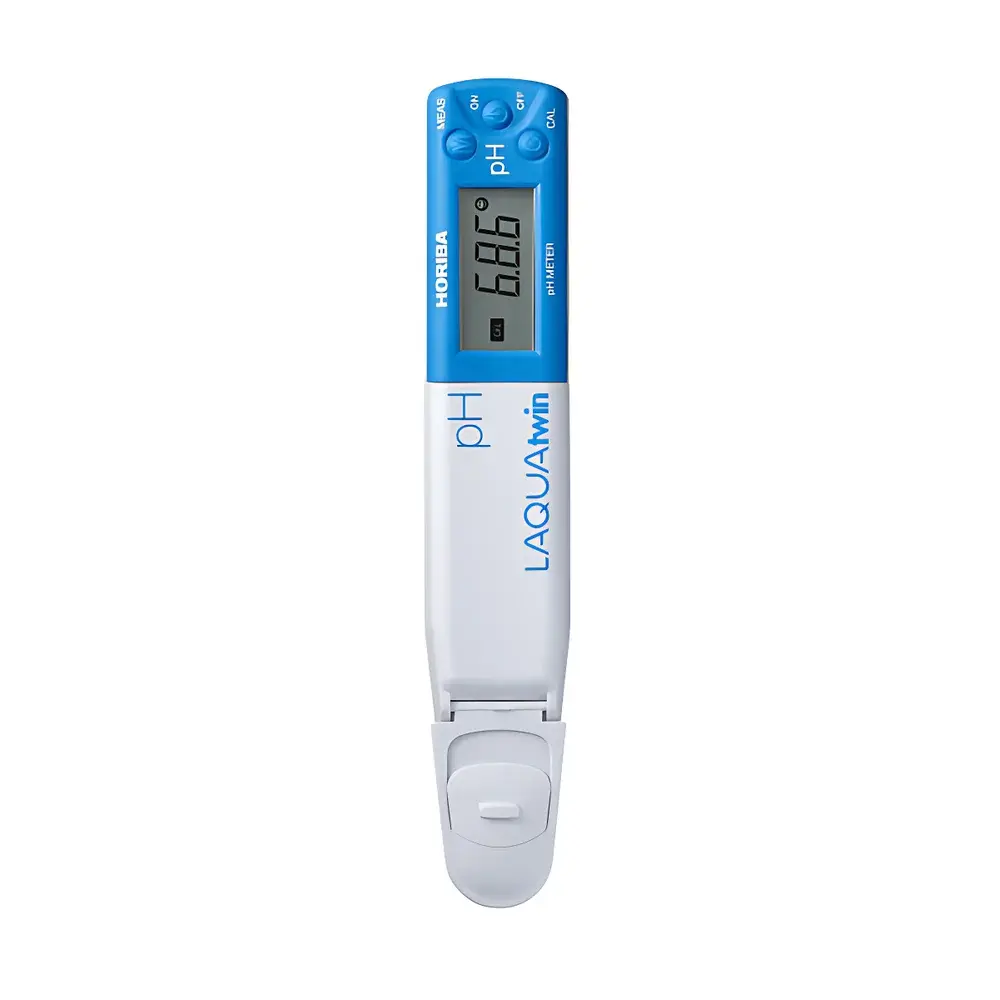
HORIBA LAQUAtwin B-711/B-712 Pocket pH Meter
| Brand | HORIBA |
|---|---|
| Origin | Japan |
| Model | B-711 / B-712 |
| Instrument Type | Pen-style pH Meter |
| Parameter Type | Single-parameter (pH) |
| Measurement Range | 2.0–12.0 pH |
| Resolution | 0.1 pH |
| Accuracy | ±0.1 pH (after calibration, repeatability in standard buffer solutions) |
| Calibration Solutions | pH 4.01, 7.00, and 9.21 buffers |
| Calibration Modes | B-711 — single-point |
| Sample Volume | ≥0.05 mL (with optional sampling film B) |
| Temperature Compensation | Automatic (NTC thermistor) |
| Auto-Hold Function | Yes |
| IP Rating | IP67 (dust-tight |
| Operating Environment | 5–40 °C, ≤85% RH (non-condensing) |
| Power Supply | Two CR2032 lithium coin cells |
| Dimensions (L×W×H) | 164 × 29 × 20 mm (excluding protrusions) |
| Weight | Approx. 50 g (instrument only, excluding batteries) |
Overview
The HORIBA LAQUAtwin B-711 and B-712 are compact, handheld pen-style pH meters engineered for rapid, field-deployable electrochemical measurement of aqueous samples. These instruments employ a planar glass pH electrode architecture—refined through decades of HORIBA sensor development—to deliver laboratory-grade reproducibility in a palm-sized format. Unlike conventional combination electrodes requiring immersion in bulk solution, the LAQUAtwin platform operates on micro-volume principle: precise pH determination is achieved with as little as 0.05 mL of sample when used with the optional sampling film accessory. This design eliminates dilution artifacts and minimizes cross-contamination risk—critical for high-value, low-volume samples such as cell culture media, pharmaceutical formulations, food extracts, and environmental pore water. The measurement principle conforms to ISO 3696 (Grade 3 water specification), ASTM D1293 (Standard Test Method for pH of Water), and supports routine compliance with GLP and GMP documentation requirements via traceable calibration records.
Key Features
- Planar glass pH sensing element with optimized surface geometry for rapid response (<5 seconds typical stabilization time)
- Micro-sample capability: 0.05 mL minimum volume (with film B); 0.1 mL standard operational volume
- Intuitive one-button operation: auto-calibration initiation, automatic endpoint detection (smiley-face icon confirms stable reading)
- IP67-rated enclosure: fully dustproof and waterproof to 1 m depth for 30 minutes—suitable for humid laboratories, outdoor fieldwork, and industrial washdown environments
- Integrated temperature compensation using built-in NTC thermistor (0–50 °C range), eliminating manual correction errors
- Auto-hold function freezes displayed value upon signal stabilization, improving data capture accuracy during single-operator workflows
- Low-power design with dual CR2032 batteries providing >2,000 measurements per set under typical usage conditions
Sample Compatibility & Compliance
The B-711/B-712 series is validated for direct measurement of clear, low-turbidity aqueous solutions including drinking water, wastewater effluent, hydroponic nutrient solutions, dairy products, fruit juices, and buffered reagents. For particulate-laden or viscous samples, HORIBA recommends use of the supplied filtration membrane to separate suspended solids prior to analysis. Electrode performance remains stable across pH 2.0–12.0, with linearity verified per IUPAC recommendations for potentiometric pH measurement. Calibration traceability aligns with NIST-traceable pH buffer standards (e.g., NIST SRM 186, 188, 191). The device meets CE marking requirements for electromagnetic compatibility (EN 61326-1) and safety (EN 61010-1), and its robust construction supports audit readiness under FDA 21 CFR Part 11-compliant quality systems when paired with documented calibration logs.
Software & Data Management
While the B-711/B-712 operate as standalone instruments without onboard memory or USB connectivity, their design facilitates integration into regulated workflows. Each unit includes a serialized calibration log sheet for manual entry of date, operator ID, buffer lot numbers, and measured offsets—enabling full traceability per ISO/IEC 17025 clause 7.7. For laboratories requiring electronic record retention, HORIBA provides optional QR-code–linked digital calibration templates compatible with LIMS platforms. All firmware updates (delivered via HORIBA’s secure customer portal) include version-controlled release notes and change logs compliant with software validation protocols outlined in Annex 11 of EU GMP guidelines.
Applications
- On-site monitoring of municipal and industrial wastewater treatment processes
- Routine QC checks in beverage production lines (soft drinks, wine, brewing)
- Field assessment of soil leachate and groundwater pH in environmental site investigations
- Point-of-use verification of buffer preparation in biopharmaceutical cleanrooms
- Educational labs requiring rugged, student-safe instrumentation with minimal maintenance overhead
- Hydroponics and aquaculture operations where real-time pH feedback informs dosing decisions
FAQ
What is the difference between the B-711 and B-712 models?
The B-711 supports single-point calibration only (typically at pH 7.00), while the B-712 offers user-selectable single- or two-point calibration (e.g., pH 4.01 and 7.00), enhancing accuracy across wider pH ranges.
Can the instrument measure samples below pH 2.0 or above pH 12.0?
No. The specified measurement range is strictly 2.0–12.0 pH. Outside this range, electrode response deviates non-linearly and may cause irreversible drift or junction clogging.
Is the IP67 rating sufficient for marine or saltwater applications?
Yes—the housing resists corrosion from saline aerosols and brief immersion, but prolonged exposure to seawater requires post-use rinsing with deionized water to prevent crystallization-induced seal degradation.
How often should calibration be performed?
Daily calibration is recommended for critical applications; for routine monitoring, calibration before each measurement session suffices—provided ambient temperature remains stable and buffers are within expiry.
Does the device comply with ISO 17025 requirements for accredited testing?
The instrument itself is not accredited, but its metrological characteristics (accuracy, resolution, stability) and traceable calibration methodology support compliance when implemented within an accredited laboratory’s documented procedures.




