
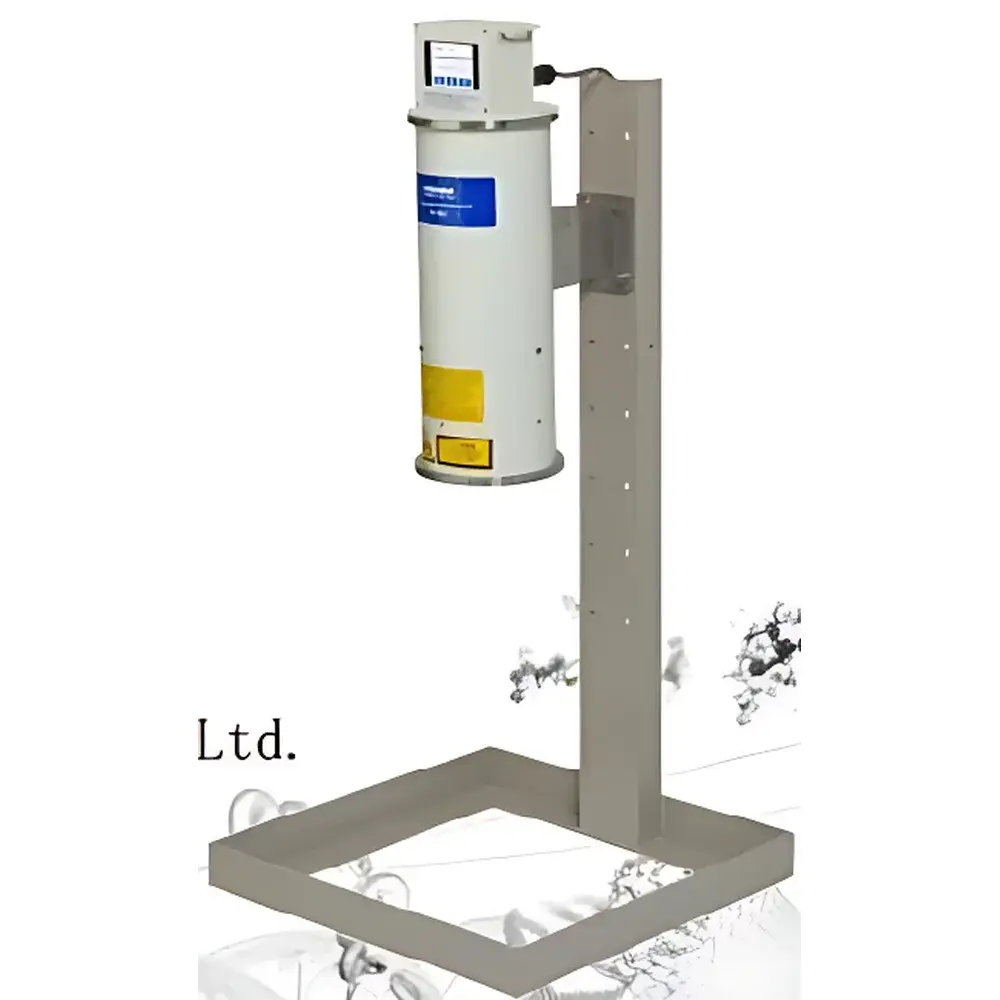
HORIBA LO-300 Online Oil Film Monitor
| Brand | HORIBA |
|---|---|
| Origin | Japan |
| Model | LO-300 |
| Detection Principle | Laser Circular Area Scanning Reflectometry |
| Detection Range | 0.3–4.0 m (up to 6.0 m on still water) |
| Oil Film Area Threshold Setting | 0–100% |
| Alarm Output | 2 relay contacts + 4–20 mA analog output |
| Environmental Rating | IP66 |
| Operating Temperature | −10 to +50 °C |
| Power Supply | AC 100 V ±10%, 50/60 Hz, ≤100 VA |
| Dimensions | Ø185 × 547 mm (H) |
| Weight | ~11 kg |
| Optional Video Recording | MP4, 1 or 3 fps, 6 MB per event, pre-/post-alarm capture |
Overview
The HORIBA LO-300 Online Oil Film Monitor is an industrial-grade, non-contact optical instrument engineered for continuous, real-time surveillance of floating hydrocarbon films on water surfaces in environmental monitoring, wastewater treatment, industrial effluent discharge points, and oil terminal containment zones. It employs laser circular area scanning reflectometry—a robust, physics-based detection method that quantifies surface reflectance anomalies caused by thin oil layers (e.g., gasoline, diesel, lubricating oil, insulating oil) without physical contact or reagent consumption. Unlike absorbance- or fluorescence-based methods, the LO-300’s Class 2 semiconductor laser (≤1 mW) illuminates a defined circular scan zone; variations in specular and diffuse reflection intensity—modulated by oil film thickness, coverage ratio, and surface dynamics—are analyzed in real time to distinguish hydrocarbon presence from wave-induced glare, foam, or debris. Its design prioritizes long-term field stability under harsh outdoor conditions, with no consumables, minimal calibration drift, and immunity to fouling or chemical degradation.
Key Features
- Non-contact, maintenance-free operation: No immersion probes, no sampling pumps, no reagents—eliminates downtime and operational cost associated with wet chemistry or mechanical sensors.
- Adaptive laser scanning optics: Automatic vertical alignment between emitter and receiver units ensures consistent beam geometry across installation tolerances (±3°), reducing commissioning time and field adjustment requirements.
- Extended detection range: Operates reliably at distances from 0.3 m to 4.0 m; up to 6.0 m achievable over calm, non-turbulent water surfaces—enabling flexible mounting on walkways, gantries, or retaining walls.
- Configurable multi-parameter alarm logic: Users define threshold criteria based on oil film area percentage (0–100%), minimum persistence duration, and intensity level—supporting adaptive response to transient spills versus sustained leakage events.
- IP66-rated sealed enclosure: Fully rated for outdoor deployment in rain, dust, and temperature extremes (−10 to +50 °C); corrosion-resistant housing suitable for marine and industrial perimeters.
- Integrated color touchscreen HMI: Intuitive menu navigation, real-time visualization of reflected light intensity (4–20 mA), detected oil area (%), setpoints, and status indicators—no external PC required for basic operation.
Sample Compatibility & Compliance
The LO-300 detects non-water-soluble petroleum-based hydrocarbons—including gasoline, kerosene, diesel fuel, heavy fuel oil, transformer insulation oil, and machine lubricants—on freshwater, seawater, and wastewater surfaces. It does not respond to water-miscible oils (e.g., certain synthetic coolants or emulsified cutting fluids), nor to organic films lacking sufficient refractive index contrast (e.g., algae scum or detergent residues). The system complies with IEC 60825-1 for Class 2 laser safety and meets electromagnetic compatibility requirements per EN 61326-1. While not certified to ISO 9001 or ISO/IEC 17025 as a standalone measurement standard, its output signals (4–20 mA, relay contacts) are compatible with SCADA, DCS, and PLC architectures used in facilities operating under EPA, EU WFD, or local regulatory frameworks requiring continuous oil-in-water surveillance. Data logging and alarm records support auditability in GLP-aligned environmental reporting workflows.
Software & Data Management
The LO-300 operates autonomously but supports network integration via standard Ethernet (LAN) for remote configuration, live video streaming, and historical data retrieval. When equipped with the optional integrated camera module, it captures synchronized MP4 video clips (1 or 3 frames/sec, 6 MB/event) triggered by alarm conditions—with 10 seconds pre-trigger and 10 seconds post-trigger duration. Each frame overlays timestamp metadata (YYYY-MM-DD HH:MM:SS), enabling forensic correlation with process events or regulatory incident logs. Nighttime operation activates built-in LED illumination automatically. Video archives are stored onboard and accessible via HTTP or FTP; no proprietary software is required—standard media players suffice for review. Analog outputs (4–20 mA) provide continuous oil film intensity representation for trend analysis in historian systems, while dual relay outputs interface directly with sirens, valve actuators, or shutdown sequences in accordance with site-specific safety protocols.
Applications
- Effluent discharge monitoring at municipal and industrial wastewater treatment plants (WWTPs) to verify compliance with oil & grease limits prior to release.
- Secondary containment surveillance around aboveground storage tanks (ASTs), loading docks, and transfer stations in petrochemical and refinery facilities.
- Stormwater outfall inspection at manufacturing campuses and transportation hubs to detect accidental hydrocarbon runoff.
- Marine port and harbor oil spill early-warning systems—deployed along berths, jetties, and marina basins.
- Environmental remediation sites where free-phase NAPL (non-aqueous phase liquid) migration must be tracked across surface water bodies.
FAQ
Does the LO-300 require periodic calibration?
No routine calibration is required. The system uses stable semiconductor laser diodes and factory-trimmed photodetectors; performance verification is conducted via built-in self-diagnostics and optional reference reflectance checks during preventive maintenance intervals (recommended annually).
Can it distinguish between different types of oil?
No. The LO-300 detects presence and spatial extent of hydrophobic oil films but does not identify chemical composition or differentiate between gasoline, diesel, or lubricating oil based on spectral signature.
Is the video recording function mandatory?
No. The camera module is an optional accessory; base LO-300 units operate fully functional without it, delivering analog and relay outputs only.
What mounting infrastructure is needed?
Standard mounting requires a rigid platform (e.g., wall bracket or pipe clamp) capable of supporting ~11 kg. Optional accessories include sunshades, steam deflectors, and adjustable mounting stands to accommodate site-specific geometry and environmental exposure.
How is false alarm suppression handled?
The system incorporates dynamic baseline tracking and configurable persistence logic: brief reflectance fluctuations (e.g., from passing birds or wind ripples) are rejected unless sustained beyond user-defined duration thresholds—reducing nuisance alarms without compromising sensitivity.
Related Products







