
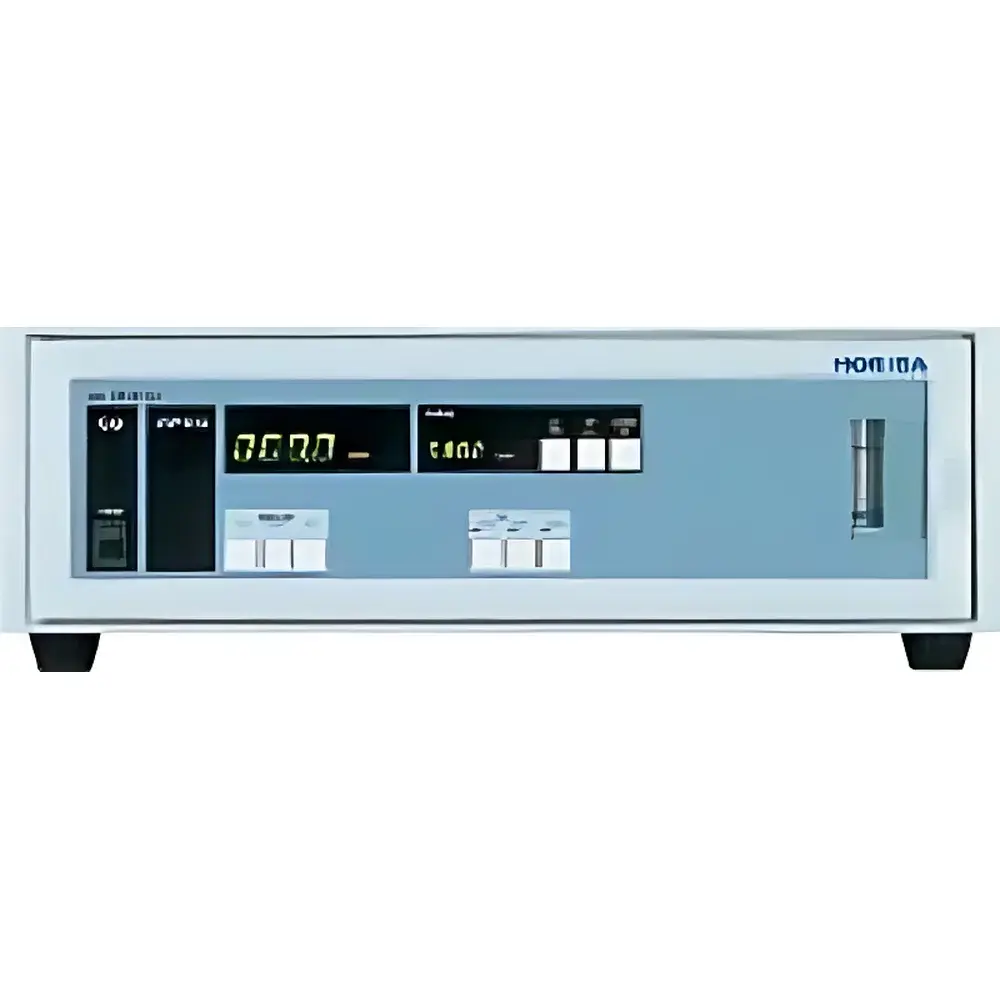
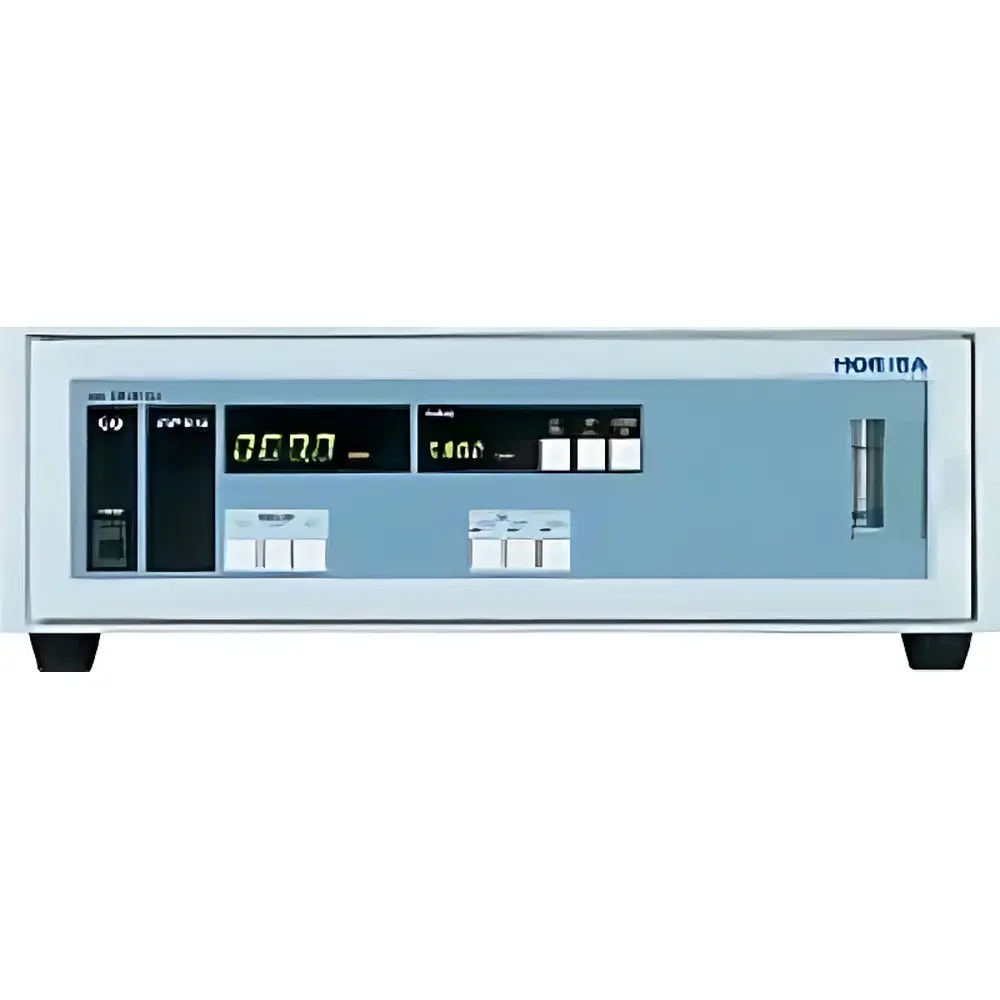
HORIBA FIA-510 Total Hydrocarbon Analyzer
| Brand | HORIBA |
|---|---|
| Origin | Japan |
| Model | FIA-510 |
| Measurement Principle | Partially depressurized hydrogen flame ionization detection (FID) |
| Measurand | Total Hydrocarbons (THC) as ppmC |
| Range | 0–50 ppmC (min) to 0–30,000 ppmC (max) |
| Repeatability | ±0.5 %FS (±1 %FS in high-sensitivity range) |
| Drift | ±1 %FS/day (±2 %FS/day in high-sensitivity range) |
| Response Time (T90) | 10 s |
| Operating Temperature | 0–40 °C |
| Relative Humidity | ≤90 % RH (non-condensing) |
| Dimensions (W×D×H) | 430 × 550 × 132 mm |
| Weight | 20 kg |
| Dynamic Range | 4-step standard (10:1), optional 20:1 |
| Display & Control | Built-in CPU, digital concentration readout, one-touch zero/span calibration, self-diagnostic functions |
| Mounting | Benchtop or 19-inch rack-mountable |
Overview
The HORIBA FIA-510 Total Hydrocarbon Analyzer is a precision-engineered continuous emission monitoring system designed for real-time quantification of total hydrocarbons (THC) in flue gas and exhaust streams. It employs a partially depressurized hydrogen flame ionization detection (FID) principle — a well-established, highly selective technique for detecting organic compounds containing C–H bonds. Unlike catalytic or infrared-based methods, FID provides near-uniform response factors across a broad spectrum of hydrocarbons (e.g., methane, propane, benzene, toluene), enabling robust and trace-level THC measurement without compound-specific calibration. The instrument is optimized for regulatory-compliant stack monitoring in industrial combustion processes, automotive emissions testing laboratories, and R&D facilities evaluating low-emission technologies. Its stable baseline, fast T90 response of 10 seconds, and minimal drift ensure reliable long-term operation under variable ambient conditions (0–40 °C, ≤90 % RH non-condensing).
Key Features
- Partially depressurized FID architecture enhances signal-to-noise ratio and reduces background interference from moisture and CO₂, improving measurement fidelity in humid or high-CO₂ flue gas matrices.
- Seven programmable concentration ranges (0–50 ppmC to 0–30,000 ppmC) with dynamic auto-ranging capability — standard 4-step (10:1) or optional extended 20:1 range ratio for seamless transition between low-background and high-concentration sampling events.
- Modular design separates sampling unit (probe, heated line, particulate filter, moisture trap) from analyzer core, enabling flexible installation — benchtop deployment, 19-inch rack integration, or mobile cart mounting for inter-laboratory transfer or field validation studies.
- Embedded microprocessor enables full local control: real-time digital concentration display, one-touch zero and span calibration, automated diagnostic routines (e.g., flame status, detector voltage, flow verification), and event-logged operational history.
- Electronically adjustable response time (T90) via DIP switch — configurable from 1 to 10 seconds — to balance temporal resolution against signal smoothing requirements in transient emission profiling (e.g., engine dynamometer cycles).
- High metrological stability: repeatability ≤ ±0.5 %FS (standard range), zero/span drift ≤ ±1.0 %FS/day — verified per ISO 10780 and ASTM D6348 protocols for continuous monitoring systems.
Sample Compatibility & Compliance
The FIA-510 is validated for use with dry or moderately humid flue gases (up to 90 % RH) from natural gas-fired boilers, diesel generators, catalytic converter test benches, and internal combustion engine exhausts. Sample conditioning includes heated sampling lines (maintained above dew point), sintered metal particulate filters (≥0.5 µm retention), and Nafion™-based moisture removal — all compliant with EN 15267-3 and EPA Method 25A prerequisites. The analyzer meets key international performance criteria for CEMS: EN 14181 (QAL1/QAL2), ISO 12039 (for stationary source THC), and supports GLP/GMP data integrity through timestamped calibration logs and audit-trail-capable firmware (optional 21 CFR Part 11 compliance package available). No internal catalytic converters or optical windows require periodic replacement, reducing lifetime cost of ownership.
Software & Data Management
Analog (4–20 mA) and digital (RS-232/RS-485 Modbus RTU) outputs enable direct integration into SCADA, DCS, or environmental data acquisition systems. Optional HORIBA’s WinCT software provides remote configuration, real-time trend visualization, alarm threshold management (high/low, rate-of-change), and automated report generation (PDF/CSV) aligned with ISO 14001 and EU IED reporting templates. All calibration actions, system faults, and parameter changes are time-stamped and stored internally for ≥30 days — sufficient for routine QA audits and regulatory inspection readiness.
Applications
- Continuous compliance monitoring of THC emissions from industrial combustion sources per EU Directive 2010/75/EU (IED) and U.S. EPA NSPS Subpart IIII.
- Engine development and certification testing (e.g., WLTP, US06, FTP-75 cycles) where sub-ppmC sensitivity and <10 s response are critical for capturing transient hydrocarbon spikes.
- Research on aftertreatment catalyst efficiency (e.g., oxidation catalysts, GPFs) requiring high-fidelity THC speciation-agnostic quantification.
- Validation of portable emission measurement systems (PEMS) and laboratory reference analyzers in accredited test labs (ISO/IEC 17025 scope).
- Process optimization in chemical manufacturing where fugitive THC leakage or solvent recovery efficiency must be tracked continuously.
FAQ
What detection principle does the FIA-510 use, and why is it preferred for THC measurement?
It uses partially depressurized flame ionization detection (FID), which offers superior selectivity for organic vapors, wide linear dynamic range, and minimal interference from inorganic gases — making it the reference method for regulatory THC monitoring per ASTM D6348 and ISO 12039.
Can the FIA-510 measure methane separately from other hydrocarbons?
No — it measures total hydrocarbons as ppmC (carbon-equivalent). For speciated methane analysis, a GC-FID or NDIR system is required.
Is the analyzer suitable for wet-stack applications?
Yes, when paired with HORIBA’s certified heated sampling system and moisture removal module; however, condensate must be actively removed upstream to prevent detector quenching.
How often is calibration required for regulatory compliance?
Per EN 14181, daily zero/span checks are recommended; full QAL2 verification every 3 months using certified gas standards traceable to NIST or BIPM.
Does the FIA-510 support remote diagnostics and firmware updates?
Yes — via RS-485 Modbus interface and optional Ethernet gateway; firmware updates are performed offline using signed binaries to maintain system integrity and auditability.
Related Products







