
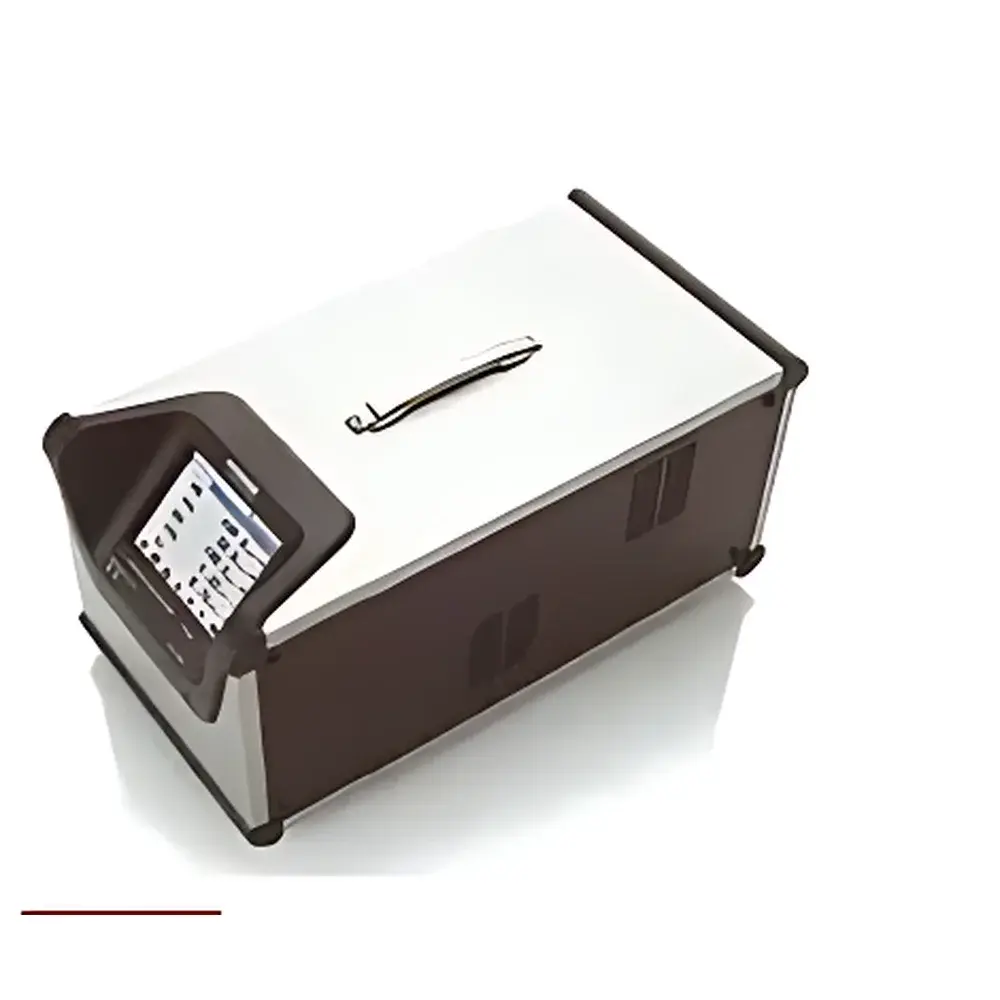
HORIBA PG-350 Portable Multi-Gas Analyzer
| Brand | HORIBA |
|---|---|
| Origin | Japan |
| Model | PG-350 (PG-300 Series) |
| Instrument Type | Portable |
| Measured Gases | NOₓ, SO₂, CO, CO₂, O₂ |
| Range Options | 0–5 / 10 / 25 vol% (CO₂, O₂) |
| Repeatability | ±1.0% F.S. |
| Drift | ±1.0% F.S./day (±2.0% F.S./day for SO₂) |
| Linearity | ±2.0% F.S. |
| Response Time (T₉₀) | ≤45 s (all gases except SO₂) |
| Sample Flow Rate | ~0.5 L/min |
| Warm-up Time | 30 min |
| Operating Environment | 5–40 °C, ≤85% RH |
| Dimensions | 226 × 265 × 510 mm (W×H×D) |
| Weight | ~14 kg |
| Compliance | UK MCERTS, EU TÜV, US EPA ETV, China CMA, Korea KOLAS, Japan JIS/MI |
Overview
The HORIBA PG-350 is a high-integrity portable multi-gas analyzer engineered for field-deployable, laboratory-grade quantification of flue gas and ambient combustion emissions. It employs a hybrid optical and electrochemical detection architecture: alternating-flow modulated chemiluminescence (AFM-CLD) for NOₓ; alternating-flow modulated non-dispersive infrared (AFM-NDIR) for SO₂, CO, and CH₄; broadband NDIR for CO₂; and galvanic cell technology for O₂. This multi-principle design ensures cross-interference mitigation, stable baseline performance under variable sample conditions, and metrological traceability aligned with ISO 12039, ISO 7935, and EN 15267-3 requirements. Unlike conventional single-technology analyzers, the PG-350 integrates full pre-conditioning—electronic condensate management, automatic purge/backflush, and heated sample line compatibility—within its compact chassis, enabling robust operation in uncontrolled industrial or roadside environments without external conditioning units.
Key Features
- True five-gas simultaneous measurement (NOₓ, SO₂, CO, CO₂, O₂) with optional CH₄ channel—configured at factory or via firmware upgrade
- Touch-enabled 7-inch color LCD with real-time trend visualization, step-by-step on-screen guidance, and intuitive menu navigation optimized for gloved operation
- Reduced mass (~14 kg) and improved shock/vibration resistance per IEC 60068-2-64, supporting extended deployment on mobile platforms including vehicles and drones
- Integrated electronic cold trap with auto-drain and manual override—eliminates need for external chillers or desiccant columns
- Full-system calibration capability (including sample probe, filter, pump, and detector), compliant with MCERTS QA/QC protocols and supporting GLP audit trails
- Dual data output: isolated 4–20 mA analog channels (user-configurable per gas) and Ethernet (TCP/IP) for secure remote monitoring and SCADA integration
- Onboard SD card logging (up to 32 GB) with programmable interval (1 sec–24 hr), timestamped metadata, and CSV export compatible with LIMS and EPA Method 205 validation workflows
Sample Compatibility & Compliance
The PG-350 accepts raw, hot, wet flue gas streams up to 200 °C (with optional high-temp probe) and handles particulate loads ≤10 mg/m³ without clogging. Its internal filtration (5 µm sintered metal + hydrophobic membrane) meets ISO 14644-1 Class 8 cleanliness requirements. Certified to multiple regulatory frameworks: UK MCERTS (QAL1/QAL2), EU TÜV Rheinland Type Approval (EN 15267-3), US EPA ETV Verification (Method 6C, 7E, 10, 3A), China CMA accreditation (JJG 968–2021), Korea KOLAS (KRISS-TR-2022-01), and Japan JIS B 7982. All gas-specific calibrations are NIST-traceable and documented in onboard calibration logs accessible via SD export.
Software & Data Management
Firmware v3.2+ supports FDA 21 CFR Part 11-compliant user access control (role-based permissions), electronic signatures, and immutable audit trails for all configuration changes, zero/span events, and alarm triggers. Data files include embedded checksums and UTC timestamps synchronized via NTP over Ethernet. PC software (HORIBA GasView Pro) enables spectral review, drift correction modeling, and automated report generation aligned with ISO 17025 clause 7.8. Remote diagnostics and firmware updates are supported via secure HTTPS API, eliminating physical site visits for routine maintenance.
Applications
- CEMS backup verification and periodic compliance auditing per EPA PS-11, EN 14181
- Combustion optimization in boilers, incinerators, and cement kilns
- Catalyst efficiency testing in R&D laboratories (e.g., SCR, SNCR, VOC oxidation)
- Mobile source emissions profiling (engines, generators, fuel cells)
- University and government air quality research—especially for transient emission characterization
- Emergency response and fugitive emission surveys requiring rapid setup and quantitative reporting
FAQ
What gases does the PG-350 measure by default, and can CH₄ be added post-purchase?
The PG-350 measures NOₓ, SO₂, CO, CO₂, and O₂ as standard. CH₄ detection is available as a factory-installed option or enabled via licensed firmware update—no hardware modification required.
Does the analyzer require external gas standards for daily calibration?
Zero and span checks may be performed using certified span gases (e.g., NO in N₂, CO in air). However, the system supports automatic zero-air generation and built-in span verification routines that reduce dependency on cylinder gas during routine field use.
Is the PG-350 suitable for continuous unattended operation?
Yes—its 30-minute warm-up stability, 24/7 power management (with battery backup option), and auto-backflush cycle support 72-hour autonomous monitoring when deployed with external power and telemetry.
How is data integrity ensured during long-term field deployment?
All measurements are time-stamped with GPS-synced UTC, logged redundantly to internal flash and removable SD card, and cryptographically signed to prevent tampering—meeting evidentiary requirements for regulatory submissions.
Can the PG-350 interface with existing plant DCS or cloud-based EMS platforms?
Yes—via Modbus TCP over Ethernet or configurable 4–20 mA outputs with HART-compatible smart transmitters; protocol mapping templates are provided for Siemens Desigo, Honeywell Experion, and AWS IoT Core ingestion pipelines.
Related Products







