
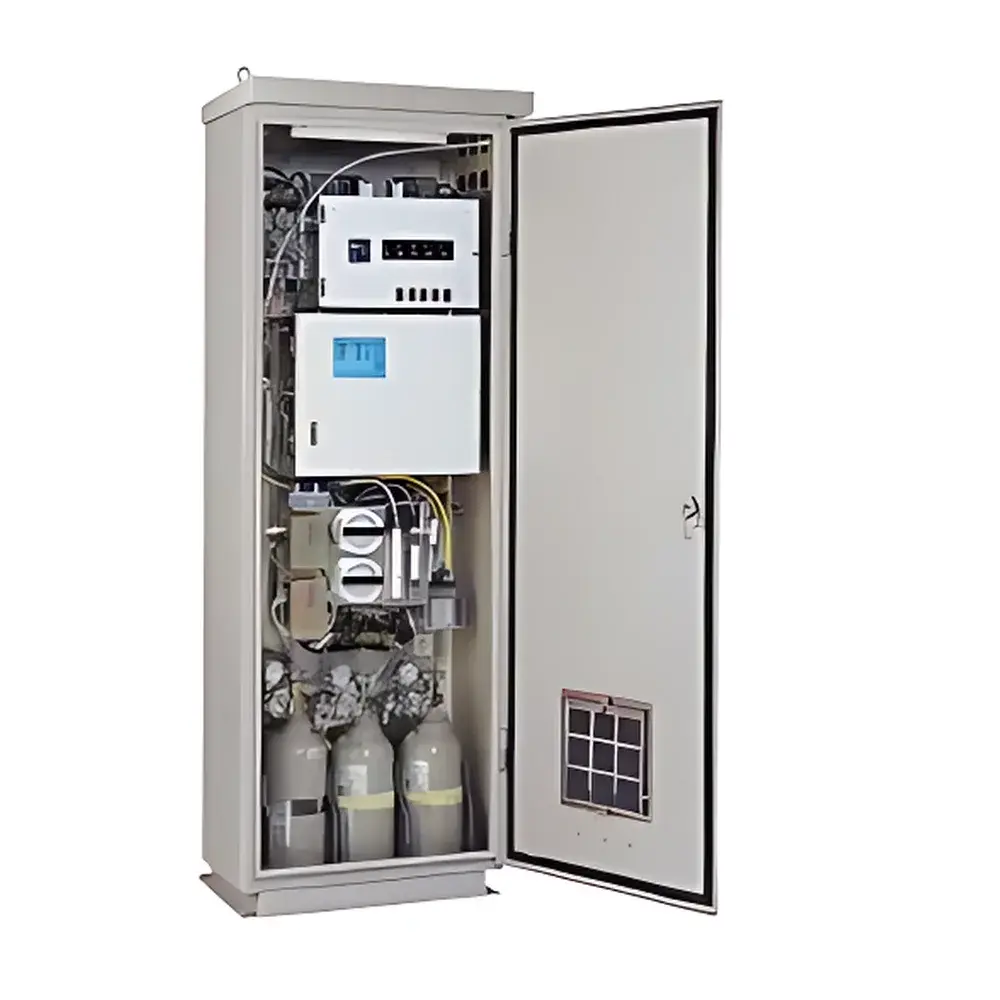
HORIBA ENDA-600ZG Series Continuous Emission Monitoring System (CEMS) for Flue Gas Analysis
| Brand | HORIBA |
|---|---|
| Origin | Japan |
| Model | ENDA-600ZG Series |
| Instrument Type | Continuous Emission Monitoring System (CEMS) |
| Measurement Accuracy | ±2.0% FS |
| Repeatability | ±0.5% FS |
| Response Time (SO₂) | 60–240 s |
| Long-Term Stability | ±1.0% FS |
Overview
The HORIBA ENDA-600ZG Series is a compact, high-integrity Continuous Emission Monitoring System (CEMS) engineered for regulatory-compliant, simultaneous online measurement of up to five key flue gas constituents: NOx, SO2, CO, CO2, and O2. Designed for permanent installation in demanding industrial stack environments, the system integrates alternating-flow non-dispersive infrared (NDIR) spectroscopy for acid gases and combustibles with paramagnetic oxygen detection—eliminating reliance on external carrier gases. Its core architecture employs dual-beam modulation and real-time reference-sample alternation at 1 Hz, ensuring intrinsic zero-point stability, immunity to optical misalignment, and absence of drift over extended operational cycles. The ENDA-600ZG meets international performance standards for CEMS, including ISO 14956, EN 15267, and EPA Performance Specification 3 (PS-3) and PS-4A, supporting compliance with national emission limits under frameworks such as the EU Industrial Emissions Directive (IED) and China’s GB 13223.
Key Features
- Single-analyzer multi-component capability: Simultaneous, continuous quantification of NOx, SO2, CO, CO2, and O2 without cross-calibration dependency.
- Drift-free NDIR detection: Alternating-flow modulation eliminates optical alignment requirements and delivers <±0.5% FS repeatability and <±1.0% FS long-term stability (7-day interval).
- Paramagnetic O2 measurement: Utilizes ambient air as the reference medium—no bottled N2 or synthetic carrier gas required—reducing consumables and operational cost.
- Integrated interference compensation: Dedicated H2O and CO2 correction channels; proprietary interference filter technology mitigates spectral overlap effects (e.g., CO2 on NOx response).
- Reduced footprint: Overall analyzer volume is 50% smaller than predecessor models (350 × 550 × 180 mm for optional wall-mounted auto-blowback controller); enables retrofitting in space-constrained installations.
- Accelerated calibration: Dry-gas SO2 span calibration completed in ≤3 minutes—versus 15 minutes for legacy wet-method protocols—minimizing downtime.
- Self-cleaning optical path: Continuous alternation between sample and reference gas streams provides passive detection cell purging, suppressing fouling-induced span drift.
Sample Compatibility & Compliance
The ENDA-600ZG accommodates highly variable flue gas matrices across thermal and chemical extremes. Its sampling subsystem is modularly configured per application: for waste incineration, it includes Cl2 scrubbers and triple-stage thermoelectric cooling (primary + dual secondary chillers) to suppress SO2/NO2 dissolution losses; for coal-fired power plants, NH3 removal units prevent sulfation artifacts during SO2 analysis; for high-dust applications (e.g., sinter plants), an integrated auto-blowback controller maintains probe and filter integrity with programmable purge timing. All configurations comply with ISO 12039 (CO/CO2), ISO 7935 (SO2), ISO 10849 (NOx), and EN 14181 (QA/QC requirements). Data integrity adheres to FDA 21 CFR Part 11 principles via audit-trail-enabled firmware, electronic signature support, and secure user-level access control.
Software & Data Management
The embedded operating system features a 10.4-inch resistive touchscreen interface with intuitive icon-driven navigation—no external PC required for routine operation. Real-time displays show all five component concentrations, O2-corrected values (per EN 14181 Annex A), 1-hour rolling averages, and alarm status. Calibration logs, maintenance records, and fault diagnostics are timestamped and exportable via USB or RS-485. Up to 12 analog outputs (4–20 mA) support integration into DCS/SCADA systems for NOx, SO2, CO, CO2, O2, corrected emissions, and dynamic averages. Firmware supports remote diagnostics via optional Ethernet module, enabling predictive maintenance alerts and configuration backup/restore functions compliant with IEC 62443-3-3 cybersecurity guidelines.
Applications
The ENDA-600ZG is validated for continuous monitoring in regulated emission sources including utility-scale coal- and gas-fired power plants, municipal solid waste incinerators, biomass boilers, glass melting furnaces, integrated steel mills, sulfuric acid production lines, and cement kilns. Its robust sample conditioning—including corrosion-resistant Inconel probes, heated sample lines (180 °C), and SO3-removing mist eliminators—ensures reliable operation in high-acidity, high-moisture, or particulate-laden streams. Application-specific options include high-temperature NOx converters (>95% NO2→NO efficiency), chlorine-tolerant filtration, and explosion-proof enclosures (ATEX Category 2G).
FAQ
What regulatory standards does the ENDA-600ZG meet for CEMS certification?
It satisfies EN 15267-3 (QAL1), ISO 14956 (performance evaluation), and U.S. EPA PS-3/PS-4A for O2, CO, CO2, NOx, and SO2 measurements.
How is zero drift prevented without manual optical adjustment?
The alternating-flow NDIR design switches sample and reference gas through the same optical path every second—eliminating differential aging and thermal lensing effects that cause drift in dual-beam systems.
Can the system operate without bottled calibration gases?
Yes—zero calibration uses purified instrument air; span calibration employs certified dry-gas standards, eliminating moisture-related errors and reducing gas cylinder dependency.
Is the analyzer suitable for high-humidity flue gas containing SO3?
Yes—the integrated mist eliminator removes SO3-rich aerosols prior to conditioning, preventing sulfation of sensors and downstream corrosion.
What maintenance intervals are recommended for the sampling system?
Primary filter replacement every 3 months; thermoelectric cooler cleaning quarterly; full system QAL2 verification annually per EN 14181 requirements.







