
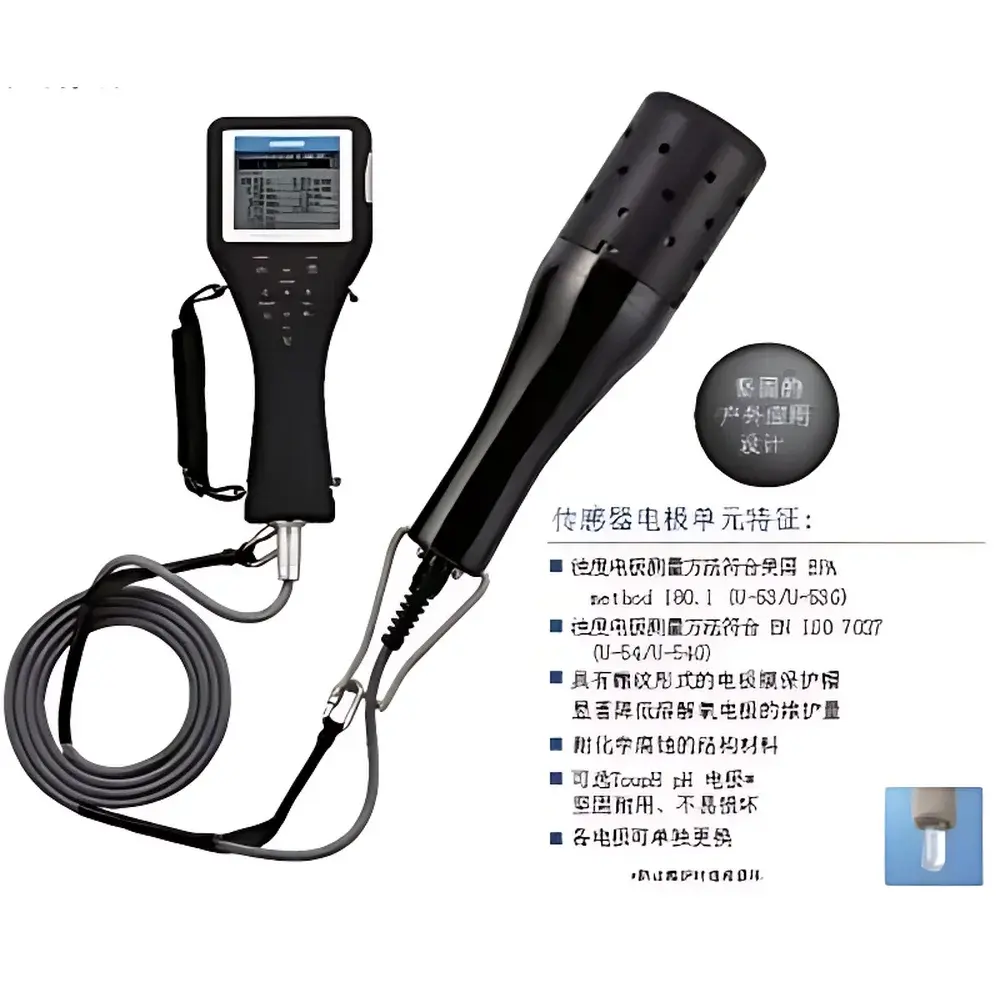
HORIBA U-50 Series Portable Multiparameter Water Quality Analyzer
| Brand | HORIBA |
|---|---|
| Origin | Japan |
| Model | U-50 Series |
| Instrument Type | Portable / Handheld Water Quality Analyzer |
| Measurable Parameters | pH, ORP, Dissolved Oxygen (DO), Electrical Conductivity (EC), Salinity, TDS, Specific Gravity (Seawater), Temperature, Turbidity (NTU), Depth (m), GPS Position |
| Turbidity Standards | U-53 — US EPA Method |
| Turbidity Resolution | 0.01 NTU |
| Operating Temperature Range | −10 °C to +55 °C |
| Waterproof Rating | IP68 (JIS Protection Class 8 for sensor, Class 7 for main unit) |
| Battery Life | Up to 70 hours (alkaline AA × 4, backlight off) |
| Data Storage | 10,000 measurement sets |
| Communication Interface | USB |
| Display | 320 × 240 monochrome LCD with backlight |
Overview
The HORIBA U-50 Series is a rugged, field-deployable multiparameter water quality analyzer engineered for high-reliability environmental monitoring in diverse aquatic environments—including rivers, lakes, groundwater wells, estuaries, wastewater treatment outfalls, and coastal zones. Utilizing proven electrochemical, optical, and pressure-based sensing principles, the U-50 platform delivers simultaneous, real-time measurement of up to 11 critical water quality parameters. Its modular probe architecture supports interchangeable sensor configurations (U-51 through U-54 variants), enabling mission-specific deployment while maintaining traceable metrology across all models. The instrument operates on standardized measurement methods aligned with international regulatory frameworks: pH and ORP employ glass and platinum electrode techniques compliant with ASTM D1293 and ISO 5667-22; dissolved oxygen uses Clark-type polarographic detection with automatic salinity compensation per ISO 5814; conductivity follows the four-electrode AC method per ISO 7888; turbidity measurements meet either US EPA Method 180.1 (U-53) or EN ISO 7027 (U-54), ensuring data compatibility with national reporting requirements under Clean Water Act or EU Water Framework Directive mandates.
Key Features
- Ruggedized IP68-rated construction: Sensor body fabricated from PPS, PEEK, titanium, SUS316L stainless steel, and FEP membranes—resistant to biofouling, abrasion, and chemical corrosion in freshwater and seawater.
- Multi-language interface: On-device display supports English, Japanese, Russian, Spanish, and Portuguese—facilitating cross-border field operations and multilingual technical support.
- High-resolution turbidity sensing: U-53 variant implements LED-based forward-scatter detection (30°) validated per US EPA protocols; U-54 employs tungsten-lamp 90° nephelometry certified to EN ISO 7027, both achieving 0.01 NTU resolution and integrated mechanical cleaning brushes to mitigate drift during extended deployments.
- Enhanced DO response kinetics: Optimized membrane geometry and electrolyte formulation reduce T90 response time by ≥30% versus prior-generation polarographic probes—critical for profiling vertical DO gradients in stratified water columns.
- Integrated GPS module (U-52G/U-53G/U-54G): 12-channel L1-band receiver provides sub-5 m horizontal positional accuracy (CEP), geotagging each measurement set for GIS-integrated spatial analysis and regulatory compliance reporting.
- Intelligent calibration management: Auto-recognition of pH 4.01 buffer enables single-point verification; two-point pH and ORP calibration routines include temperature-stamped audit trails—supporting GLP documentation requirements.
Sample Compatibility & Compliance
The U-50 Series is validated for use across natural and anthropogenically impacted waters with total dissolved solids up to 100 g/L and salinity up to 70 ppt. Probe materials comply with FDA 21 CFR §177.2420 (food-contact polymers) and EU REACH Annex XIV restrictions. All electrical safety design conforms to IEC 61010-1:2010 (Measurement Category II, Pollution Degree 2). Turbidity modules satisfy regulatory equivalence criteria under US EPA Region 10 QA/G-5 and German LAWA guidelines. Data integrity meets ALCOA+ principles: measurements are timestamped, sensor-specific calibration coefficients are stored in non-volatile memory, and USB export generates CSV files with embedded metadata (sensor ID, calibration date, operator code) suitable for 21 CFR Part 11-compliant systems when paired with validated third-party LIMS software.
Software & Data Management
Field data are stored internally in a tamper-resistant 10,000-entry buffer with full parameter arrays, timestamps, GPS coordinates (where equipped), and operator identifiers. USB 2.0 interface enables direct transfer to Windows/macOS platforms using HORIBA’s free U-50 Manager software—capable of batch calibration curve generation, statistical outlier detection (Grubbs’ test), and automated report export in PDF/Excel formats compliant with ISO/IEC 17025 clause 7.8.2. Raw data files include embedded CRC-32 checksums and sensor health diagnostics (e.g., membrane resistance, reference junction potential), supporting root-cause analysis during QA/QC review. Firmware updates are delivered via signed binary packages with SHA-256 hash verification to ensure supply-chain integrity.
Applications
- Regulatory ambient monitoring: Routine compliance sampling for NPDES permits, WFD ecological status assessment, and WHO drinking water guideline verification.
- Wastewater process control: Real-time tracking of aeration basin DO, influent/effluent conductivity, and final discharge turbidity to optimize energy use and meet effluent limits.
- Hydrogeological surveys: Vertical profiling of redox potential (ORP), pH, and conductivity in multi-level well installations to delineate contaminant plumes.
- Marine and estuarine research: Simultaneous measurement of salinity-corrected DO, specific gravity, and turbidity to model sediment resuspension dynamics and hypoxia development.
- Educational field labs: Modular probe configuration allows students to compare sensor response characteristics across water matrices while practicing standardized ASTM D3370 sampling protocols.
FAQ
What turbidity standards does the U-50 Series comply with?
The U-53 probe adheres to US EPA Method 180.1 (LED forward-scatter), while the U-54 probe meets EN ISO 7027 (tungsten-lamp 90° nephelometry). Both provide 0.01 NTU resolution and include motorized cleaning brushes.
Is depth measurement available on all U-50 models?
Depth sensing via piezoresistive transducer is standard on U-52G, U-53G, and U-54G models (0–30 m range, ±0.3 m accuracy); it is not supported on U-51, U-52, or U-54 base variants.
How is calibration traceability maintained?
Each calibration event stores sensor ID, date/time, reference solution lot number, and measured deviation values in non-volatile memory—enabling full audit trail reconstruction per ISO/IEC 17025 section 7.7.
Can the U-50 operate in freezing conditions?
Yes—the sensor housing and electronics are rated for continuous operation between −10 °C and +55 °C; however, DO membrane response slows below 0 °C, requiring extended equilibration time per ISO 5814 Annex B.
What battery type and life expectancy does the U-50 support?
Four AA alkaline cells deliver up to 70 hours of operation (backlight off, 20 °C ambient); lithium AA batteries extend service life in sub-zero environments and reduce voltage sag during high-current DO polarization cycles.







