
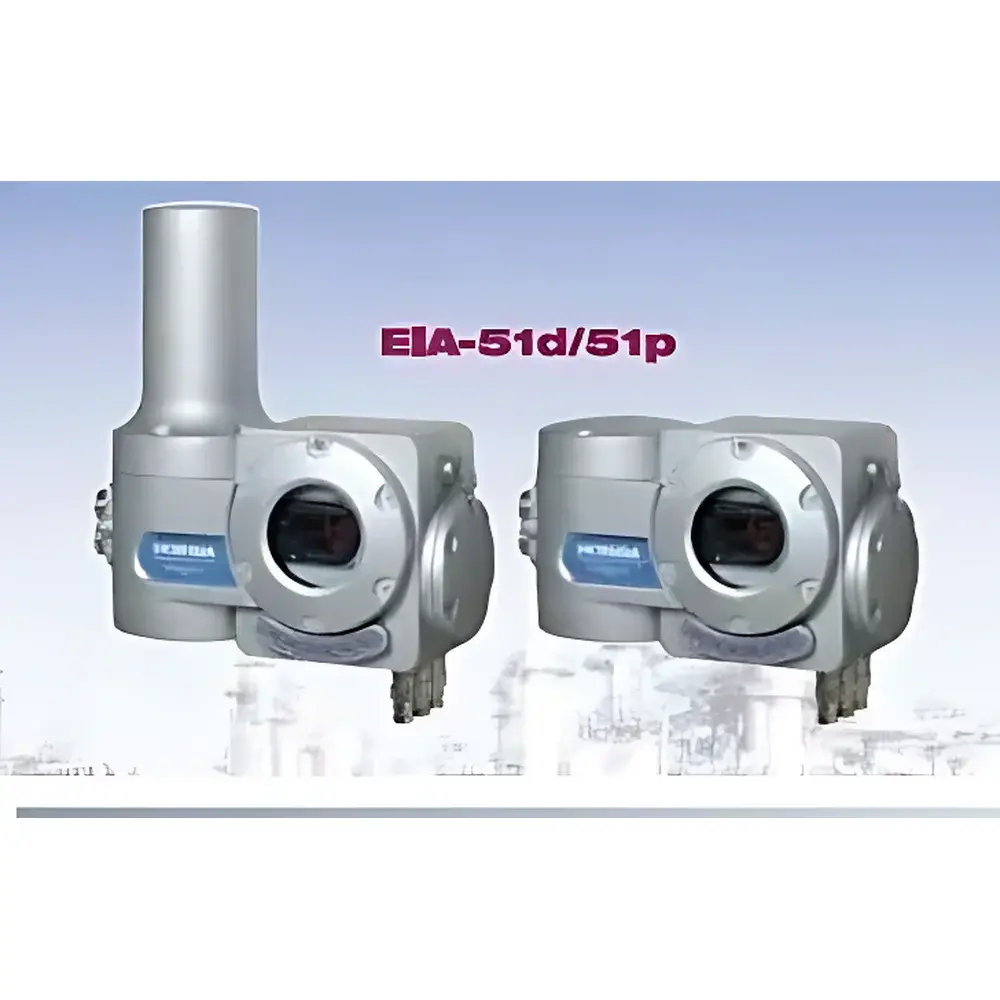
HORIBA EIA-51d / EIA-51p Intrinsically Safe and Explosion-Proof NDIR Gas Analyzer
| Brand | HORIBA |
|---|---|
| Origin | Japan |
| Model | EIA-51d / EIA-51p |
| Explosion Protection | Ex d IIB+H2 T4 (EIA-51d) / Ex p II T4X (EIA-51p) |
| Measurement Principle | Non-Dispersive Infrared (NDIR) with Interference Compensation |
| Measured Gases | CO, CO₂, CH₄ (configurable per application) |
| Range | 0–0.11 vol% to 0–100 vol% (gas-dependent) |
| Repeatability | ±0.5% F.S. (standard range) |
| Linearity | ±1.0% F.S. |
| Zero & Span Drift | ±2.0% F.S./week |
| Response Time (T90) | ≤20 s (standard), ≤40 s (extended range) |
| Sample Flow Rate | 500 mL/min |
| Operating Ambient Temperature | –5 to +40 °C |
| Analog Output | Isolated 4–20 mA (DC), optional 0–10 V |
| Communication | RS-485, Modbus-RTU (selectable baud rates: 1200–19200 bps) |
| Wetted Materials | SUS304, SUS316, FKM, CaF₂, Au |
| Calibration | Manual standard / Auto-calibration optional |
Overview
The HORIBA EIA-51d and EIA-51p are certified explosion-proof continuous gas analyzers engineered for reliable, high-stability measurement of combustible gases—including carbon monoxide (CO), carbon dioxide (CO₂), and methane (CH₄)—in hazardous industrial environments. These analyzers employ non-dispersive infrared (NDIR) spectroscopy with proprietary interference-compensated optical architecture. Unlike conventional single-detector NDIR systems, the EIA-51 series integrates co-located measurement and reference detectors within a shared optical path. This dual-detector configuration actively suppresses signal drift caused by optical aging, mechanical vibration, thermal fluctuation, and spectral interference from background gas components—enabling robust long-term performance in demanding process settings such as chemical plants, refineries, biogas facilities, and syngas production units.
Key Features
- Explosion protection certified to international IEC 60079 standards: EIA-51d meets Ex d IIB+H₂ T4 for flameproof enclosure design; EIA-51p complies with Ex p II T4X for pressurized enclosure operation—both rated for surface temperature class T4 (≤135 °C).
- Interference-compensated NDIR optics deliver enhanced selectivity and stability when measuring target gases in complex matrices containing water vapor, hydrocarbons, or other IR-active interferents.
- High-reproducibility performance: repeatability of ±0.5% full scale (F.S.) on standard ranges; linearity maintained within ±1.0% F.S.; zero and span drift limited to ±2.0% F.S. per week under controlled operating conditions.
- Rapid response time: T90 ≤ 20 seconds for standard measurement ranges, extendable to ≤ 40 seconds for ultra-low or high-concentration configurations.
- Modular analog and digital interfaces: isolated 4–20 mA output (750 Ω max load); optional voltage outputs (0–1 V, 0–5 V, 1–5 V, 0–10 V); RS-485 serial interface supporting Modbus-RTU protocol at configurable baud rates (1200–19200 bps).
- Chemically resistant wetted materials include SUS304/SUS316 stainless steel, fluorocarbon elastomer (FKM), calcium fluoride (CaF₂) optical windows, and gold-coated reflective surfaces—ensuring compatibility with aggressive or corrosive sample streams.
Sample Compatibility & Compliance
The EIA-51d/51p is designed for continuous analysis of dry, dust-free sample gas streams with oxygen concentration below 21% (v/v). It operates optimally at sample pressure ≥ 1.98 kPa (absolute) and flow rate of 500 mL/min. For applications requiring inert sweep gas (e.g., zero-air purging), nitrogen is recommended at 196–690 kPa supply pressure, with flow rates of 10 L/min during purge cycles and 0.5 L/min during normal operation. The analyzer complies with IEC 60079-0 (general requirements), IEC 60079-1 (flameproof “d”), and IEC 60079-2 (pressurized “p”) standards. While not inherently compliant with FDA 21 CFR Part 11, its analog and digital outputs support integration into validated control systems where electronic record integrity is enforced at the supervisory level (e.g., DCS/SCADA with audit-trail-enabled historian).
Software & Data Management
The EIA-51d/51p operates as a standalone field instrument with local parameter configuration via front-panel keypad and LCD display. All operational parameters—including range selection, alarm thresholds, analog scaling, and communication settings—are configurable without external software. Optional auto-calibration functionality enables scheduled zero/span verification using external calibration gas inputs, supporting routine quality assurance in accordance with ISO 17025-aligned laboratory practices. Data logging is performed externally via connected PLCs, DCS, or SCADA systems utilizing Modbus-RTU polling. No embedded firmware-based data storage or cloud connectivity is provided; this architecture prioritizes determinism, cybersecurity resilience, and compliance with air-gapped industrial network policies common in petrochemical and power generation sectors.
Applications
- Continuous emission monitoring (CEM) of CO and CO₂ in flare gas, furnace exhaust, and incinerator stacks.
- Process safety interlock systems for hydrogenation reactors, reformers, and synthesis loops where real-time detection of flammable gas accumulation is critical.
- Biogas upgrading plants—monitoring CH₄ purity and CO₂ removal efficiency prior to grid injection or vehicle fuel compression.
- Landfill gas collection systems—tracking methane slip and optimizing combustion efficiency in thermal oxidizers.
- Confined space entry pre-checks and perimeter monitoring in battery manufacturing, metal processing, and semiconductor fabrication facilities handling reducing atmospheres.
FAQ
What explosion protection certifications does the EIA-51d hold?
The EIA-51d is certified Ex d IIB+H₂ T4 per IEC 60079-1, suitable for Zone 1 and Zone 2 classified areas where Group IIB gases (e.g., acetone, ethyl alcohol) or hydrogen mixtures may be present.
Can the EIA-51p operate in Zone 0 environments?
No—the EIA-51p carries Ex p II T4X certification, which applies to Zone 1 and Zone 2 only. It is not rated for continuous operation in Zone 0 (continuous hazard presence).
Is automatic calibration supported as standard equipment?
Auto-calibration is an optional feature requiring additional hardware (solenoid valves, calibration gas manifolds) and must be specified at time of order.
What is the minimum detectable concentration for CO using the EIA-51 series?
The lowest standard range is 0–50 ppm CO; extended low-range configurations down to 0–5 ppm are available upon request and subject to optical path length and detector sensitivity validation.
Does the analyzer require carrier gas for operation?
No carrier gas is required for basic NDIR operation. However, nitrogen purge gas (10 L/min) is recommended during zero calibration or maintenance intervals to prevent optical contamination and ensure baseline stability.







