
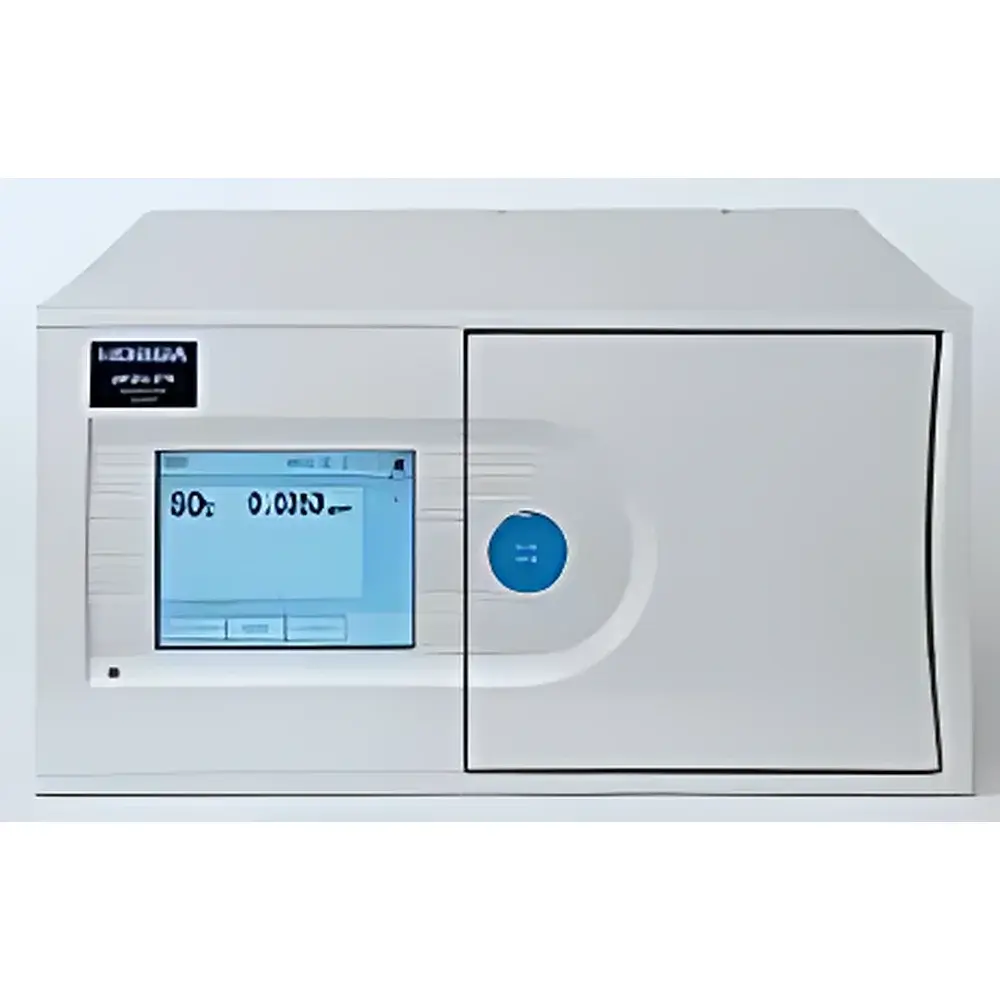
HORIBA APSA-370 UV Fluorescence Sulfur Dioxide (SO₂) Ambient Air Quality Monitor
| Brand | HORIBA |
|---|---|
| Origin | Japan |
| Model | APSA-370 |
| Measurement Principle | Ultraviolet Fluorescence (UVF) |
| Range | 0–0.05 / 0.1 / 0.2 / 0.5 ppm (standard) |
| LOD | 0.5 ppb (2σ, for ranges ≤0.2 ppm) or 0.5% F.S. (2σ, for ranges >0.2 ppm) |
| Repeatability | ±1.0% F.S. |
| Linearity | ±1.0% F.S. |
| Zero Drift | ±1.0% F.S./day (lowest range), ±2.0% F.S./week (lowest range) |
| Span Drift | ±1.0% F.S./day (lowest range), ±2.0% F.S./week (lowest range) |
| Response Time (T₉₀) | ≤180 s |
| Sample Flow Rate | ~0.7 L/min |
| Output Signals | 0–1 V / 0–10 V / 4–20 mA (configurable) |
| Operating Temperature | 5–40 °C |
| Power Supply | 100–240 VAC, 50/60 Hz (user-specified) |
| Dimensions | 430 × 550 × 221 mm (W×D×H) |
| Weight | ~19 kg |
Overview
The HORIBA APSA-370 is a high-performance, laboratory-grade ambient air quality monitor engineered for continuous, real-time measurement of sulfur dioxide (SO₂) concentrations in outdoor and indoor atmospheric environments. It employs the ultraviolet fluorescence (UVF) detection principle—a physically robust, selective, and trace-level analytical method widely endorsed by international air quality standards including EPA Method 42, ISO 7935, and EN 14212. In this technique, SO₂ molecules are excited by pulsed ultraviolet light (typically at 214 nm), inducing characteristic fluorescence emission near 320 nm. The intensity of this emitted signal is directly proportional to SO₂ concentration, enabling linear, interference-resistant quantification without reliance on carrier gases or chemical reagents.
Key Features
- Optimized UVF optical architecture: Features a newly designed fluorescence cell with minimized internal reflections and enhanced photon collection efficiency—enabling sub-ppb detection limits (0.5 ppb at 2σ for low-range operation) and exceptional signal-to-noise ratio under ambient background conditions.
- Integrated hydrocarbon barrier system: Utilizes a proprietary semi-permeable aromatic-selective membrane upstream of the reaction cell, effectively suppressing cross-sensitivity from volatile organic compounds (VOCs), ozone, and nitrogen oxides—critical for long-term stability in complex urban or industrial monitoring networks.
- Active moisture compensation: Patented flow-path geometry and thermal management reduce water vapor quenching effects on SO₂ fluorescence yield, maintaining accuracy across relative humidity ranges up to 90% RH without external drying or permeation dryers.
- Auto-ranging & remote configurability: Supports four factory-calibrated measurement spans (0–0.05 to 0–10 ppm), all switchable in real time via Ethernet or RS-232 commands—ideal for dynamic regulatory compliance scenarios requiring adaptive sensitivity.
- Dual-output flexibility: Provides simultaneous analog outputs (0–1 V, 0–10 V, or 4–20 mA) for both instantaneous concentration and dynamically averaged values (e.g., 1-, 8-, or 24-hour rolling averages), compliant with EU Directive 2008/50/EC reporting requirements.
- Embedded diagnostics & audit-ready logging: Continuously monitors lamp intensity, catalytic scrubber temperature, zero/span calibration status, and optical alignment—recording timestamped events with full traceability per GLP/GMP and FDA 21 CFR Part 11 data integrity guidelines.
Sample Compatibility & Compliance
The APSA-370 is validated for direct analysis of ambient air, stack effluents (with appropriate dilution and particulate filtration), and indoor air samples. Its sample inlet accepts standard ¼-inch PTFE or stainless-steel tubing and integrates a replaceable 2.0 µm particulate filter to prevent optical contamination. The instrument meets electromagnetic compatibility (EMC) requirements per IEC 61326-1 and environmental operating specifications per IEC 60721-3-3 (Class 3K3). It supports compliance with U.S. EPA Reference Method equivalency protocols and is routinely deployed in national air quality monitoring networks certified under ISO/IEC 17025-accredited laboratories.
Software & Data Management
Data acquisition, visualization, and remote maintenance are enabled through HORIBA’s standardized ADAQ software suite (Windows-based, optional web interface via embedded HTTP server). All measurements—including raw fluorescence counts, calibrated concentration values, diagnostic flags, and calibration logs—are stored internally on removable CompactFlash (CF) cards with FAT32 formatting. File export supports CSV, XML, and EPA-compatible .DAT formats. Network integration includes TCP/IP Ethernet (10/100BASE-TX), Modbus TCP, and SNMP v2c for SCADA interoperability. Audit trails include user login history, parameter modification timestamps, and electronic signatures for calibration verification—all retained for ≥12 months as required under ISO 14001 and EU MRV frameworks.
Applications
- Continuous emissions monitoring systems (CEMS) for coal-fired power plants and industrial combustion sources
- National and municipal ambient air quality monitoring stations (AQS) complying with WHO Air Quality Guidelines and EU Air Quality Directive thresholds
- Mobile monitoring platforms and roadside pollution mapping campaigns
- Research-grade field studies assessing SO₂ dispersion, atmospheric chemistry, and sulfate aerosol formation kinetics
- Indoor air quality assessment in industrial hygiene and occupational safety programs (OSHA PEL and ACGIH TLV validation)
FAQ
What is the minimum detectable concentration for SO₂ using the APSA-370?
The instrument achieves a limit of detection (LOD) of 0.5 parts per trillion (ppb) at 2σ confidence level when operating on the 0–0.2 ppm range.
Does the APSA-370 require zero gas or span gas for routine operation?
Yes—periodic zero and span calibration is required per regulatory protocols (e.g., EPA 40 CFR Part 60, Appendix B); however, no auxiliary carrier gas is needed for measurement itself.
Can the APSA-370 be integrated into an existing SCADA or central data acquisition system?
Yes—via Modbus TCP over Ethernet or RS-232 serial communication, supporting configurable polling intervals and alarm-triggered data push.
Is the CF card data format compatible with third-party environmental data management platforms?
Yes—CSV and XML exports are natively supported, and metadata fields conform to the AQMesh and EEA AirBase schema conventions.
How often does the aromatic hydrocarbon barrier require replacement?
Under typical urban ambient conditions, the barrier module maintains functional integrity for ≥6 months; replacement intervals are tracked automatically and reported via front-panel alerts and diagnostic logs.
Related Products







