
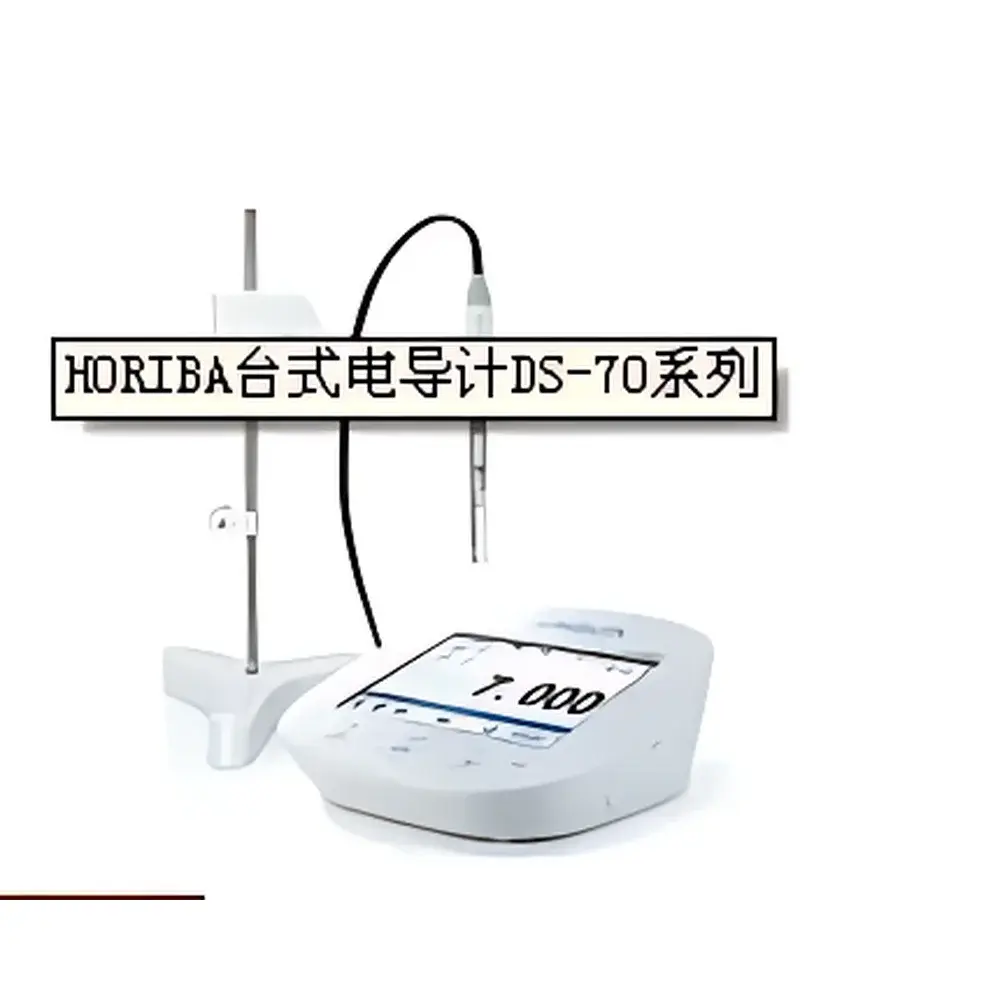
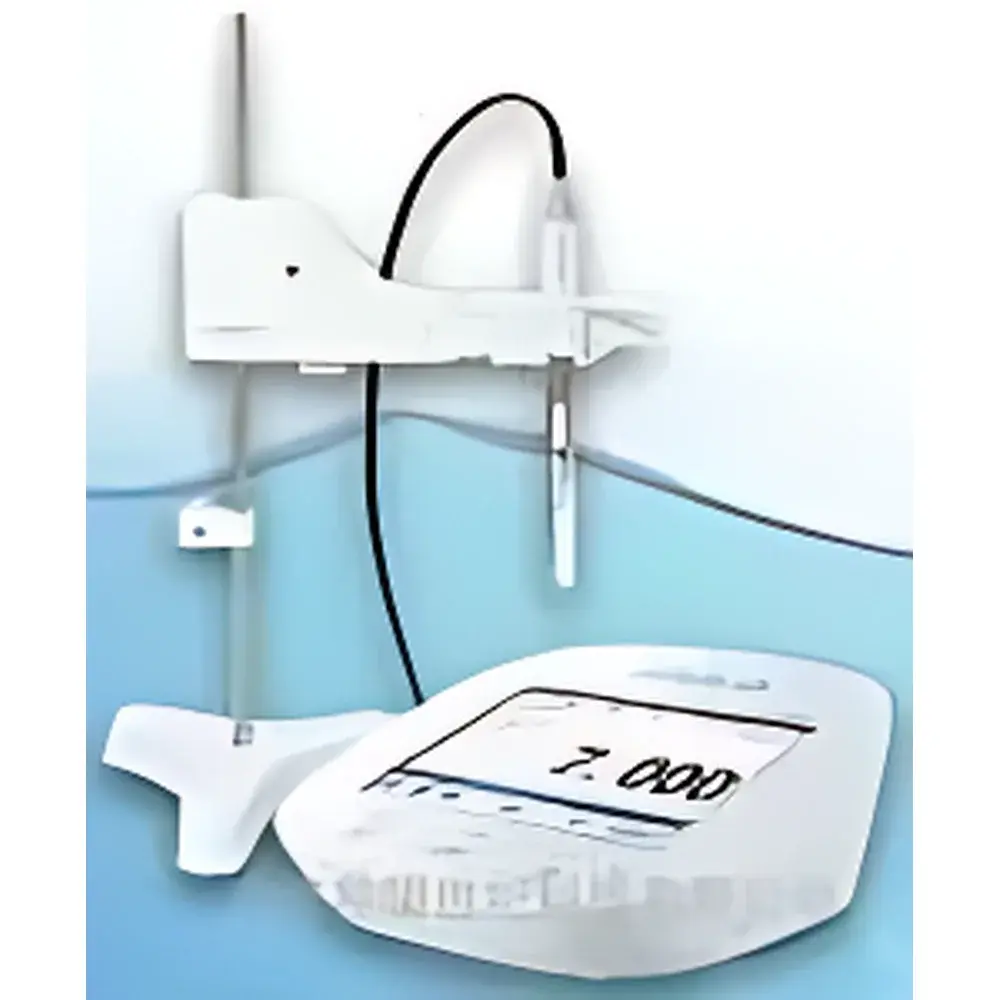
HORIBA DS-71 Desktop Multi-Parameter Conductivity Meter with Touchscreen Interface
| Brand | HORIBA |
|---|---|
| Origin | Japan |
| Model | DS-71 |
| Instrument Type | Laboratory Water Quality Analyzer |
| Power Supply | 100–240 V AC, 50/60 Hz |
| Power Consumption | ~0.7 VA |
| Weight | ~500 g |
| Data Storage Capacity | 999 measurement records |
| Display | Capacitive touchscreen (multilingual: English, Chinese, Japanese, Korean) |
| Temperature Range | −30.0 to 130.0 °C (display range: 0.0–100.0 °C), Resolution: 0.1 °C, Repeatability: ±0.1 °C ±1 digit |
| Conductivity Measurement Principle | Dual-electrode AC excitation method |
| Conductivity Ranges (by cell constant) | 10 m⁻¹: 0.0 µS/m – 1.999 S/m |
| 100 m⁻¹ | 0.000 mS/m – 19.99 S/m |
| 1000 m⁻¹ | 0.00 mS/m – 199.9 S/m |
| Resolution | 0.05% of full scale |
| Repeatability | ±0.5% FS ±1 digit |
| Resistivity (calculated from conductivity) | 10 m⁻¹: 0.0 Ω·m – 1.999 MΩ·m |
| 100 m⁻¹ | 0.00 Ω·m – 199.9 kΩ·m |
| 1000 m⁻¹ | 0.000 Ω·m – 19.99 kΩ·m |
| Salinity Range | 0.00–80.00 ppt (0.000–8.000%), Resolution: 0.01 ppt (0.001%) |
| TDS Range | 0.01 mg/L – 100 g/L, Resolution: 0.01 mg/L |
| Compliance | JIS Z 8809, USP <645>, EP 2.2.38, JP XVIII, CP 2020 Chapter 0803 |
Overview
The HORIBA DS-71 is a precision-engineered desktop multi-parameter conductivity meter designed for rigorous laboratory water quality analysis. It employs a dual-electrode AC excitation method—standardized under ISO 7888 and ASTM D1125—to eliminate polarization effects and ensure stable, drift-free conductivity measurements across wide dynamic ranges. Unlike single-frequency DC-based systems, the DS-71’s optimized 2-electrode AC architecture minimizes electrode fouling and enables accurate readings in low-conductivity ultrapure water (e.g., pharmaceutical WFI and PW) as well as high-salinity brines, without requiring manual cell constant selection during operation. Its integrated temperature compensation follows the standardized nonlinear algorithm per USP , supporting automatic correction using either built-in Pt1000 sensor or external probe input. The instrument meets critical regulatory requirements for analytical instrumentation used in GxP environments, including traceable calibration verification, secure user access control, and time-stamped measurement records compliant with FDA 21 CFR Part 11 principles.
Key Features
- Capacitive touchscreen interface with intuitive navigation, supporting English, Chinese, Japanese, and Korean languages—designed for ergonomic daily use in QC laboratories.
- Automated diagnostic guidance for sensor verification, calibration validation, and fault resolution—aligned with JIS Z 8809 and pharmacopeial compliance workflows (USP , EP 2.2.38, JP XVIII).
- Real-time display of all measured parameters (conductivity, resistivity, salinity, TDS, temperature) on a single screen, eliminating mode-switching delays and reducing operator error.
- Modular electrode design with quick-release glass-tube conductivity cells—facilitating cleaning, storage, and traceable sensor lifecycle management.
- Onboard periodic verification mode supporting JIS-defined routine checks, pharmaceutical water system validation protocols, and digital simulator emulation (F-72/F-73/F-74 compatibility).
- Low-power architecture (~0.7 VA) enabling continuous operation in environmentally controlled labs without thermal drift concerns.
Sample Compatibility & Compliance
The DS-71 is validated for use with aqueous matrices ranging from deionized water (0.055 µS/cm at 25 °C) to seawater-level salinity (up to 80 ppt). Its conductivity cell constants (10, 100, and 1000 m⁻¹) are factory-characterized and certified per ISO/IEC 17025-accredited procedures. All measurement algorithms adhere to internationally harmonized standards: resistivity is derived directly from conductivity using the inverse relationship ρ = 1/κ; salinity is calculated per PSS-78 (Practical Salinity Scale); and TDS conversion applies industry-standard 0.65–0.75 correlation factors depending on ionic composition—configurable by user. Regulatory documentation includes full traceability to NIST-traceable reference solutions, and the device supports audit-ready GLP/GMP reporting when paired with HORIBA’s optional data export software.
Software & Data Management
Data integrity is ensured through timestamped internal storage of up to 999 measurement records, each containing parameter values, temperature, date/time stamp, operator ID (if enabled), and calibration status flags. USB 2.0 connectivity enables direct transfer to Windows-based PCs for CSV export or integration with LIMS platforms. No proprietary drivers are required—the DS-71 appears as a standard CDC serial device. For regulated environments, optional firmware upgrades enable electronic signature capture, user role-based permissions (admin/operator/auditor), and immutable audit trails meeting ALCOA+ criteria. All stored data retain metadata necessary for 21 CFR Part 11 compliance, including creation/modification timestamps and source identification.
Applications
The DS-71 serves as a primary or secondary conductivity verification tool in pharmaceutical manufacturing (WFI/PW monitoring per USP ), environmental testing labs (EPA Method 120.1 compliance), semiconductor ultrapure water systems, academic research involving electrolyte characterization, and municipal drinking water QA/QC programs. Its stability and repeatability make it suitable for long-term trending studies, calibration verification of inline sensors, and reference-grade benchtop validation prior to field deployment. The instrument is routinely deployed in facilities undergoing MHRA, PMDA, or EMA inspections due to its transparent calibration history tracking and documented uncertainty budgets.
FAQ
Does the DS-71 support automatic temperature compensation using external probes?
Yes—it accepts Pt1000 RTD inputs for high-accuracy external temperature measurement, configurable to override the internal sensor when required.
Can calibration data be exported for regulatory review?
All calibration events—including date, standard used, slope, offset, and acceptance criteria—are stored alongside measurement records and exportable via USB.
Is the DS-71 compatible with GLP-compliant printers?
It supports standard ESC/POS protocol printers via USB; hardcopy reports include instrument ID, calibration status, and measurement metadata.
What is the recommended recalibration frequency?
Per USP , daily verification with certified standards is advised for GMP applications; annual full calibration against NIST-traceable references is recommended.
How does the DS-71 handle electrode fouling in high-fouling samples?
The AC excitation method inherently reduces polarization and coating artifacts; additionally, the instrument provides real-time electrode resistance diagnostics to alert users before accuracy degradation occurs.







