
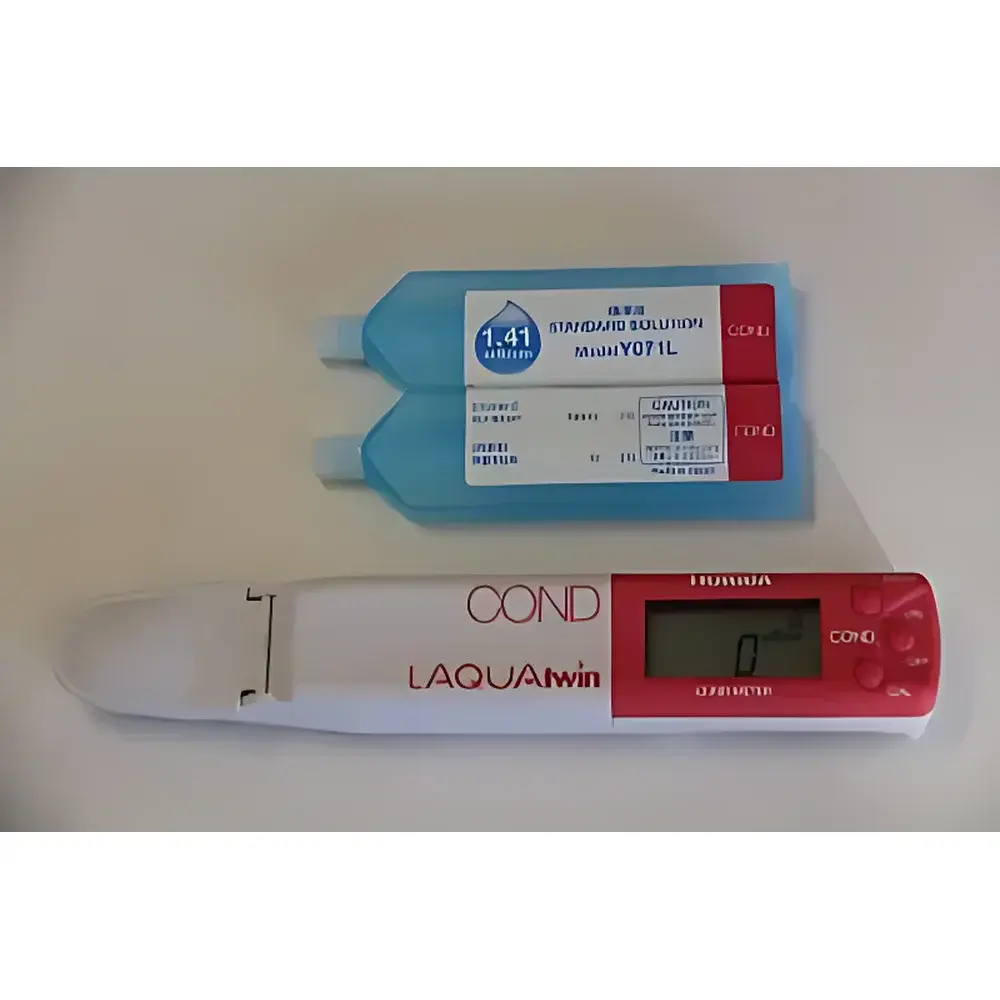
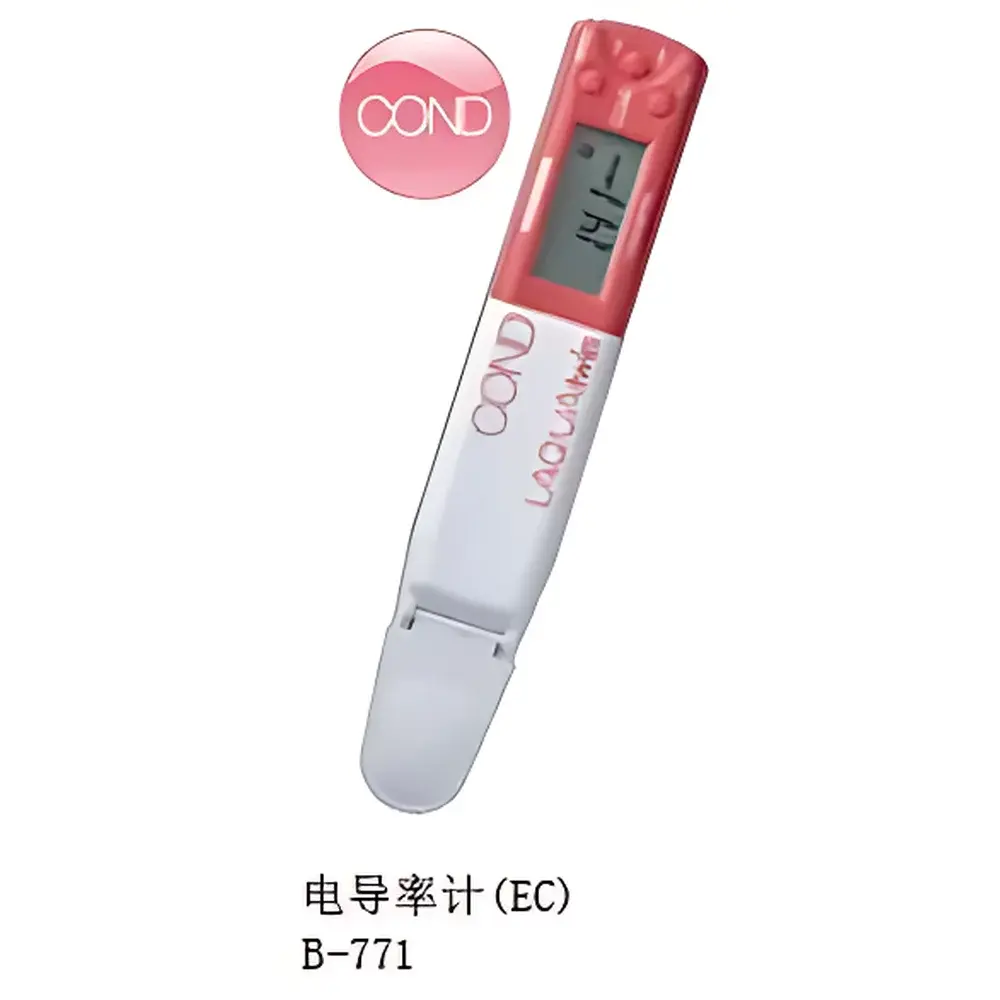
HORIBA B-771 Portable Conductivity/TDS/Salinity Pen Meter
| Brand | HORIBA |
|---|---|
| Origin | Japan |
| Model | B-771 |
| Portability | Pen-type |
| Conductivity Range | 0–19.9 mS/cm |
| TDS Range | 0–9900 ppm |
| Salinity Range | 0–1.1% NaCl |
| Temperature Range | 5–40 °C |
| Accuracy | ±2% F.S. ±1 digit |
| Resolution | 0.1 (for all primary parameters) |
| Measurement Principle | Two-electrode AC conductometry |
| Minimum Sample Volume | ≥0.12 mL |
| Temperature Compensation | Fixed 2%/°C |
| IP Rating | IP67 |
| Power | Two CR2032 batteries |
| Dimensions | 164 × 29 × 20 mm (excl. probe protrusion) |
| Weight | ~45 g (instrument only) |
Overview
The HORIBA B-771 is a compact, handheld conductivity pen meter engineered for rapid, field-deployable measurements of electrical conductivity (EC), total dissolved solids (TDS), and salinity in aqueous solutions. It operates on the principle of two-electrode AC conductometry—applying a low-frequency alternating current across a fixed-distance electrode pair to minimize polarization effects and ensure stable readings in low-to-moderate ionic strength samples. Unlike potentiometric or four-electrode systems, the B-771’s dual-electrode architecture delivers consistent performance with minimal calibration drift, making it especially suitable for routine quality checks in environmental monitoring, aquaculture, hydroponics, educational labs, and light industrial process support. Its sealed, ergonomic pen format enables single-handed operation, immediate immersion-based measurement, and reliable data acquisition without external power sources or ancillary hardware.
Key Features
- True portable design: Weighing only ~45 g (instrument body only), with dimensions of 164 × 29 × 20 mm—optimized for pocket storage and glove-compatible handling.
- IP67-rated enclosure: Fully protected against dust ingress and temporary immersion (up to 1 m for 30 min), enabling robust use in humid, outdoor, or washdown environments.
- Multi-parameter capability: Simultaneous real-time display of conductivity (0–19.9 mS/cm), TDS (0–9900 ppm, calculated as NaCl-equivalent), and salinity (0–1.1% w/w NaCl).
- Fixed temperature compensation: Automatic linear correction at 2%/°C, referenced to 25 °C—aligned with standard EC reporting conventions per ASTM D1125 and ISO 7888.
- Auto-hold function: Freezes the stabilized reading upon signal convergence, facilitating recording in unstable or hard-to-reach sampling locations.
- Two-point calibration support: Enables traceable adjustment using certified standard solutions (e.g., 1413 µS/cm and 12.88 mS/cm KCl standards), ensuring compliance with internal QA protocols.
- Low-power operation: Powered by two replaceable CR2032 coin-cell batteries, delivering >10,000 measurements per set under typical usage conditions.
Sample Compatibility & Compliance
The B-771 is validated for use with clean to moderately turbid aqueous samples—including freshwater, brackish water, nutrient solutions, and diluted process streams—provided suspended solids do not coat the electrode surface. It is not intended for highly viscous, oily, or strongly oxidizing media. With a minimum sample volume requirement of 0.12 mL, the instrument supports micro-volume testing in petri dishes, test tubes, or shallow surface water layers. While not certified for GLP or GMP-regulated release testing, its measurement repeatability (±2% F.S. ±1 digit) and documented calibration traceability align with preliminary screening requirements under EPA Method 120.1 and ISO 15839 for water quality field instrumentation. The device meets IEC 60529 (IP67) and RoHS Directive 2011/65/EU specifications.
Software & Data Management
The B-771 operates as a standalone, non-data-logging instrument. All measurements are displayed in real time on a high-contrast LCD screen with dual-unit readout (e.g., mS/cm and ppm). No proprietary software, drivers, or USB connectivity are included; data recording requires manual transcription or integration with third-party digital logbooks. However, its consistent output format and defined calibration intervals support inclusion in laboratory-controlled documents (e.g., SOPs, equipment logs) compliant with ISO/IEC 17025 clause 6.4.2 (Equipment Management) and FDA 21 CFR Part 11–aligned audit trails when used within documented workflows.
Applications
- Environmental field surveys: Rapid EC/TDS profiling of rivers, lakes, and groundwater wells during site assessments.
- Aquaculture management: Monitoring salinity stability in hatcheries and recirculating aquaculture systems (RAS).
- Hydroponic and greenhouse operations: Verifying nutrient solution strength prior to irrigation cycles.
- Educational laboratories: Demonstrating ionic concentration principles in general chemistry and environmental science curricula.
- Facility maintenance: Spot-checking deionized water rinse quality in cleanroom or labware washing stations.
- Food & beverage pre-screening: Assessing brine concentration consistency in pickling or curing processes.
FAQ
What is the electrode configuration and why does it matter?
The B-771 uses a fixed-distance, two-electrode AC sensor. This design minimizes electrode polarization and eliminates the need for frequent cleaning or platinization—ideal for intermittent use in variable water matrices.
Can the B-771 measure resistivity?
No. The instrument does not compute or display resistivity; it reports conductivity directly in mS/cm, with TDS and salinity derived via fixed conversion factors.
Is temperature compensation adjustable?
No. Compensation is fixed at 2%/°C, conforming to the standard NaCl-based temperature coefficient recommended in ISO 7888 for general-purpose conductivity meters.
How often should calibration be performed?
Calibration is recommended before each measurement session or after exposure to extreme temperatures, high-conductivity samples, or physical shock—consistent with ASTM D1125 guidance for portable EC devices.
Does the B-771 comply with FDA or pharmacopeial standards?
It is not designed for USP , EP 2.2.38, or FDA-critical applications requiring full electronic records; however, its accuracy and reproducibility meet preliminary qualification criteria for non-GxP water system checks.
Related Products




