
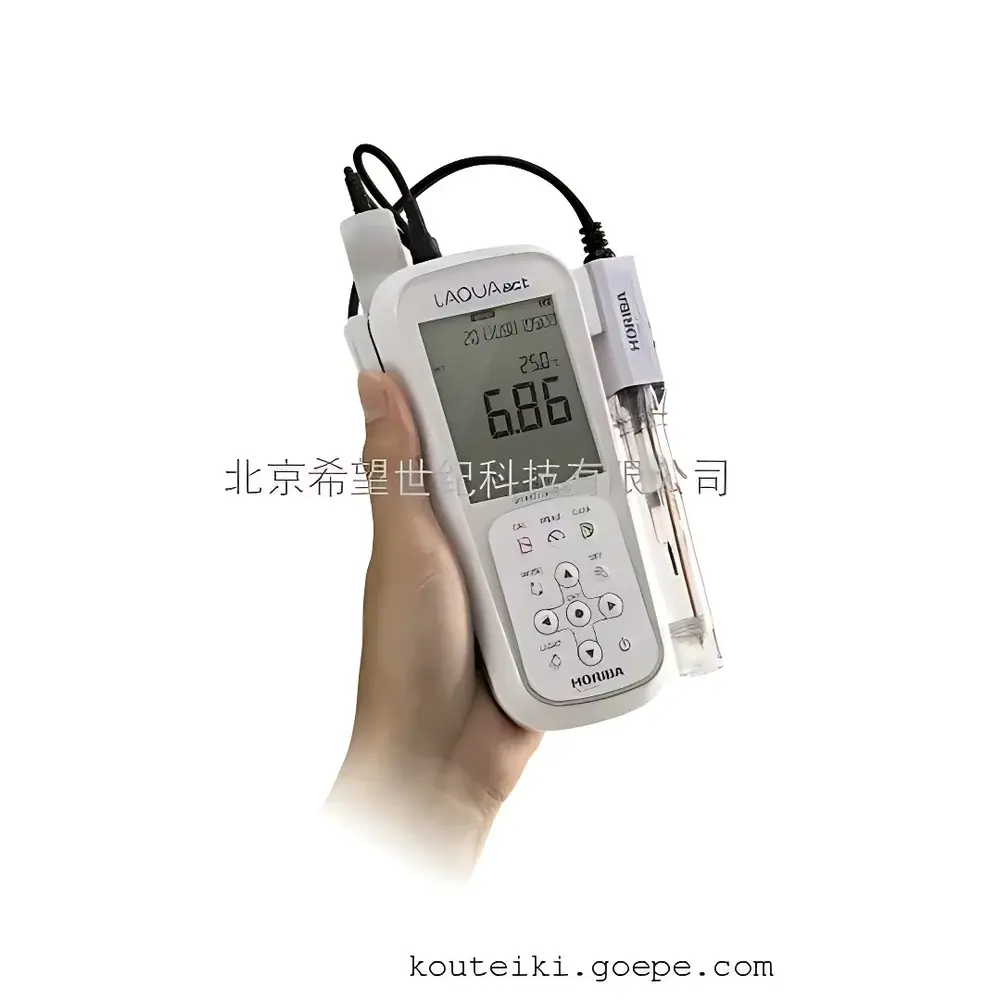
HORIBA OM-71 Portable Dissolved Oxygen Meter
| Brand | HORIBA |
|---|---|
| Origin | Japan |
| Model | OM-71 |
| Instrument Type | Portable |
| Parameter Type | Single-parameter (Dissolved Oxygen) |
| Measurement Range | 0.00–19.99 mg/L |
| Resolution | 0.01 mg/L |
| Accuracy | ±0.01 mg/L |
| Measurement Principle | Membrane-based Galvanic Cell |
| Temperature Compensation | 0–40 °C |
| Salinity Compensation | 0–40 ppt |
| Atmospheric Pressure Compensation | Yes |
| Saturation DO Range | 0.0–200.0 % |
| Oxygen Concentration Range | 0.0–50.0 % |
| Display | Backlit Monochrome LCD |
| Data Storage | 1000 records with timestamp, ID, and temperature |
| Environmental Rating | IP67 |
| Operating Temperature | 0–45 °C |
| Power | 2× AAA alkaline or Ni-MH batteries (≈500 h battery life) |
| Dimensions | 67 × 28 × 170 mm (max thickness 80 mm) |
| Weight | 270 g (body only) |
Overview
The HORIBA OM-71 is a field-deployable, single-parameter dissolved oxygen (DO) meter engineered for high-reproducibility measurements in environmental monitoring, wastewater treatment, aquaculture, and drinking water quality assessment. It employs a membrane-covered galvanic cell sensor — a robust electrochemical transduction method that generates a current proportional to the partial pressure of molecular oxygen diffusing through a selective hydrophobic membrane. This principle ensures stable zero-point behavior, minimal polarization drift, and no requirement for external polarization voltage — distinguishing it from polarographic sensors. The OM-71 integrates automatic temperature compensation (0–40 °C), salinity correction (0–40 ppt), and real-time barometric pressure adjustment to deliver concentration values referenced to standard atmospheric conditions (760 mmHg). Its compact, IP67-rated housing enables reliable operation in humid, dusty, or splash-prone environments — including riverbanks, treatment plant effluent channels, and marine sampling stations.
Key Features
- Galvanic DO sensor with integrated temperature thermistor for simultaneous in-situ thermal correction
- Automatic atmospheric pressure compensation via built-in barometric sensor — eliminates manual input errors during elevation-dependent calibration
- Salinity-compensated algorithm compliant with Winkler-derived reference methods for brackish and seawater applications
- IP67 ingress protection: fully dust-tight and submersible up to 1 m for 30 minutes — validated per IEC 60529
- Backlit monochrome LCD with AutoHold function for stabilized reading capture in turbulent or low-light conditions
- 1000-point internal memory with GLP-compliant metadata: timestamp, sample ID, temperature, pressure, and salinity settings
- USB interface supporting data export to PC for traceable reporting under ISO/IEC 17025 or EPA Method 360.1 workflows
- Low-power architecture: ≈2 mA standby current; >500 hours continuous operation on two AAA alkaline cells
Sample Compatibility & Compliance
The OM-71 is validated for aqueous matrices across a broad conductivity range (0–200 mS/cm) and pH 4–12. It meets ASTM D888-22 (Standard Test Methods for Dissolved Oxygen in Water) for field use when operated with HORIBA-certified calibration solutions and maintained per manufacturer’s interval schedule. Sensor response time (t90) is ≤30 s at 25 °C in stirred samples — consistent with US EPA guidance for rapid DO screening. The instrument supports GLP/GMP data integrity requirements through immutable timestamping, user-defined ID tagging, and audit-ready export logs. While not FDA 21 CFR Part 11–certified out-of-the-box, its data structure aligns with electronic record retention protocols when paired with validated third-party LIMS integration.
Software & Data Management
Data acquisition and reporting are managed via HORIBA’s LAQUA Connect desktop software (Windows-compatible), which enables batch export in CSV and Excel formats. Each stored measurement includes: DO concentration (mg/L), saturation (%), partial pressure (mmHg), temperature (°C), atmospheric pressure (hPa), salinity (ppt), and operator-assigned ID. The software enforces read-only archival of raw datasets and supports configurable report templates compliant with ISO 17025 Clause 7.8.2 (Reporting of Results). No cloud synchronization or remote firmware updates are implemented — ensuring data sovereignty and minimizing cybersecurity exposure in regulated facilities.
Applications
- Regulatory compliance monitoring per EU Water Framework Directive (WFD) Annex V and US Clean Water Act §402 discharge permits
- In-situ profiling of hypolimnetic oxygen depletion in stratified lakes and reservoirs
- Process control in activated sludge basins, where DO setpoints directly impact nitrification kinetics
- Aquaculture site assessment: correlation of DO levels with fish stress thresholds (e.g., <5 mg/L for salmonids)
- Groundwater redox characterization in contaminated plumes — particularly in conjunction with ORP and pH measurements using compatible D-70-series hosts
- Educational field labs requiring rugged, student-safe instrumentation with intuitive tactile feedback
FAQ
What calibration standards are required for the OM-71?
The OM-71 requires HORIBA’s proprietary zero-oxygen and saturated-air calibration solutions (Cat. No. 9501-10Z and 9501-10S). Use of non-certified fluids invalidates traceability to NIST SRM 2194.
Can the OM-71 measure DO in seawater?
Yes — provided salinity is manually entered or measured separately; the built-in algorithm applies the Garcia & Gordon (1992) solubility model for accurate correction up to 40 ppt.
Is the sensor replaceable by the user?
The galvanic DO probe is a field-serviceable module (Cat. No. 9501-10E); replacement requires no soldering or alignment tools and retains factory calibration coefficients.
Does the OM-71 support automatic temperature compensation during measurement?
Yes — the integrated Pt1000 thermistor continuously monitors sample temperature and dynamically adjusts the DO calculation in real time without user intervention.
How is data integrity ensured during battery replacement?
All 1000 memory entries are retained during battery swap due to non-volatile EEPROM storage; no data loss occurs even with complete power interruption.




