
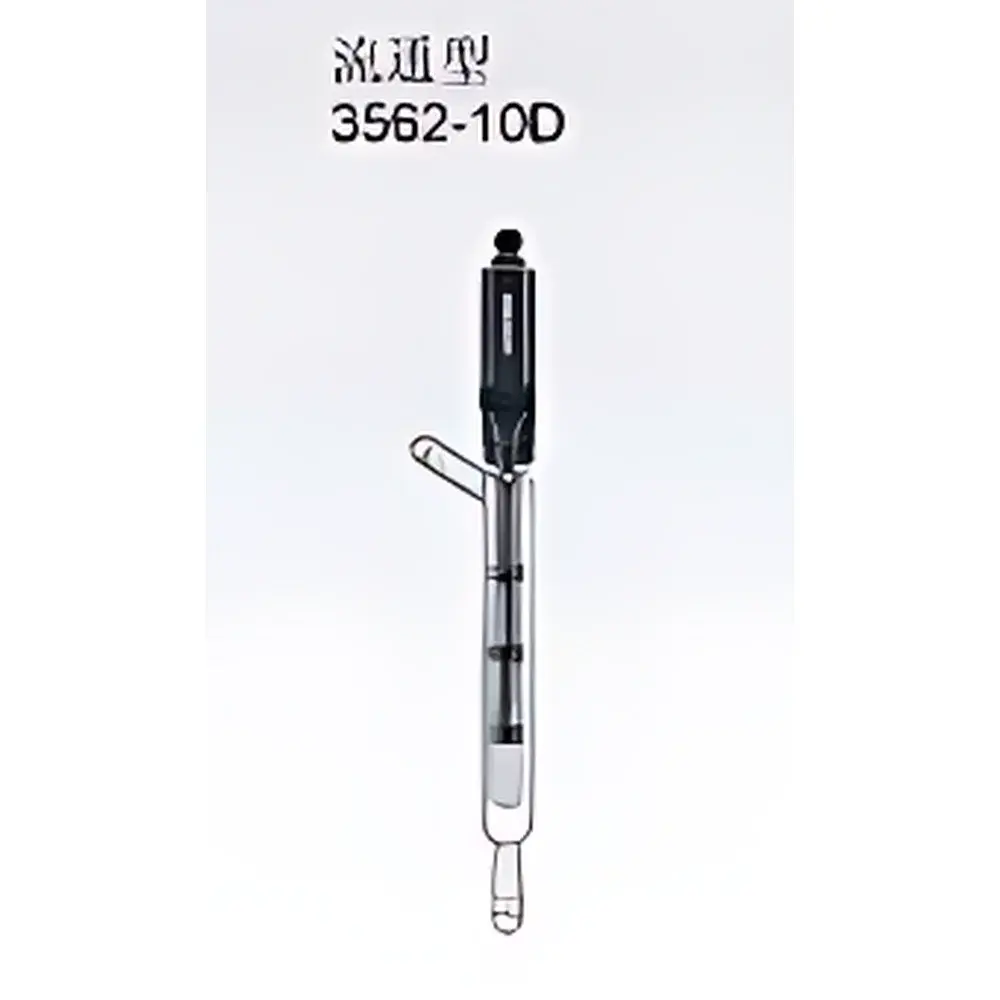
HORIBA 3562-10D Flow-Through Conductivity Electrode
| Brand | HORIBA |
|---|---|
| Origin | Japan |
| Model | 3562-10D |
| Conductivity Range | 0.1 mS/cm to 10 S/cm (1 µS/cm to 100 mS/cm) |
| Cell Constant | 100 m⁻¹ (1 cm⁻¹) |
| Minimum Sample Volume | 16 mL |
| Operating Temperature Range | 0–60 °C |
| Part Number | 3014082513 (Legacy: 9056001200) |
Overview
The HORIBA 3562-10D is a precision-engineered flow-through conductivity electrode designed for continuous, real-time monitoring of aqueous electrolyte solutions in process analytical applications. Based on the four-electrode (tetrapolar) AC measurement principle, it eliminates polarization errors and electrode fouling effects commonly encountered with two-electrode systems—making it especially suitable for samples with variable ionic strength, suspended solids, or scaling tendencies. Its cell constant of 100 m⁻¹ (1 cm⁻¹) enables accurate quantification across a broad dynamic range—from low-conductivity ultrapure water (1 µS/cm) to high-salinity industrial brines (up to 10 S/cm). The electrode’s stainless steel body and platinum-black coated electrodes ensure long-term stability, chemical resistance, and reproducible calibration traceability per ISO/IEC 17025–accredited reference standards.
Key Features
- Tetrapolar AC conductivity measurement architecture minimizes polarization impedance and contact resistance artifacts
- Robust 316L stainless steel housing with IP67-rated sealing for reliable operation in humid or splash-prone environments
- Integrated temperature sensor (Pt1000) enables automatic temperature compensation (ATC) with ±0.2 °C accuracy over 0–60 °C
- Optimized flow cell geometry ensures laminar flow profile and eliminates air entrapment; compatible with standard 1/4″ NPT or 6 mm push-to-connect tubing interfaces
- Calibration verification supported via standardized KCl solutions (e.g., 0.01 mol/kg, 0.1 mol/kg) aligned with IUPAC and ASTM D1125 guidelines
- No internal electrolyte refill required—maintenance-free operation with extended service intervals under continuous flow conditions
Sample Compatibility & Compliance
The 3562-10D is validated for use with aqueous solutions including municipal wastewater, boiler feedwater, pharmaceutical rinse water, semiconductor process baths, and food-grade cleaning-in-place (CIP) effluents. It is not recommended for non-aqueous solvents, highly viscous fluids (>50 cP), or suspensions containing abrasive particulates >50 µm. The electrode complies with key regulatory frameworks for process instrumentation: its construction materials meet USP Class VI biocompatibility requirements; electrical safety conforms to IEC 61010-1; and its measurement performance supports data integrity practices consistent with FDA 21 CFR Part 11 when integrated with compliant data acquisition systems. Documentation includes full traceable calibration certificates (NIST-traceable reference standards) and material declarations per RoHS 2011/65/EU and REACH Annex XIV.
Software & Data Management
The 3562-10D operates as a transducer-level sensor and is fully interoperable with HORIBA’s LAQUA Smart Series meters (e.g., LAQUA Twin, LAQUA DO-300), as well as third-party PLCs, SCADA platforms, and DCS systems via analog 4–20 mA output or digital Modbus RTU (RS-485). When paired with HORIBA’s LAQUASoft™ v4.x software, users gain access to audit-trail-enabled calibration logs, drift trend analysis, multi-point linearity validation reports, and automated compliance documentation for GLP/GMP audits. All stored datasets include timestamped metadata (temperature, flow rate if monitored, calibration history), satisfying ALCOA+ principles for data reliability.
Applications
- Continuous conductivity monitoring in reverse osmosis (RO) and electrodeionization (EDI) systems for ultrapure water production
- In-line quality control of cleaning and sterilization cycles in biopharmaceutical manufacturing (e.g., CIP/SIP validation)
- Real-time salinity tracking in aquaculture recirculation systems and desalination pre-treatment stages
- Concentration control of acid/base reagents in electroplating bath management
- Leachate conductivity profiling in landfill leachate treatment plants
- Validation of conductivity specifications per USP , EP 2.2.38, and JP 2.07 for purified and water-for-injection (WFI) systems
FAQ
What is the recommended flow rate range for optimal performance?
For stable readings and minimal pressure drop, maintain a linear flow velocity between 0.1 and 1.5 m/s (typical volumetric range: 10–200 mL/min), ensuring complete cell filling without turbulence-induced noise.
Can the 3562-10D be autoclaved or sterilized in place?
No—autoclaving exceeds its maximum temperature rating (60 °C). For sterile applications, use steam-in-place (SIP) at ≤60 °C with controlled ramp/soak profiles, or validate with vaporized hydrogen peroxide (VHP) per ISO 14644-3.
How often should calibration be performed?
Initial calibration is required before first use. Subsequent verification frequency depends on application criticality: daily for GMP-regulated processes, weekly for municipal utilities, and monthly for general laboratory monitoring—always following documented SOPs per ISO/IEC 17025 Clause 7.7.
Is this electrode compatible with HORIBA’s LAQUA Twin portable meter?
Yes—the 3562-10D connects directly via the optional LAQUA Twin Flow Adapter Kit (Cat. No. 9056001201), enabling field-deployable in-line measurements with full ATC and auto-ranging functionality.
Does the electrode require periodic cleaning?
Yes—cleaning every 1–4 weeks (depending on sample matrix) using 0.1 M HNO₃ or citric acid solution is recommended to prevent scale buildup; avoid abrasive brushes or ultrasonic baths that may damage the platinum-black coating.




