
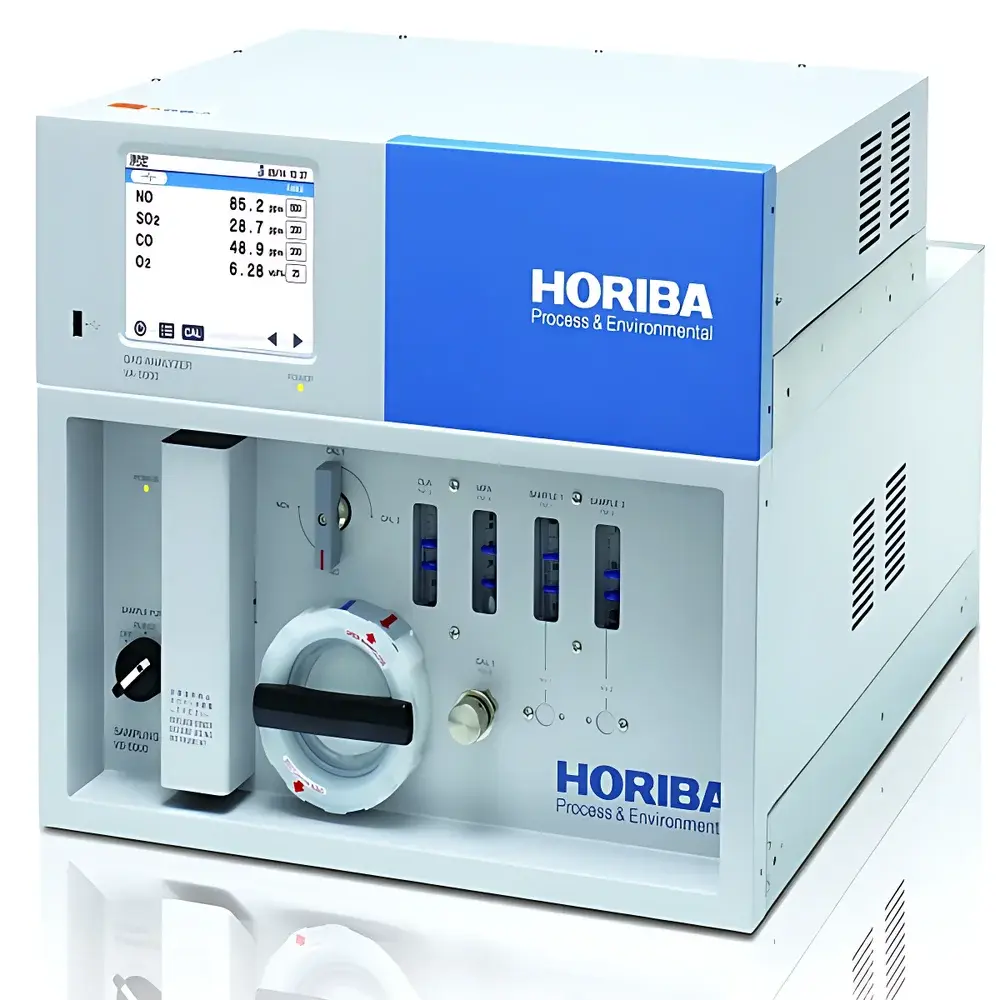
HORIBA VA-5000/VS-5000 Series NDIR & CLA-Based Multicomponent Infrared Gas Analyzer
| Brand | HORIBA |
|---|---|
| Origin | Japan |
| Model | VA-5000/VS-5000 |
| Detection Principle | Non-Dispersive Infrared (NDIR) / Chemiluminescence (CLA) / Magnetic Pressure (MPA) / Electrochemical (Galvanic Cell) / Zirconia / Paramagnetic |
| Configuration | Rack-Mountable Online Analyzer |
| Response Time (T90) | ≤30 s |
| Repeatability | ±0.5% FS |
| Linearity | ±1.0% FS (≤10× range), ±1.5% FS (>10× range) |
| Zero/Span Drift | ±2.0% FS/week (NDIR, CLA, MPA, Zirconia, Paramagnetic) |
| Dynamic Range Ratio | Up to 20:1 (NDIR, optional), 100:1 (CLA) |
| Analog Outputs | Dual 0–1 V DC or 4–20 mA per module |
| Communication Interface | RS-232C |
| Sample Flow Rate | 0.5 L/min (analysis unit) |
| Operating Temperature | 0–40 °C |
| Power Supply | AC 100–120 V or 200–240 V, 50/60 Hz |
| Weight | ~20 kg (VA-5000), ~14–20 kg (VS-5001–VS-5004) |
Overview
The HORIBA VA-5000/VS-5000 Series is a modular, rack-mounted multicomponent infrared gas analyzer engineered for high-reliability online monitoring in environmental compliance, industrial emissions control, energy research, and laboratory-scale process validation. Unlike single-gas analyzers, the VA-5000 integrates up to three independently configurable sensor modules within a standard 19-inch chassis—each employing application-optimized detection principles: Non-Dispersive Infrared (NDIR) for CO, CO₂, CH₄, N₂O, and SO₂; Chemiluminescence (CLA) for NOₓ; Magnetic Pressure Analysis (MPA) or paramagnetic detection for O₂; electrochemical (galvanic cell) or zirconia-based sensing for specialized O₂ applications. This architecture enables simultaneous, cross-interference-minimized quantification of up to six gases—including CO, CO₂, NOₓ, SO₂, CH₄, C₂H₄, N₂O, and O₂—within a single analytical platform. The system operates on the fundamental physical principles of molecular absorption spectroscopy (NDIR), light-emission kinetics (CLA), magnetic susceptibility (MPA/paramagnetic), and electrochemical potential equilibrium (galvanic/zirconia), ensuring trace-level sensitivity and long-term stability under continuous operation.
Key Features
- Modular sensor architecture supporting up to three interchangeable detection modules in one VA-5000 analyzer unit—enabling flexible configuration for site-specific gas matrices.
- Multi-principle detection platform: NDIR (CO, CO₂, CH₄, SO₂, N₂O), CLA (NO, NO₂), MPA/paramagnetic (O₂), galvanic cell (O₂), and zirconia (O₂), each selected based on required sensitivity, interference tolerance, and regulatory alignment.
- Wide dynamic measurement range: NDIR modules support up to 20:1 range ratio (optional); CLA modules achieve up to 100:1 via multi-range segmentation—eliminating manual range switching during transient emissions events.
- High metrological performance: Repeatability ±0.5% FS, linearity ±1.0% FS (within 10× span), zero/span drift ≤±2.0% FS/week (NDIR/CLA/MPA/zirconia/paramagnetic), and ≤±1.0% FS/day for galvanic O₂ sensors.
- Ruggedized 19-inch rack-mount design (430 × 132 × 550 mm, ~20 kg) with integrated LCD display (118.18 × 89.38 mm), dual analog outputs (0–1 V or 4–20 mA) per module, and RS-232C serial interface for SCADA integration.
- Comprehensive sampling compatibility via VS-5000 series pre-conditioning units (VS-5001–VS-5004), supporting dry sampling at 5 °C dew point, particulate filtration (<0.1 mg/m³), and corrosion-resistant wetted materials (SUS, PTFE, PVDF, FKM).
Sample Compatibility & Compliance
The VA-5000/VS-5000 system is designed for continuous analysis of clean, dry, non-corrosive, non-explosive sample streams compliant with ISO 12039, EPA Method 6C, EN 15267-3, and JIS B 7982. Sample conditioning must maintain moisture below 5 °C saturation (VS-5000 dry sampling), particulate load 10 ppm necessitates an upstream oxidation catalyst (e.g., for N₂O correction). Zirconia O₂ sensors require stoichiometric balance between reducing gases (CO, H₂, THC) and available O₂/H₂O to prevent sensor degradation—governed by the thermodynamic constraint: [CO] + [H₂] + [THC] < [H₂O] + [O₂]. All configurations meet CE marking requirements for electromagnetic compatibility (EN 61326-1) and safety (EN 61010-1).
Software & Data Management
The VA-5000 operates without proprietary operating systems—data acquisition relies on industry-standard analog output signals (4–20 mA or 0–1 V) compatible with PLCs, DCS, and data loggers. RS-232C serial communication supports ASCII-based command protocols for remote calibration initiation, range selection, and status polling. While HORIBA provides optional PC-based configuration software for setup and diagnostics, the analyzer itself requires no embedded OS or firmware updates during routine operation—ensuring deterministic real-time response and audit-trail simplicity. All analog outputs are isolated and calibrated per IEC 61298-2, enabling direct integration into GLP/GMP-compliant data acquisition systems that enforce 21 CFR Part 11 electronic signature and audit trail requirements. Calibration gas sequences (zero/span) can be triggered manually or via external TTL signal, supporting automated QA/QC workflows aligned with ISO/IEC 17025.
Applications
- Continuous Emissions Monitoring Systems (CEMS) for thermal power plants, cement kilns, and waste incinerators—measuring CO, NOₓ, SO₂, CO₂, and O₂ per EU Directive 2010/75/EU and U.S. EPA 40 CFR Part 60.
- Biogas upgrading and landfill gas quality control—simultaneous CH₄, CO₂, O₂, and H₂S (with optional electrochemical module) analysis for pipeline injection compliance (ISO 14502, EN 16723-1).
- R&D laboratories evaluating low-carbon fuel combustion, catalytic converter efficiency, and carbon capture process streams—leveraging NDIR’s ppm-level CO/CH₄ detection and CLA’s sub-ppm NO sensitivity.
- Industrial hygiene and workplace safety monitoring—tracking CO, CO₂, and O₂ in confined spaces or fermentation facilities under OSHA 1910.1200 and ACGIH TLV® guidelines.
- Automotive exhaust testing (engine dynamometers, chassis rolls) where fast T90 ≤30 s response and multi-gas correlation enable real-time lambda and combustion efficiency calculation.
FAQ
What detection principles are supported in the VA-5000 platform?
NDIR (for CO, CO₂, CH₄, SO₂, N₂O), chemiluminescence (CLA) for NOₓ, magnetic pressure (MPA) or paramagnetic for O₂, electrochemical (galvanic cell), and zirconia-based O₂ sensing.
Can the same VA-5000 unit measure both CO and NOₓ simultaneously?
Yes—by installing one NDIR module (CO) and one CLA module (NOₓ) in the same chassis, with independent signal processing and analog outputs.
What is the maximum number of gases measurable per VA-5000 unit?
Up to six gases across three modules—e.g., CO + CO₂ + NOₓ, or CH₄ + SO₂ + O₂—with each module capable of dual-range or dual-gas configurations where technically feasible.
Is the system compliant with EPA or EU emissions reporting standards?
Yes—when configured with appropriate modules, sampling conditioning (VS-5000), and calibration protocols, it meets performance specifications for EN 15267-3 QAL1 certification and EPA PS-4/PS-5 equivalency.
How is zero and span calibration performed?
Via dedicated RC1/8 calibration gas inlets on the VS-5000 sampler; automated or manual sequence initiation through front-panel keys or RS-232C command—calibration data (date, gas values, deviation) is retained in non-volatile memory for audit purposes.







