
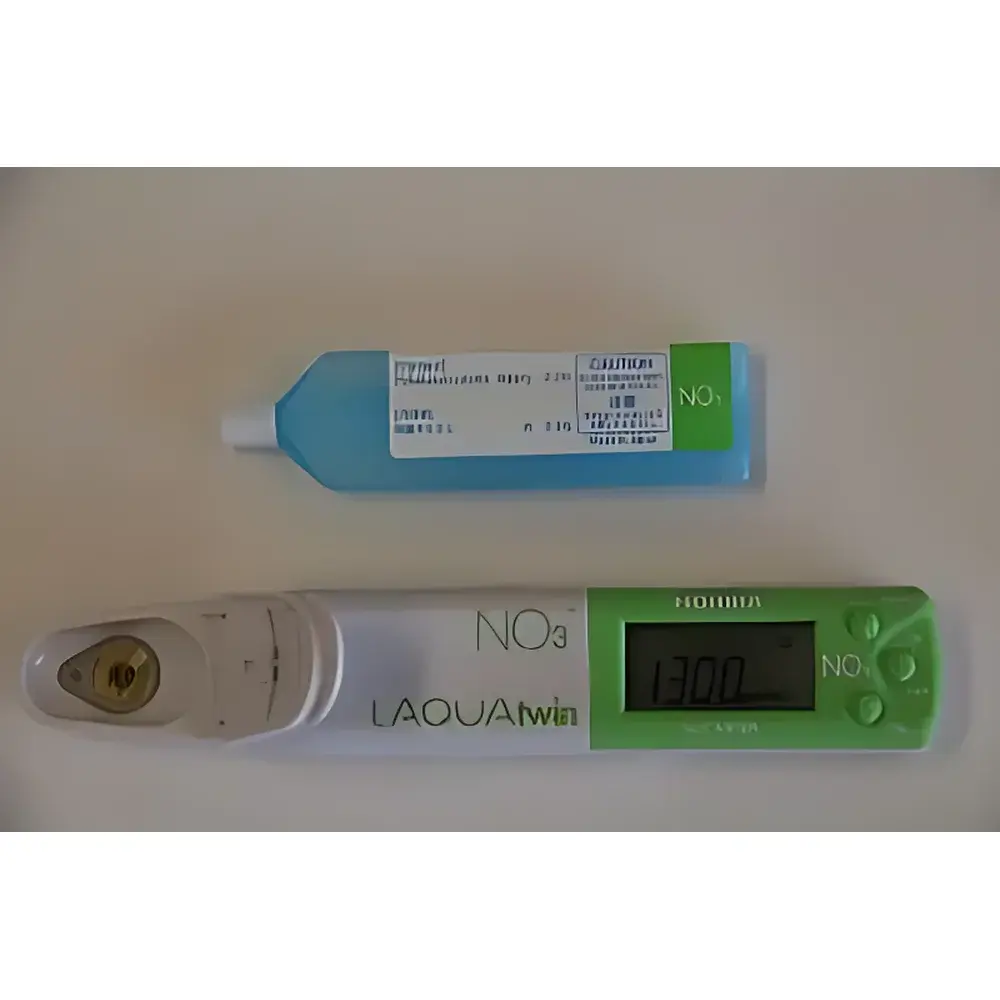
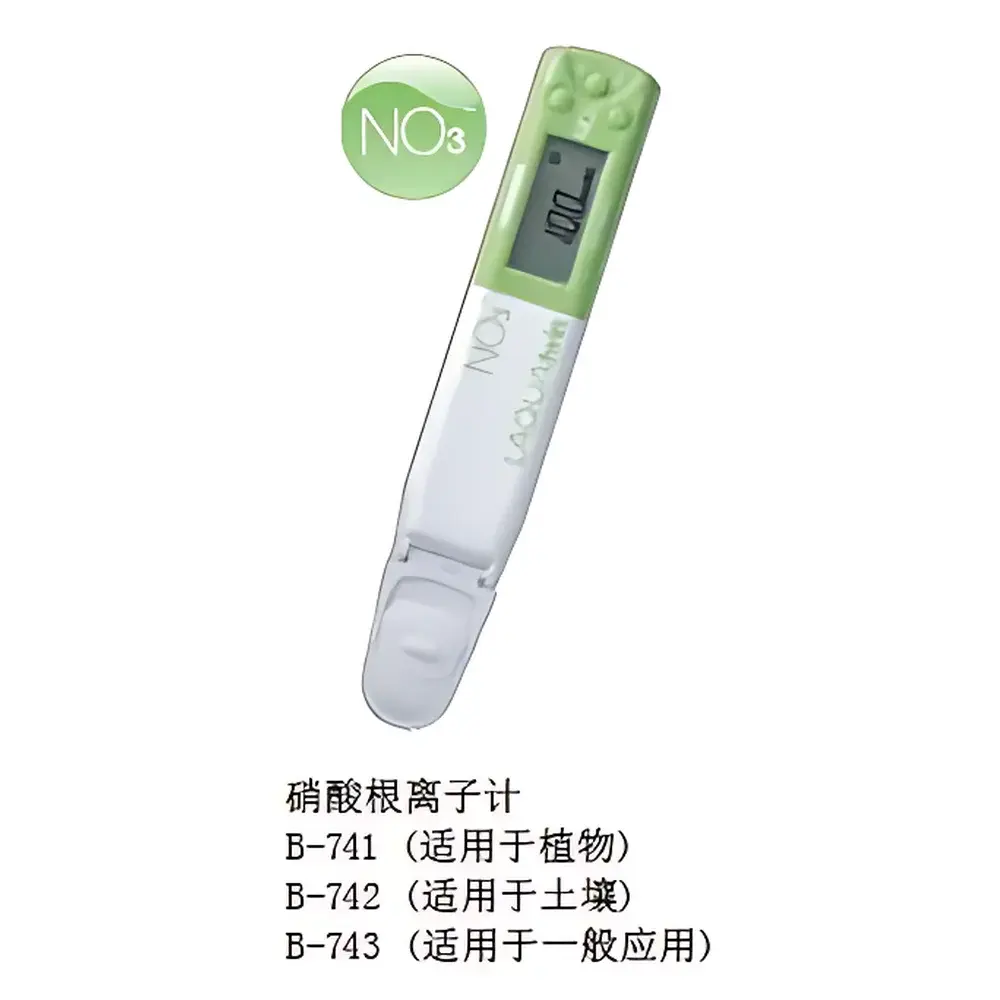
HORIBA B-741/B-742/B-743 Portable Nitrate Ion Meter
| Brand | HORIBA |
|---|---|
| Origin | Japan |
| Model | B-741/B-742/B-743 |
| Type | Pen-style single-parameter ion meter |
| Measurement Principle | Solid-state ion-selective electrode (ISE) method |
| Nitrate (NO₃⁻) Range | 62–6,200 ppm (mg/L) [10⁻³–10⁻¹ mol/L] |
| Nitrate-nitrogen (NO₃⁻–N) Range | 14–1,400 ppm (mg/L) |
| Temperature Range | 5–40 °C |
| Temperature Compensation | Automatic (2 %/°C fixed coefficient) |
| Accuracy | ±10 % of reading |
| Resolution | 0.1 ppm (for NO₃⁻) |
| Calibration | Two-point calibration with standard solutions |
| IP Rating | IP67 |
| Power | Two CR2032 lithium batteries |
| Dimensions | 164 × 29 × 20 mm (excl. protrusions) |
| Weight | ~50 g (instrument only) |
Overview
The HORIBA B-741/B-742/B-743 is a compact, pen-style nitrate ion meter engineered for rapid, field-deployable quantification of nitrate (NO₃⁻) and nitrate-nitrogen (NO₃⁻–N) in aqueous samples. It operates on the potentiometric principle using a solid-state, membrane-type nitrate-selective electrode (ISE), delivering direct mV-to-concentration conversion based on the Nernst equation. Designed for routine environmental monitoring, agricultural runoff assessment, drinking water screening, and aquaculture management, the instrument eliminates the need for complex wet chemistry or laboratory infrastructure. Its micro-volume sampling capability—requiring as little as 0.05 mL per measurement—enables analysis in confined or low-yield sample environments without dilution or pre-treatment. The device features built-in temperature compensation (fixed 2 %/°C coefficient), ensuring stable readings across ambient conditions typical of outdoor or mobile lab use (5–40 °C, <85 % RH, non-condensing). As a CE-marked, Japan-manufactured instrument, it complies with IEC 60529 (IP67) for dust-tight and immersion-resistant operation up to 1 m for 30 minutes—critical for field durability in rain, irrigation ditches, or humid greenhouse settings.
Key Features
- Pen-form factor (164 × 29 × 20 mm, ~50 g) optimized for one-handed operation and pocket portability
- Solid-state nitrate ISE with integrated reference system—no liquid electrolyte refills or membrane replacement required during normal service life
- Two-point calibration protocol using certified NO₃⁻ standard solutions (e.g., 100 ppm and 1,000 ppm) for traceable accuracy
- Auto-hold function freezes stable readings upon signal stabilization, reducing operator variability
- IP67-rated housing ensures reliable performance in wet, dusty, or splash-prone environments (e.g., soil leachate collection, pond margins, wastewater channels)
- Low-power design powered by two replaceable CR2032 coin cells (typical battery life >1,000 measurements)
- Direct readout in both NO₃⁻ (ppm, mg/L) and NO₃⁻–N (ppm, mg/L) units—supporting regulatory reporting formats (e.g., EPA Method 353.2, ISO 10304-1)
Sample Compatibility & Compliance
The B-741/B-742/B-743 is validated for use with clear, low-turbidity aqueous matrices including surface water, groundwater, treated effluent, nutrient solutions, and hydroponic reservoirs. It is not intended for highly viscous, suspended-solid-laden, or strongly oxidizing samples without filtration (0.45 µm) or pH adjustment (optimal range: pH 4–9). While not GLP-certified, its two-point calibration traceability, auto-hold repeatability, and documented temperature compensation align with QA/QC expectations for Level 1–2 environmental field screening per ASTM D3370 and ISO 5667-3. The instrument meets IEC 61000-4 electromagnetic immunity standards for portable electrochemical devices and carries RoHS and REACH compliance documentation from HORIBA Ltd. (Japan).
Software & Data Management
As a standalone, button-operated instrument, the B-741/B-742/B-743 does not feature Bluetooth, USB, or cloud connectivity. All measurement data remain on-device only; no internal memory or export functionality is provided. This architecture prioritizes operational simplicity, battery longevity, and regulatory acceptability in contexts where electronic data integrity controls (e.g., FDA 21 CFR Part 11 audit trails) are not mandated. Users record results manually into field notebooks or LIMS-compatible spreadsheets. Calibration history, date/time stamps, and unit selection are not stored—consistent with ISO/IEC 17025 Clause 7.7.1 requirements for instruments used in non-accredited, qualitative/semi-quantitative applications.
Applications
- On-site nitrate screening in municipal drinking water distribution systems (per WHO Guideline Value: 50 mg/L NO₃⁻)
- Rapid assessment of fertilizer leaching in agricultural soils and tile drainage water
- Monitoring NO₃⁻ accumulation in recirculating aquaculture systems (RAS) to prevent fish toxicity
- Verification of denitrification efficiency in constructed wetlands and bioreactors
- Educational demonstrations of ion-selective detection principles in university chemistry and environmental science labs
- Pre-screening prior to confirmatory lab analysis via ion chromatography (IC) or UV spectrophotometry (EPA 353.2)
FAQ
What sample volume is required for a valid measurement?
A minimum of 0.05 mL is sufficient when using the dual-dip sampling mode; however, ≥0.3 mL is recommended for improved signal stability and reduced air bubble interference.
Can the B-741/B-742/B-743 measure other ions such as chloride or phosphate?
No—this model is dedicated exclusively to nitrate (NO₃⁻) and nitrate-nitrogen (NO₃⁻–N). HORIBA offers separate pen meters (e.g., B-711 for pH, B-722 for K⁺) with distinct ISE elements.
Is temperature compensation adjustable or fixed?
Compensation follows a fixed 2 %/°C coefficient per ISO 7888 and cannot be user-modified; it is optimized for natural water matrices within 5–40 °C.
How often should calibration be performed?
Calibrate before each measurement session and re-calibrate if ambient temperature shifts >5 °C or after measuring >10 samples in high-ionic-strength media.
Does the device meet EPA or ISO regulatory acceptance criteria for compliance reporting?
It serves as a screening tool—not a definitive compliance instrument. Data must be verified by accredited laboratory methods (e.g., EPA 300.0, ISO 10304-1) for regulatory submission.





