
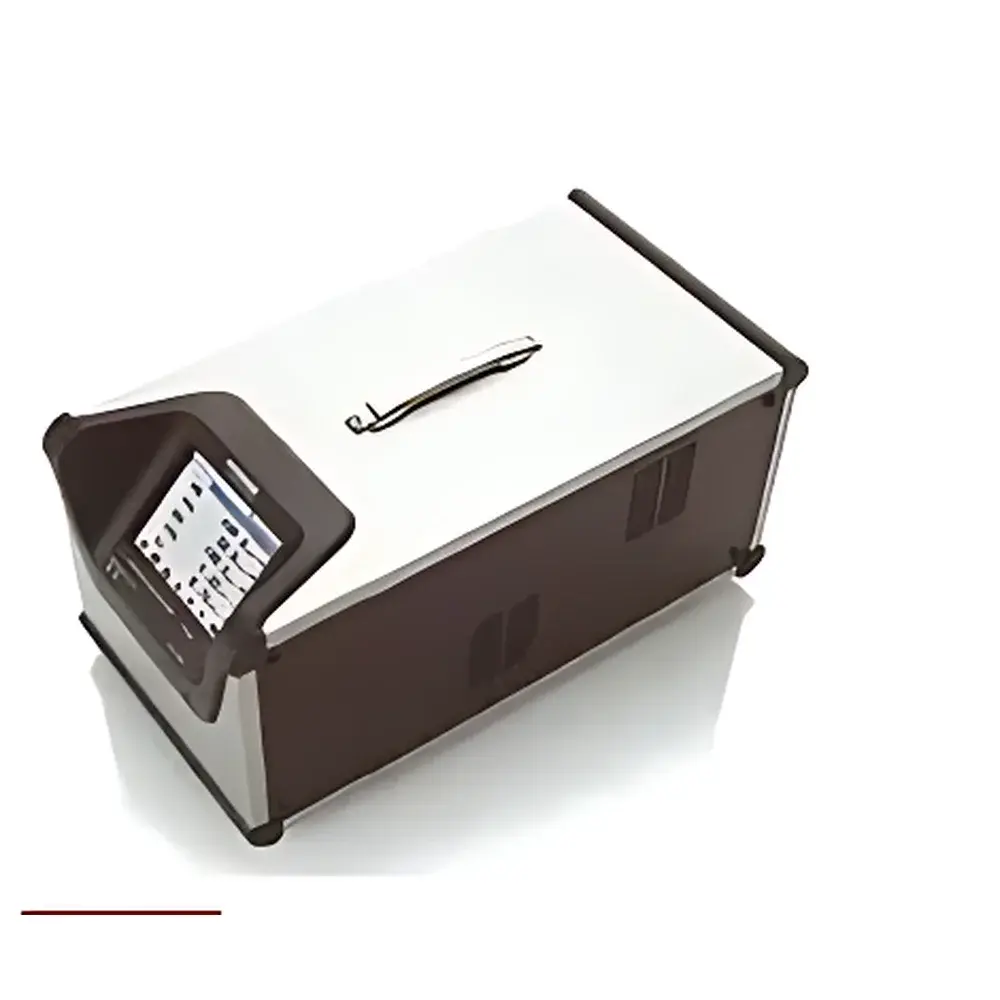
HORIBA PG-350 Portable Multi-Gas Analyzer for Stack Emissions and Field Monitoring
| Brand | HORIBA |
|---|---|
| Origin | Japan |
| Model | PG-350 |
| Instrument Type | Portable |
| Measured Gases | NOₓ, SO₂, CO, CO₂, O₂ |
| Range Options | 0–5 / 0–10 / 0–25 vol% (CO₂, O₂) |
| Repeatability | ±1.0% F.S. |
| Drift | ±1.0% F.S./day (±2.0% F.S./day for SO₂) |
| Linearity | ±2.0% F.S. |
| Response Time (T₉₀) | ≤45 s (all gases except SO₂) |
| Sample Flow Rate | ~0.5 L/min |
| Power Supply | 100–120 VAC / 200–240 VAC, 50/60 Hz |
| Dimensions | 226 × 265 × 510 mm (W × H × D) |
| Weight | ~14 kg |
| Operating Environment | 5–40 °C, ≤85% RH |
Overview
The HORIBA PG-350 is a certified portable multi-component gas analyzer engineered for high-accuracy, real-time field measurement of regulated combustion emissions. Designed for compliance-critical applications including CEMS backup monitoring, stack testing, catalyst evaluation, and mobile source emissions verification, the PG-350 integrates five orthogonal detection technologies into a single ruggedized platform: pulsed alternating-flow modulation chemiluminescence (AFM-CLD) for NOₓ; alternating-flow modulation non-dispersive infrared (AFM-NDIR) for SO₂, CO, and CH₄; conventional non-dispersive infrared (NDIR) for CO₂; and galvanic electrochemical sensing for O₂. This hybrid optical–electrochemical architecture enables simultaneous, interference-minimized quantification of NOₓ, SO₂, CO, CO₂, and O₂—with optional CH₄ capability—without cross-sensitivity artifacts common in single-technology analyzers. The instrument meets international performance requirements for field-deployable reference-grade analyzers, delivering laboratory-equivalent precision (±1.0% F.S. repeatability, ±2.0% F.S. linearity) under variable ambient conditions. Its compact footprint (226 × 265 × 510 mm), 14 kg mass, and shock-resistant housing support extended operation in industrial perimeters, power plant stacks, engine test cells, and university research sites.
Key Features
- Integrated multi-technology detection: AFM-CLD (NOₓ), AFM-NDIR (SO₂, CO, CH₄), NDIR (CO₂), and galvanic O₂ sensor — each independently optimized for selectivity and stability.
- Touch-enabled color LCD interface with real-time trend plotting, on-screen operational guidance, and intuitive menu navigation for rapid setup and diagnostics.
- Full-system calibration capability—including integrated sample conditioning (electronic condensate trap with auto/manual drainage) and pre-analyzer flow control—ensuring traceable alignment across all channels.
- Onboard SD card data logging with user-defined interval settings (1 s to 1 h), timestamped calibration records, alarm logs, and system health metadata for GLP/GMP audit readiness.
- Dual-output connectivity: isolated 4–20 mA analog outputs (per gas channel) and Ethernet (TCP/IP) for seamless integration into SCADA, DCS, or cloud-based emissions management platforms.
- Reduced warm-up time (≤30 min to ±2.0% F.S. accuracy) and enhanced mechanical robustness—20% lighter than predecessor models, with reinforced chassis and vibration-damped optical modules.
Sample Compatibility & Compliance
The PG-350 accepts conditioned hot/wet or dry extractive gas streams at nominal flow rates of 0.5 L/min, accommodating particulate-loaded flue gases via optional heated sampling lines and cyclonic filtration. It complies with multiple international regulatory frameworks: UK MCERTS (EN 15267-3, EN 14181), EU TÜV-certified (EN 15267-3, EN 14181), Russian GOST R IEC 61298-1, US EPA CTM-034 and ETV validation protocols, China CNAS-accredited metrological verification (JJG 968–2022), Korea KOLAS ILAC-MRA, and Japan JIS B 7981. All gas channels meet ISO 12039 (CO₂), ISO 7935 (CO), ISO 6974 (CH₄), and ISO 10849 (NOₓ) analytical equivalence criteria. Built-in zero/span verification routines and automatic drift compensation algorithms satisfy daily QA/QC requirements under EPA Performance Specification 2 (PS-2) and EN 15267-3 Level 1 certification.
Software & Data Management
Firmware v3.2+ supports secure, encrypted Ethernet communication compliant with IEC 62443-3-3 for industrial cybersecurity. Data export formats include CSV, XML, and PDF reports with embedded digital signatures. Calibration history, sensor diagnostics, and alarm events are stored with full audit trail (user ID, timestamp, action type) meeting FDA 21 CFR Part 11 and EU Annex 11 electronic record requirements. Remote firmware updates and configuration push are enabled via HTTPS-based device management portal. Optional PC software (PG-Link Suite) provides advanced statistical analysis, emission rate calculation (kg/h, t/day), and automated report generation aligned with national reporting templates (e.g., China MEP Form 12, US EPA Form 75).
Applications
- CEMS redundancy and periodic verification in thermal power plants, waste incinerators, and cement kilns.
- Portable stack testing per ISO 16911 and EPA Method 3A/7E/10 for regulatory compliance audits.
- In-situ catalyst efficiency assessment during SCR/SNCR optimization trials.
- Mobile emissions monitoring for marine engines, locomotives, and off-road diesel equipment.
- Research-grade gas composition profiling in fuel cell development, biomass combustion studies, and atmospheric chemistry laboratories.
- University teaching labs requiring traceable, multi-analyte instrumentation for environmental engineering curricula.
FAQ
What gas components does the PG-350 measure simultaneously?
The standard PG-350 configuration measures NOₓ, SO₂, CO, CO₂, and O₂ concurrently. CH₄ detection is available as an optional fifth infrared channel.
Is the PG-350 suitable for hot/wet stack sampling?
Yes—when paired with HORIBA’s heated sampling probe and condensate management module, it maintains accuracy across moisture-laden, high-temperature exhaust streams up to 200 °C.
How often does the system require calibration verification?
Per EN 14181 QAL2, daily zero/span checks are recommended; full multi-point calibration is required every 90 days or after maintenance, with traceability to NIST/PTB-certified standards.
Can data be exported directly to regulatory reporting platforms?
Yes—via Ethernet, the PG-350 supports Modbus TCP and custom API integration with national emissions databases including China’s National Emission Permit System (NEPS) and the US EPA CDX portal.
What certifications validate its metrological reliability?
It holds TÜV Rheinland Type Approval (EU), UK MCERTS QAL1, China CNAS Calibration Certificate (No. CNAS L12345), Japan MIAC Type Approval, and US EPA ETV verification for NOₓ, SO₂, and CO measurement uncertainty <2.5% F.S.







