
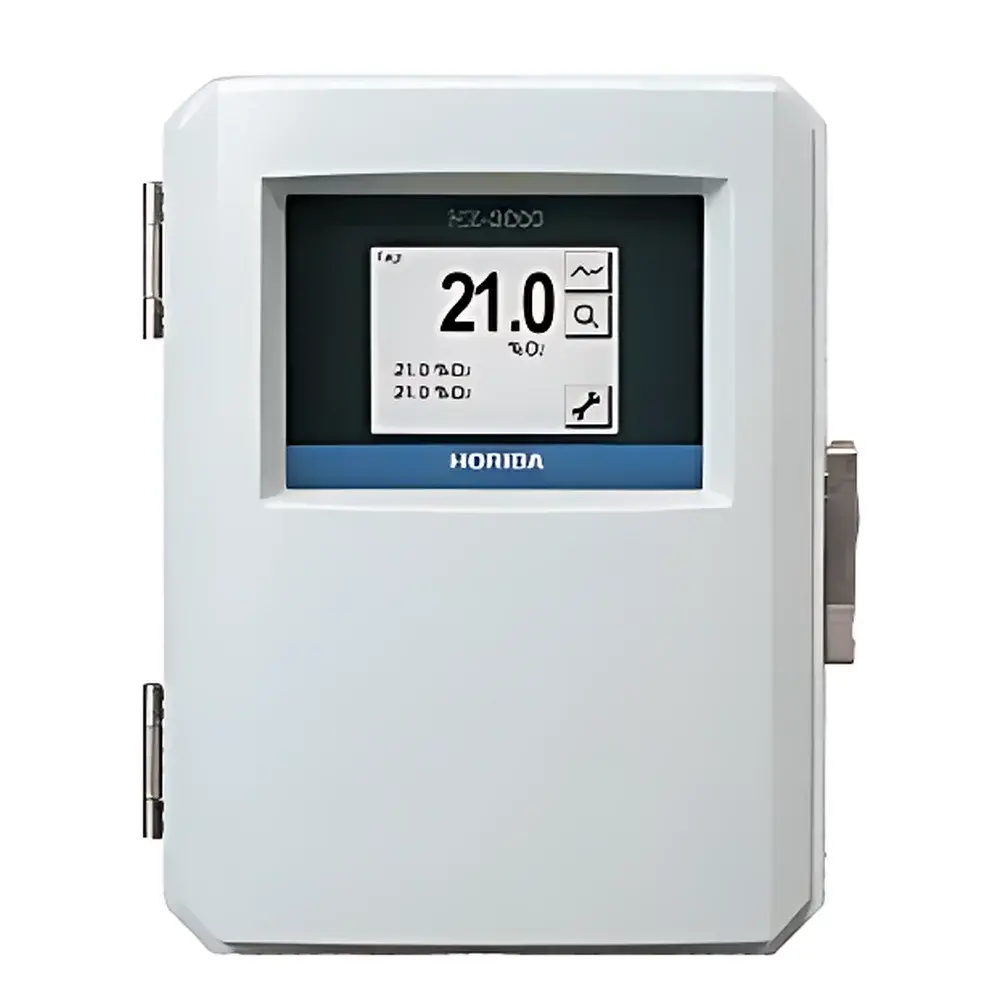
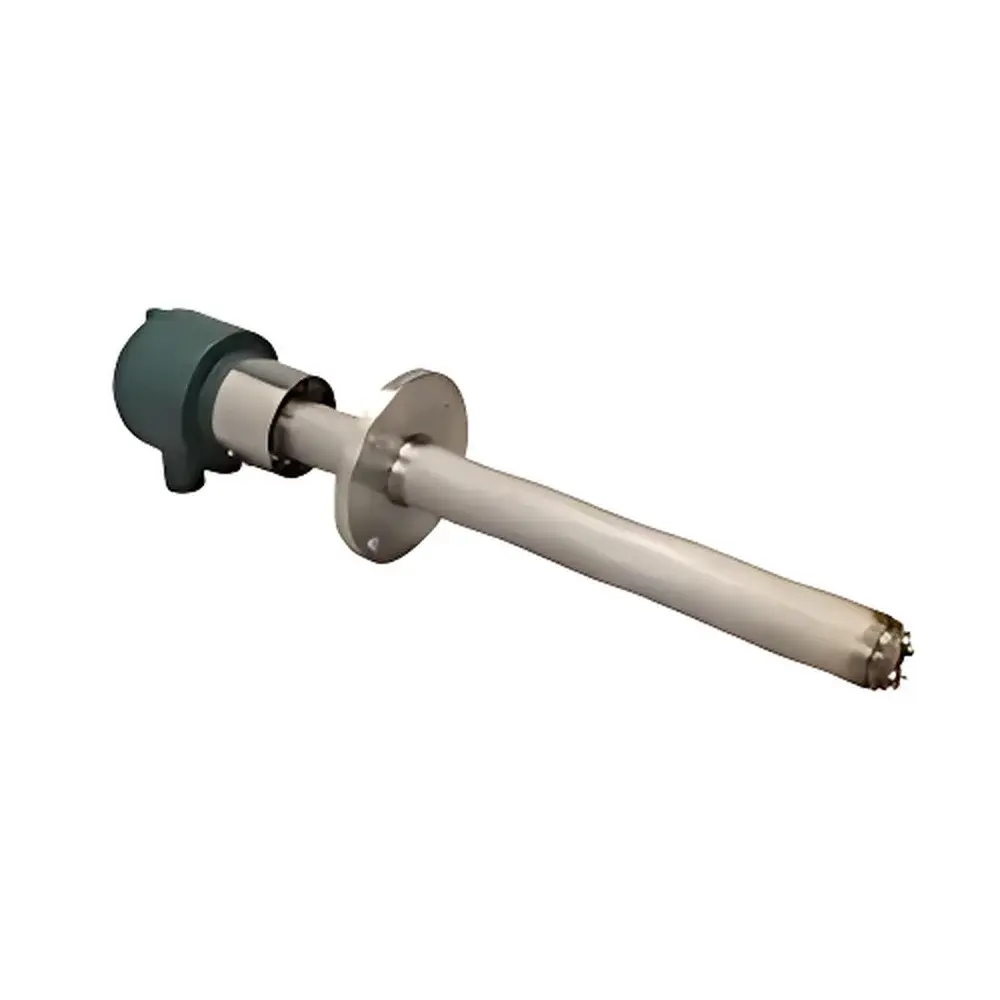
HORIBA NZ-3000 Zirconia Oxygen Analyzer
| Brand | HORIBA |
|---|---|
| Origin | Japan |
| Model | NZ-3000 |
| Detection Principle | Zirconia Electrochemical Cell |
| Measurement Range | 0–100 vol% O₂ (user-configurable output span, 1 vol% increments) |
| Gas Temperature Range | Standard Probe: 0–700 °C |
| High-Temp Probe | 0–1400 °C |
| Pressure Range | –5 to +250 kPa |
| Insertion Length Options | 0.15–3.0 m (standard) |
| Output Signal | 4–20 mA DC |
| Relay Outputs | 4 configurable contacts (30 VDC/3 A or 250 VAC/3 A) |
| Enclosure Rating | NEMA 4X / IP65 (detector & transmitter) |
| Ambient Temp | Detector: –20 to +150 °C |
| Transmitter | –20 to +55 °C |
| Power Supply | AC 100–240 V, 50/60 Hz |
| Power Consumption | ≤300 VA (max), ~100 VA (typical) |
| Repeatability | ±0.5% of full scale |
| Drift | ±2% of full scale per month (zero & span) |
| Response Time (t₉₀) | ≤5 s (under standard conditions) |
Overview
The HORIBA NZ-3000 Zirconia Oxygen Analyzer is a high-reliability, in-situ combustion gas monitoring instrument engineered for continuous, real-time measurement of oxygen concentration in flue gases from power plant boilers, industrial furnaces, small-scale steam generators, and other combustion systems. It operates on the principle of high-temperature electrochemical sensing using a stabilized zirconium dioxide (ZrO₂) solid electrolyte cell. At elevated temperatures (>650 °C), the zirconia element becomes conductive to oxygen ions, generating a Nernst voltage proportional to the logarithmic ratio of partial pressures of oxygen between the reference air and the process gas. This intrinsic thermodynamic relationship ensures direct, calibration-stable measurement without reliance on gas sampling lines, pumps, or conditioning systems—eliminating transport lag, condensation artifacts, and maintenance-intensive hardware.
Key Features
- In-situ probe design: Direct insertion into the flue duct eliminates the need for extractive sampling systems, reducing installation complexity, maintenance frequency, and potential measurement errors caused by gas cooling, adsorption, or reaction in sample lines.
- Extended sensor lifetime architecture: Platinum electrodes are protected by a proprietary ceramic coating that mitigates catalytic poisoning and thermal degradation. The electrode configuration employs a wire-free, co-fired ceramic structure—removing mechanical failure modes associated with lead wire fatigue or thermal expansion mismatch.
- Modular probe selection: Two probe families—standard (0–700 °C) and high-temperature (0–1400 °C)—support application-specific thermal requirements. Insertion lengths range from 0.15 m to 3.0 m (standard) or 1.0–1.5 m (high-temp), enabling optimal positioning across duct geometries and velocity profiles.
- Ruggedized outdoor-rated construction: Both detector and transmitter housings comply with NEMA 4X and IP65 standards, ensuring resistance to rain, dust, corrosion, and ambient temperature extremes encountered in industrial field environments.
- Configurable analog and relay outputs: A 4–20 mA current loop provides linear O₂ concentration output over any user-defined span within 0–100 vol% O₂ (in 1 vol% steps). Four programmable relay contacts support alarm, status, and control functions—including adjustable hysteresis, delay timing, and dedicated flags for sensor fault, calibration mode, and range switching.
Sample Compatibility & Compliance
The NZ-3000 is validated for use with hot, dry, or moderately humid flue gases containing CO₂, N₂, H₂O vapor, SO₂, NOₓ, and trace hydrocarbons—provided combustible gas concentrations remain below lower explosive limit (LEL) thresholds (as specified in IEC 60079-29-1). It is not intended for use in atmospheres containing significant concentrations of reducing gases (e.g., H₂ > 2%, CO > 5%) at low O₂ levels (<1%), where cross-sensitivity may affect accuracy. The analyzer meets electromagnetic compatibility requirements per EN 61326-1 (industrial environment) and safety standards per UL 61010-1 and IEC 61010-1. Its design supports compliance with combustion efficiency optimization protocols referenced in ASTM D5845 and ISO 14644-1 cleanroom monitoring frameworks when integrated into broader emissions management systems.
Software & Data Management
While the NZ-3000 operates as a standalone field instrument with local push-button interface and LED display, it is fully compatible with distributed control systems (DCS), SCADA platforms, and PLC-based data acquisition networks via its isolated 4–20 mA output and dry-contact relays. All relay logic states—including “Sensor Fault”, “Calibration in Progress”, and “Range Switch Acknowledge”—are accessible as discrete digital statuses for audit trail generation. The device supports traceable calibration documentation through external loggers; although it does not embed FDA 21 CFR Part 11-compliant electronic records, its deterministic analog output and deterministic alarm behavior align with GLP/GMP-aligned process validation requirements when deployed in regulated thermal utility operations.
Applications
- Real-time O₂ trim control in coal-, oil-, and gas-fired power plant boilers to optimize excess air ratio and minimize NOₓ formation.
- Combustion efficiency monitoring in ceramic kilns, glass melting furnaces, and heat-treating ovens operating up to 1400 °C.
- Continuous emission monitoring system (CEMS) auxiliary O₂ measurement for dilution correction of CO, NO, and SO₂ analyzers.
- Startup/shutdown sequence verification in refinery fired heaters and petrochemical reformers.
- Energy conservation audits in food processing steam tunnels and pharmaceutical autoclave exhaust streams.
FAQ
Does the NZ-3000 require periodic calibration with certified span gas?
Yes—while the zirconia sensor exhibits excellent long-term stability, quarterly zero/span verification using certified O₂/N₂ mixtures (e.g., 0.5% and 20.9% O₂) is recommended per ISO 14644-3 and manufacturer guidelines to maintain traceability to NIST standards.
Can the probe be installed in a vertical duct with upward gas flow?
Yes—probe orientation is unrestricted, but insertion depth must ensure the sensing tip resides in representative, non-eddy flow regions. For upward flow, avoid bottom-mounted installations where particulate settling may cause fouling.
What is the minimum detectable O₂ concentration?
The instrument resolves down to 0.1 vol% O₂ under standard conditions; however, accuracy specifications apply across the full 0–100 vol% range, with repeatability and drift defined relative to the user-selected full-scale value.
Is the transmitter compatible with Modbus RTU or HART communication?
No—the NZ-3000 uses only analog (4–20 mA) and discrete relay I/O. For digital integration, third-party signal converters or gateway modules are required.
How is sensor temperature controlled during operation?
The zirconia element is heated internally via an integrated Pt resistance heater, regulated by a closed-loop controller maintaining the ceramic at ~700 °C (±10 °C). No external temperature compensation is needed; the transmitter automatically adjusts for ambient thermal effects on electronics.







