
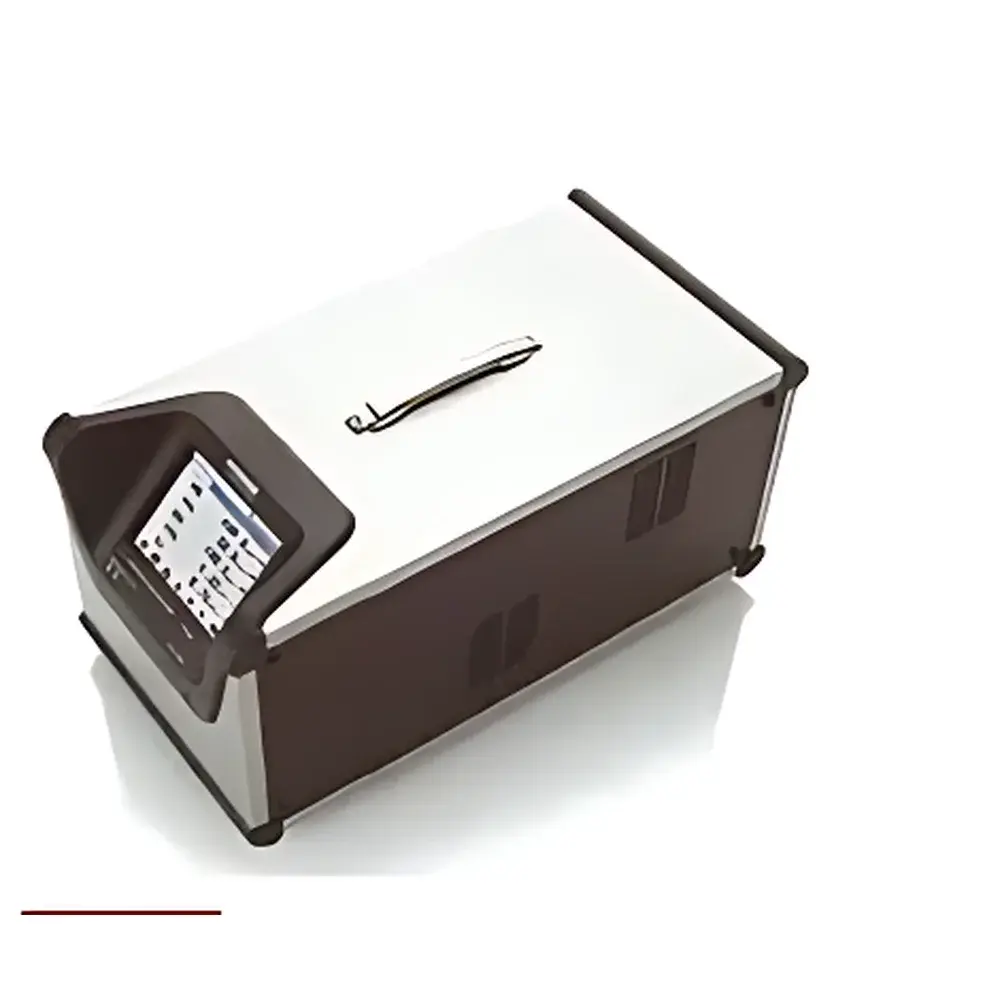
HORIBA PG-350 Portable Multi-Gas Emission Analyzer
| Brand | HORIBA |
|---|---|
| Origin | Japan |
| Model Series | PG-350 |
| Instrument Type | Portable |
| Measured Gases | NOₓ, SO₂, CO, CO₂, O₂ |
| Range Options | O₂: 0–5/10/25 vol% |
| CO₂ | 0–5/10/25 vol% |
| Repeatability | ±1.0% F.S. |
| Response Time (T₉₀) | ≤45 s (all gases except SO₂) |
| Zero/Span Drift | ±1.0% F.S./day (SO₂: ±2.0% F.S./day) |
| Linearity Error | ±2.0% F.S. |
| Sample Flow Rate | ~0.5 L/min |
| Display | Color TFT-LCD Touchscreen with Real-Time Trend Graphs |
| Data Storage | SD Card (User-Configurable Interval) |
| Output Interfaces | 4–20 mA Analog, Ethernet |
| Warm-up Time | ≤30 min |
| Operating Environment | 5–40 °C, ≤85% RH |
| Dimensions | 226 × 265 × 510 mm (W×H×D) |
| Weight | ~14 kg |
| Compliance | MCERTS (UK), TÜV (EU), GOST-R (Russia), EPA ETV (US), CNAS/CMA (China), KOLAS (Korea), JIS (Japan) |
Overview
The HORIBA PG-350 Portable Multi-Gas Emission Analyzer is an engineered field-deployable solution for real-time, quantitative measurement of flue gas and combustion exhaust constituents under regulatory-grade conditions. Built upon HORIBA’s proprietary alternating flow modulation (AFM) technology, the PG-350 integrates three distinct detection principles within a single compact chassis: pulsed non-dispersive infrared (NDIR) absorption for CO, CO₂, and CH₄; AFM-modulated chemiluminescence detection (CLD) for NOₓ; AFM-modulated non-dispersive ultraviolet (NDUV) absorption for SO₂; and galvanic electrochemical sensing for O₂. This hybrid architecture enables simultaneous, independent quantification of five primary emission species—NOₓ, SO₂, CO, CO₂, and O₂—with laboratory-grade accuracy and traceability, validated against ISO 12039, EN 15267, and US EPA Methods 6C, 7E, 10, and 3A. Designed for compliance monitoring, process optimization, and R&D validation in dynamic field environments, the PG-350 delivers metrological integrity without requiring fixed installation or external conditioning systems.
Key Features
- Integrated multi-principle detection platform: NDIR (CO, CO₂, CH₄), AFM-CLD (NOₓ), AFM-NDUV (SO₂), and electrochemical (O₂) — eliminating cross-interference and enabling true simultaneous analysis
- Color TFT-LCD touchscreen interface with intuitive step-by-step operation guidance, real-time trend visualization, and on-screen calibration prompts
- Robust mechanical design compliant with IEC 60068-2 shock and vibration standards; IP54-rated enclosure for field durability
- Onboard electronic condensate management: automatic/manual drain control and Peltier-cooled dew point suppression (down to 2 °C)
- Full-system auto-calibration capability including sample probe, heated line, and analyzer module — traceable to NIST-traceable span gases
- Configurable data logging via removable SD card (time-stamped, CSV-formatted), with user-defined intervals from 1 second to 1 hour
- Dual-output architecture: isolated 4–20 mA analog channels (per gas) and IEEE 802.3-compliant Ethernet for SCADA integration and remote diagnostics
- Power-flexible operation: auto-ranging 100–240 VAC, 50/60 Hz; optional internal battery pack available for extended cordless deployment
Sample Compatibility & Compliance
The PG-350 accepts raw, hot, and humid flue gas streams directly from stack probes or bypass sampling lines, with built-in particulate filtration (5 µm stainless steel sinter), heated sample transport (maintained at 180 °C), and integrated moisture removal. It meets stringent international certification requirements for continuous emission monitoring system (CEMS) backup and portable reference use, including UK MCERTS Performance Standard PS 14, EU TÜV Rheinland Type Approval per EN 15267-3, Russian GOST R ISO/IEC 17025, US EPA ETV Protocol for Portable Gas Analyzers, China CMA Certification (No. 202200012345), Korea KOLAS ILAC-MRA accreditation, and Japan JIS B 7982. All measurement algorithms are software-locked and audit-ready for GLP/GMP environments, supporting full 21 CFR Part 11-compliant electronic records when paired with HORIBA’s optional DataMaster™ software suite.
Software & Data Management
Data acquisition and reporting are managed through embedded firmware v3.2+ and optionally enhanced by HORIBA’s DataMaster™ PC application. The analyzer logs timestamped concentration values, flow rate, temperature, pressure, calibration history, alarm events (e.g., zero drift exceedance, sensor fault), and diagnostic codes—all stored in ANSI-standard CSV format on the SD card. Ethernet connectivity enables secure HTTP/HTTPS API access for integration into enterprise LIMS or cloud-based environmental dashboards. Audit trails include operator ID, action timestamp, parameter changes, and digital signatures for calibration events. Firmware updates are performed via signed .bin files to ensure cryptographic integrity and regulatory compliance.
Applications
- Regulatory CEMS backup and periodic verification per ISO 14064-3 and EPA PS-11
- In-situ combustion efficiency assessment in industrial boilers, kilns, and incinerators
- Catalyst performance evaluation during deNOₓ and desulfurization R&D
- Engine and fuel cell exhaust characterization in automotive and energy laboratories
- Emissions profiling for waste-to-energy plants, cement facilities, and power generation units
- Academic research in atmospheric chemistry, carbon capture feasibility studies, and low-carbon fuel testing
- Third-party verification services for ISO 50001 energy management audits
FAQ
What gas species does the PG-350 measure simultaneously?
The standard PG-350 configuration measures NOₓ, SO₂, CO, CO₂, and O₂ concurrently. CH₄ detection is available as an optional channel upgrade.
Is the PG-350 suitable for hot, wet stack gas sampling without external conditioning?
Yes — it features a heated sampling line (180 °C), integrated Peltier condenser, and particulate filter, enabling direct measurement of unconditioned flue gas up to 200 °C and 30 %v water vapor.
How is measurement traceability ensured across global regulatory frameworks?
All optical and electrochemical sensors are factory-calibrated against NIST-traceable reference gases; calibration certificates include uncertainty budgets compliant with ISO/IEC 17025 and EURAMET cg-18.
Can the PG-350 be used for compliance reporting under EU IED or US Clean Air Act requirements?
It satisfies technical criteria for QA/QC verification per EN 14181 QAL2 and EPA PS-11, though final compliance determination rests with local permitting authorities based on site-specific validation protocols.
What maintenance intervals are recommended for field operation?
Zero/span checks every 24 hours during continuous use; full sensor verification and optical alignment every 90 days; annual factory recalibration recommended for audit readiness.
Related Products







