
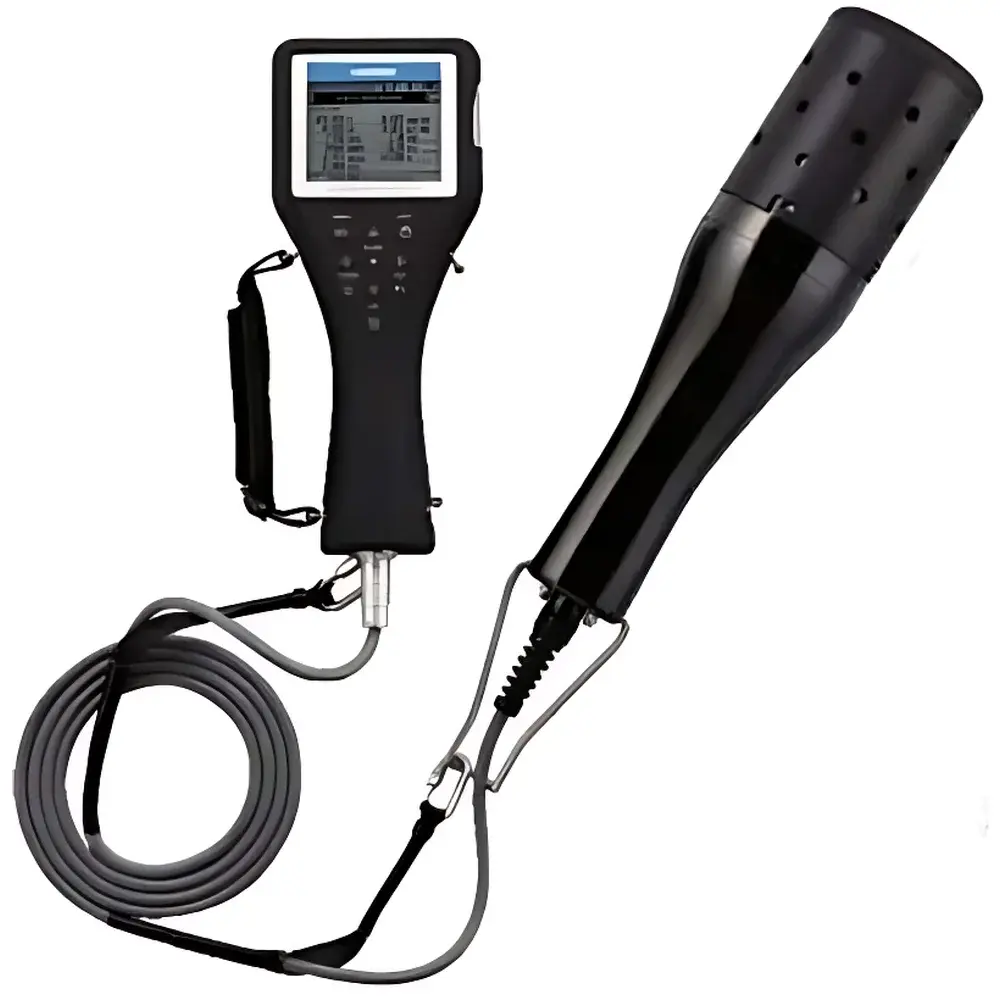
HORIBA U-50 Series Portable Multiparameter Water Quality Analyzer
| Brand | HORIBA |
|---|---|
| Origin | Japan |
| Model | U-50 Series |
| Instrument Type | Portable / Handheld Water Quality Analyzer |
| Measured Parameters | pH, ORP, Dissolved Oxygen (DO), Conductivity, Salinity, TDS, Specific Gravity (Seawater), Temperature, Turbidity (LED or Tungsten Lamp), Water Depth (on select models) |
| Turbidity Standards | US EPA Method (U-53), EN ISO 7027 (U-54) |
| Operating Temperature Range | −10 to 55 °C |
| Depth Measurement Range | up to 30 m (pressure-based, on U-52G/U-53/U-53G/U-54/U-54G) |
| Waterproof Rating | IP67 (host), IP68 (probe) |
| Display | 320 × 240 monochrome backlit LCD |
| Data Storage | 10,000 measurement sets |
| Power | Four AA alkaline batteries (≈70 h operation without backlight) |
| Communication | USB |
| Probe Cable Length | Standard 2 m (optional 10 m or 30 m) |
| Probe Material | PPS, SUS316L, SUS304, FKM, PEEK, Titanium, FEP membrane, POM |
| Weight | Host ≈ 800 g |
Overview
The HORIBA U-50 Series is a rugged, field-deployable multiparameter water quality analyzer engineered for high-reliability environmental monitoring in diverse aquatic environments—including rivers, lakes, groundwater wells, estuaries, wastewater outfalls, and coastal zones. Designed and manufactured in Japan, the U-50 platform integrates electrochemical, optical, and pressure-based sensing technologies into a single, ergonomically optimized handheld instrument. Its core measurement architecture employs standardized, traceable methodologies: glass electrode potentiometry for pH and ORP; Clark-type polarographic amperometry for dissolved oxygen (with enhanced response time and simplified membrane/electrolyte maintenance); four-electrode AC conductivity for robust salinity and TDS derivation; platinum resistance thermometry (JIS Class B) for temperature compensation and direct reporting; and dual-wavelength light scattering (LED forward-scatter, tungsten 90° scatter, or LED 90° scatter) for turbidity quantification—each calibrated per internationally recognized protocols (US EPA Method 180.1 for U-53; EN ISO 7027 for U-54). The system supports simultaneous real-time display of up to 11 parameters, with GPS geotagging available on G-series models (U-52G, U-53G, U-54G) for spatially referenced data collection compliant with ISO 5667-3 and ASTM D3370 sampling frameworks.
Key Features
- Simultaneous real-time measurement and display of up to 11 water quality parameters: pH, mV (ORP), dissolved oxygen (mg/L and % saturation), conductivity (S/m or mS/cm), salinity (ppt), total dissolved solids (g/L), seawater specific gravity (δt), temperature (°C), turbidity (NTU), water depth (m), and GPS coordinates (G-models only).
- Dual turbidity sensor options: U-53 probe conforms to US EPA Method 180.1 using LED forward-scatter optics (0–800 NTU, 0.01 NTU resolution below 10 NTU); U-54 probe complies with EN ISO 7027 using tungsten-lamp 90° scatter (0–1000 NTU, 0.01 NTU resolution in low range) — both equipped with integrated mechanical cleaning brushes to mitigate biofouling in long-term deployments.
- Enhanced polarographic DO sensor with faster stabilization time (<60 s to 90% response) and user-serviceable membrane caps and electrolyte cartridges—reducing downtime and consumable costs in routine field operations.
- Automatic temperature compensation across all electrochemical and optical measurements, with built-in Pt1000 thermistor meeting JIS B-class accuracy (±0.3 + 0.005|t| °C).
- Ruggedized hardware: probe body constructed from corrosion-resistant materials including SUS316L stainless steel, titanium, PEEK, and FEP membranes; host enclosure rated IP67 (JIS Class 7), probe rated IP68 (JIS Class 8); operating ambient range −5 to 45 °C; storage range −10 to 60 °C.
- Intuitive multilingual interface supporting English, Japanese, Russian, Spanish, and Portuguese—enabling cross-border deployment and operator training consistency in multinational environmental programs.
Sample Compatibility & Compliance
The U-50 Series is validated for use with natural freshwater, brackish water, seawater (up to 70 ppt salinity), treated and untreated wastewater, and groundwater. All sensor modules undergo factory calibration against NIST-traceable standards, and field recalibration is supported via two-point pH (pH 4.01/7.00 or 4.01/10.01), single-point ORP (Zobell’s solution), zero-oxygen (sodium sulfite) and saturated-air DO, and multi-point conductivity (KCl standards). Turbidity sensors are certified per their respective regulatory frameworks: U-53 meets US EPA requirements for compliance monitoring under Clean Water Act reporting; U-54 satisfies European Union drinking water directive (98/83/EC) and surface water monitoring mandates under WFD (2000/60/EC). Data integrity aligns with GLP principles—timestamped, georeferenced, and stored with full audit trail metadata (sensor ID, calibration date, operator tag if entered).
Software & Data Management
Measurements are stored internally in non-volatile memory (10,000 datasets maximum), each tagged with date, time, GPS coordinates (G-models), temperature, and all active parameter values. Data export is performed via USB interface to HORIBA’s proprietary U-50 PC Utility software (Windows-compatible), which enables batch download, spectral visualization, statistical summary (min/max/avg/stdev), QA/QC flagging (e.g., out-of-range alerts), and export to CSV or PDF report templates. The software supports calibration log management, sensor health diagnostics (e.g., electrode slope, DO membrane integrity check), and firmware updates. While not natively 21 CFR Part 11 compliant, the system supports ALCOA+ data governance practices when used with controlled access procedures and external electronic lab notebook (ELN) integration.
Applications
- Regulatory field monitoring: EPA Region-specific ambient water quality surveys, NPDES discharge verification, and TMDL assessment support.
- Drinking water utility operations: Source water characterization, distribution system residual profiling, and rapid response to taste/odor or turbidity excursions.
- Academic and research limnology: Longitudinal profiling of stratified lakes, tidal creek biogeochemistry, and wetland restoration performance tracking.
- Industrial pretreatment and effluent compliance: On-site verification of pH neutralization, DO demand in biological treatment units, and conductivity-based salinity screening prior to discharge.
- Emergency response: First-responder deployment during chemical spills, algal bloom events, or post-storm combined sewer overflow (CSO) assessments—leveraging GPS-tagged, timestamped, multi-parameter snapshots for incident documentation.
FAQ
What turbidity standards does the U-50 Series comply with?
The U-53 probe is certified to US EPA Method 180.1 (LED forward-scatter); the U-54 probe meets EN ISO 7027 (tungsten lamp 90° scatter). Both provide 0.01 NTU resolution in the low-range (0–10 NTU).
Can the U-50 perform automatic temperature compensation across all parameters?
Yes—integrated Pt1000 temperature sensing enables real-time, parameter-specific compensation for pH, ORP, DO, conductivity, salinity, TDS, and turbidity per IUPAC and ISO guidelines.
Is GPS functionality available on all U-50 models?
No—GPS is exclusive to G-series variants: U-52G, U-53G, and U-54G (12-channel receiver with sub-5 m horizontal accuracy under open-sky conditions).
What is the maximum operational depth for the pressure-based depth sensor?
The depth sensor is rated for continuous operation up to 30 meters (≈3 bar), with ±0.3 m absolute accuracy and 0.05 m resolution—validated per IEC 60529 and JIS C 0920 for underwater pressure transducers.
How is data integrity ensured during extended field deployments?
All measurements include embedded timestamps, sensor serial numbers, calibration status flags, and (on G-models) WGS84 geocoordinates—enabling full traceability in accordance with ISO/IEC 17025 Clause 7.7 and EPA SW-846 guidance for field data validation.







