
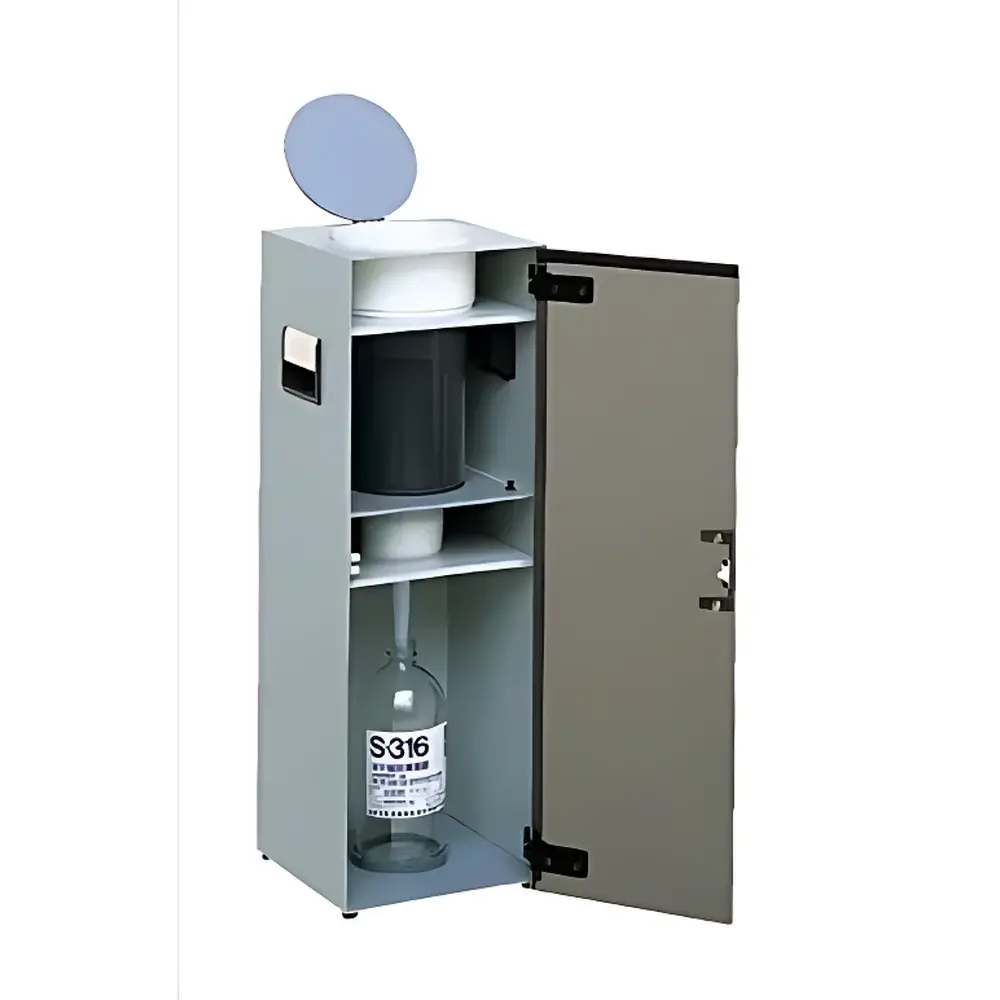
HORIBA SR-305 Solvent Regeneration System
| Brand | HORIBA |
|---|---|
| Origin | Japan |
| Model | SR-305 |
| Dimensions | 200 mm (W) × 200 mm (D) × 600 mm (H) |
| Solvents Supported | S-316 and H-997 |
| Power Requirement | None |
| Regeneration Method | Dual-bed Gravity-driven Adsorption Column System |
Overview
The HORIBA SR-305 Solvent Regeneration System is a dedicated, passive purification unit engineered to restore spent extraction solvents—specifically S-316 (1,1,2-trichloro-1,2,2-trifluoroethane) and H-997 (a proprietary chlorinated hydrocarbon blend)—used in conjunction with the HORIBA OCMA-300 series of oil-in-water analyzers. Unlike distillation-based or thermal regeneration methods, the SR-305 employs a gravity-fed, dual-stage adsorption process that leverages the selective affinity of activated carbon and activated alumina for polar impurities, residual surfactants, and oxidized hydrocarbon byproducts. This design ensures consistent solvent purity without phase change, thermal degradation, or energy input—making it uniquely suited for laboratory environments where operational simplicity, safety compliance, and long-term reagent economy are critical. The system is not a standalone analytical instrument but an integral component of a compliant oil content measurement workflow under ISO 9377-2, ASTM D7066, and EPA Method 1664B frameworks.
Key Features
- Passive operation: Requires no electrical power, compressed air, or external vacuum source—ideal for glovebox integration, mobile labs, or locations with limited infrastructure.
- Dual-bed column architecture: First stage uses granular activated carbon to remove organic contaminants and color bodies; second stage employs activated alumina to scavenge water, acids, and polar oxidation products.
- High regeneration fidelity: Restores solvent clarity, density, and spectral transmittance to levels meeting OCMA-300 optical path requirements—validated via UV-Vis absorbance at 225 nm and refractive index verification.
- Modular, serviceable design: Columns are user-replaceable; standard replacement cartridges (SR-CARBON and SR-ALUMINA) are supplied with traceable lot documentation and pre-conditioning certificates.
- Compact footprint: Occupies only 0.024 m³ of bench space, enabling co-location adjacent to OCMA-300 analyzers without compromising workflow ergonomics or fume hood clearance.
Sample Compatibility & Compliance
The SR-305 is validated exclusively for regenerating S-316 and H-997 solvents used in gravimetric and infrared-based oil-in-water quantification. It does not support halogenated solvents beyond this specification (e.g., chloroform, carbon tetrachloride) nor non-halogenated alternatives (e.g., hexane, MTBE). Regenerated solvent performance is verified against OCMA-300 calibration stability criteria: ≤ ±2% drift in instrument response over 24-hour continuous operation using regenerated solvent versus fresh reagent. The system supports GLP-compliant documentation through optional batch log templates aligned with ISO/IEC 17025 clause 7.7 (reporting of sampling and preparation conditions). No regulatory certification (e.g., UL, CE) applies, as the device contains no active electronics or pressure vessels.
Software & Data Management
The SR-305 operates independently of software control and generates no digital output. However, its use is fully traceable within HORIBA’s OCMA-300 data acquisition ecosystem: solvent regeneration cycles are logged as metadata fields in OCMA-300 .csv export files (e.g., “Solvent_Source”, “Regen_Batch_ID”, “Regen_Date”) when paired with OCMA-300 firmware v3.2+. These fields interface with LIMS platforms supporting ASTM E1482-compliant import schemas. For audit readiness, users are advised to maintain physical regeneration logs per ICH-GCP Annex 11 principles—recording column installation dates, throughput volumes, and visual inspection notes (e.g., discoloration, channeling).
Applications
- Routine wastewater monitoring in municipal treatment plants performing daily oil-in-water testing per ISO 9377-2 Annex B.
- Industrial effluent compliance screening for petrochemical, metalworking, and food processing facilities subject to local discharge permits referencing EPA Method 1664B.
- Reference laboratory validation studies requiring solvent reuse consistency across multi-day inter-laboratory comparison trials.
- Field-deployable oil analysis workflows where generator-powered distillation units are impractical due to weight, noise, or explosion hazard concerns.
FAQ
How many times can S-316 be regenerated using the SR-305 before cartridge replacement?
Typical throughput is 4–6 L per activated carbon cartridge and 8–10 L per activated alumina cartridge under standard OCMA-300 usage (10–15 samples/day). Performance decay is indicated by ≥5% increase in baseline absorbance at 225 nm.
Does regenerated solvent meet USP/EP specifications for residual solvents?
No—the SR-305 is not intended for pharmaceutical-grade solvent recovery. Its validation scope is limited to OCMA-300 analytical performance, not pharmacopeial purity thresholds.
Can the SR-305 be used with third-party oil analyzers?
It is not validated for use with non-HORIBA instruments. Optical path length, detector sensitivity, and calibration algorithms vary significantly across platforms; solvent purity requirements may differ accordingly.
Is column conditioning required before first use?
Yes—cartridges must be flushed with 50 mL of fresh S-316 or H-997 prior to sample introduction to remove manufacturing fines and stabilize adsorption kinetics.
Related Products







